The Arabian Nights (also known as One Thousand and One Nights) is not a single book with a single author but a vast, evolving collection of stories that accumulated across many centuries, in Arabic, Persian, and other languages, before being written down in the form we now know. The frame narrative is among the most elegant in world literature: King Shahryar, having discovered his wife's infidelity, resolves to marry a new woman each night and execute her in the morning. Scheherazade, the vizier's daughter, volunteers to be his bride — and delays her execution by telling a story each night, always leaving the ending unresolved at dawn, so the king must spare her to hear the conclusion. One story branches into another and another; the narrative never arrives at a resting point.
The textual history of the Nights is as intricate as the stories themselves. There is no single canonical Arabic manuscript — different manuscripts contain different stories, and some of the most famous tales (Aladdin and the Lamp, Ali Baba and the Forty Thieves, Sindbad the Sailor) were inserted by European translators and may have no Arabic original at all. The scholar Muhsin Mahdi spent decades establishing a critical edition based on the oldest surviving manuscript, a 14th-century Syrian text, which represents the authentic core of roughly 271 nights. The remaining stories — including some of the most beloved — come from later, less authoritative manuscripts.
Every translator of the Arabian Nights faces the same series of choices: which Arabic text to follow; how to handle the prose-and-verse alternation of the original; how to render Scheherazade's storytelling voice; and how explicit to be with the erotic and violent content that Victorian translators often either omitted or, in Burton's case, elaborately annotated. The three translations below represent distinct approaches across two centuries.
Malcolm Lyons's Penguin Classics translation is this guide's primary recommendation. It is the most complete modern translation, the most readable, and the version best suited to a reader encountering the Nights for the first time.
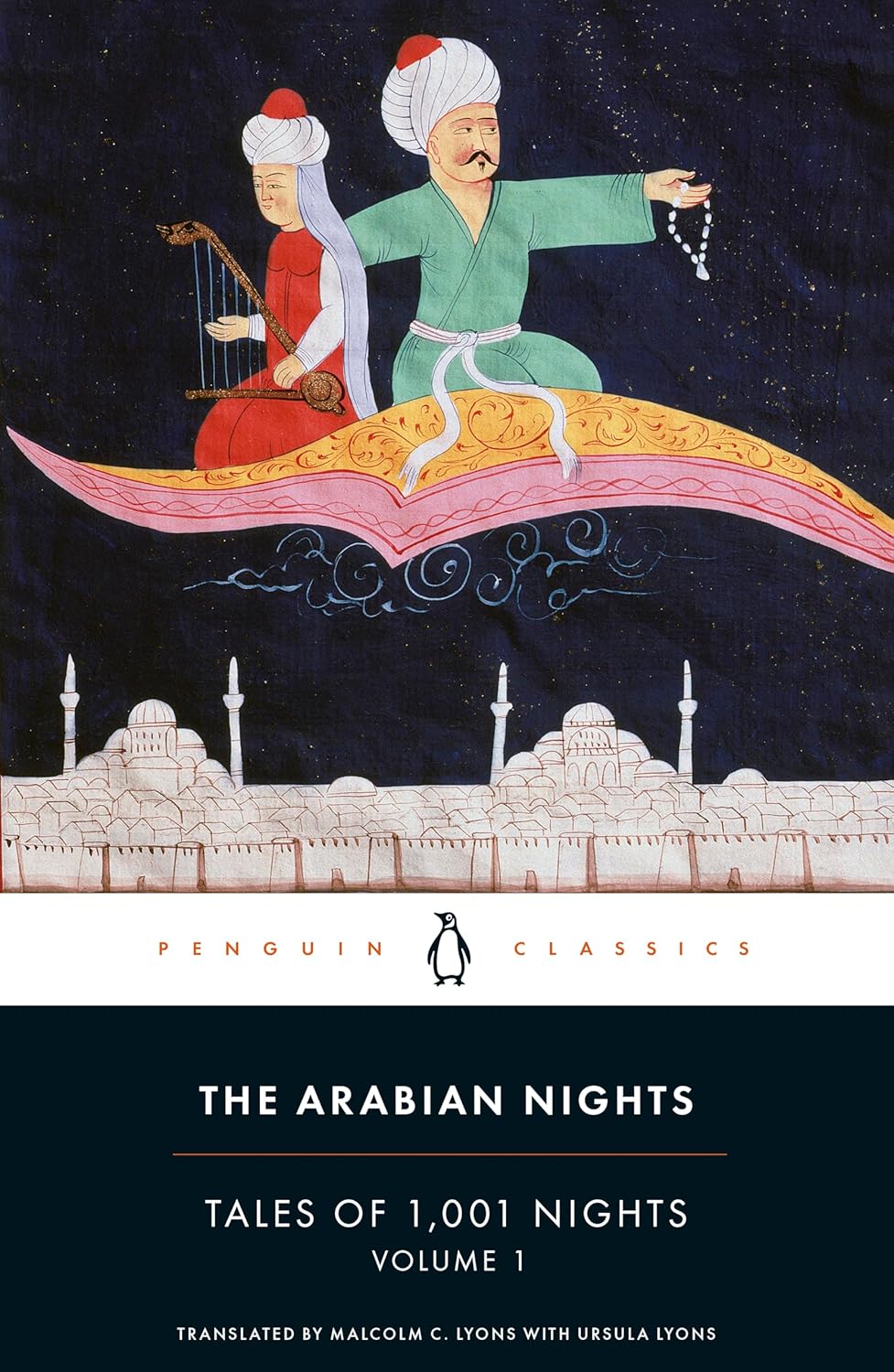
The Arabian Nights: Tales of 1,001 Nights (3 vols.) — trans. Malcolm C. Lyons with Ursula Lyons (2008)
First translation, recommended for most readers — complete modern prose translation
Malcolm Lyons's three-volume Penguin Classics translation is the most complete and authoritative modern English version of the Arabian Nights. Lyons, an Arabist at Cambridge, worked from the Calcutta II printed text (which, unlike the Mahdi critical edition, includes the full range of stories across all 1,001 nights) and produced a translation that is both scholarly and highly readable. His prose is clear and direct without being flat — he catches the storytelling rhythm of the original, the cadences of repetition that create the hypnotic quality of Scheherazade's voice, without allowing them to become monotonous in English. The Penguin edition includes a substantial introduction by Robert Irwin, author of the indispensable companion volume The Arabian Nights: A Companion, which sets the textual history and cultural context in detail. Each volume covers roughly 333 nights: Volume 1 takes the reader through the earliest stories including Sindbad; Volumes 2 and 3 cover the remaining nights. For a reader who wants to spend real time with the Nights in their fullest form, this is the translation to choose. The link below goes to Volume 1; Volumes 2 and 3 are available separately.
Buy on Amazon → 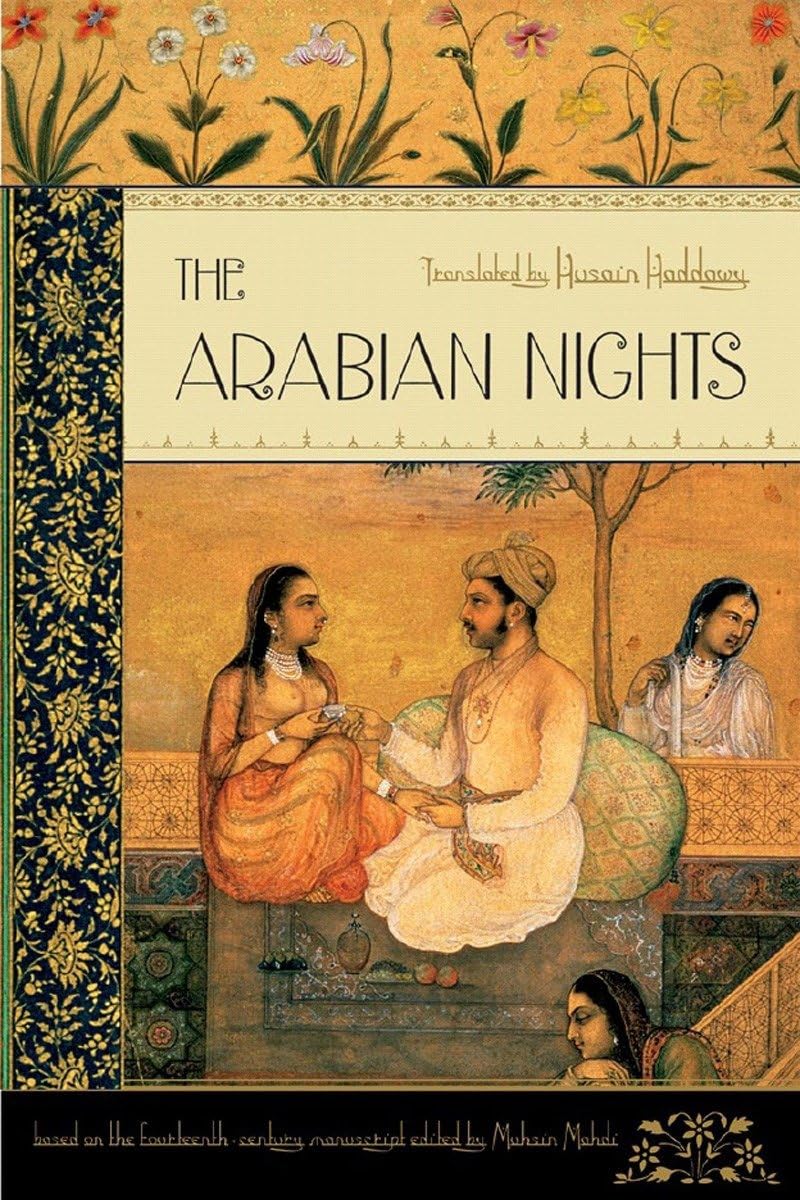
The Arabian Nights — trans. Husain Haddawy, ed. Muhsin Mahdi (1990 / 2008)
The philologically authoritative translation — based on the oldest surviving manuscript
Husain Haddawy's translation is unique among major English versions in being based on Muhsin Mahdi's critical edition of the 14th-century Syrian manuscript — the oldest and most carefully transmitted Arabic text of the Nights. This means Haddawy's translation is shorter than Lyons's: it covers only the stories that appear in the Mahdi text (roughly 271 nights), and it omits Aladdin, Ali Baba, and other tales that were added by later manuscript traditions or European compilers. What remains is in some ways the purest core of the Nights — the stories that are most certainly original to the tradition — and Haddawy renders them in prose that is both faithful and literary. His Scheherazade is supple and vivid; his handling of the nested frame structure is exceptionally clear. For a reader interested in what the Arabian Nights actually is as a literary text, rather than what it has become in European imagination, Haddawy's translation is indispensable. A companion volume, Sindbad: And Other Stories from the Arabian Nights, covers the Sindbad cycle and related tales.
Buy on Amazon → 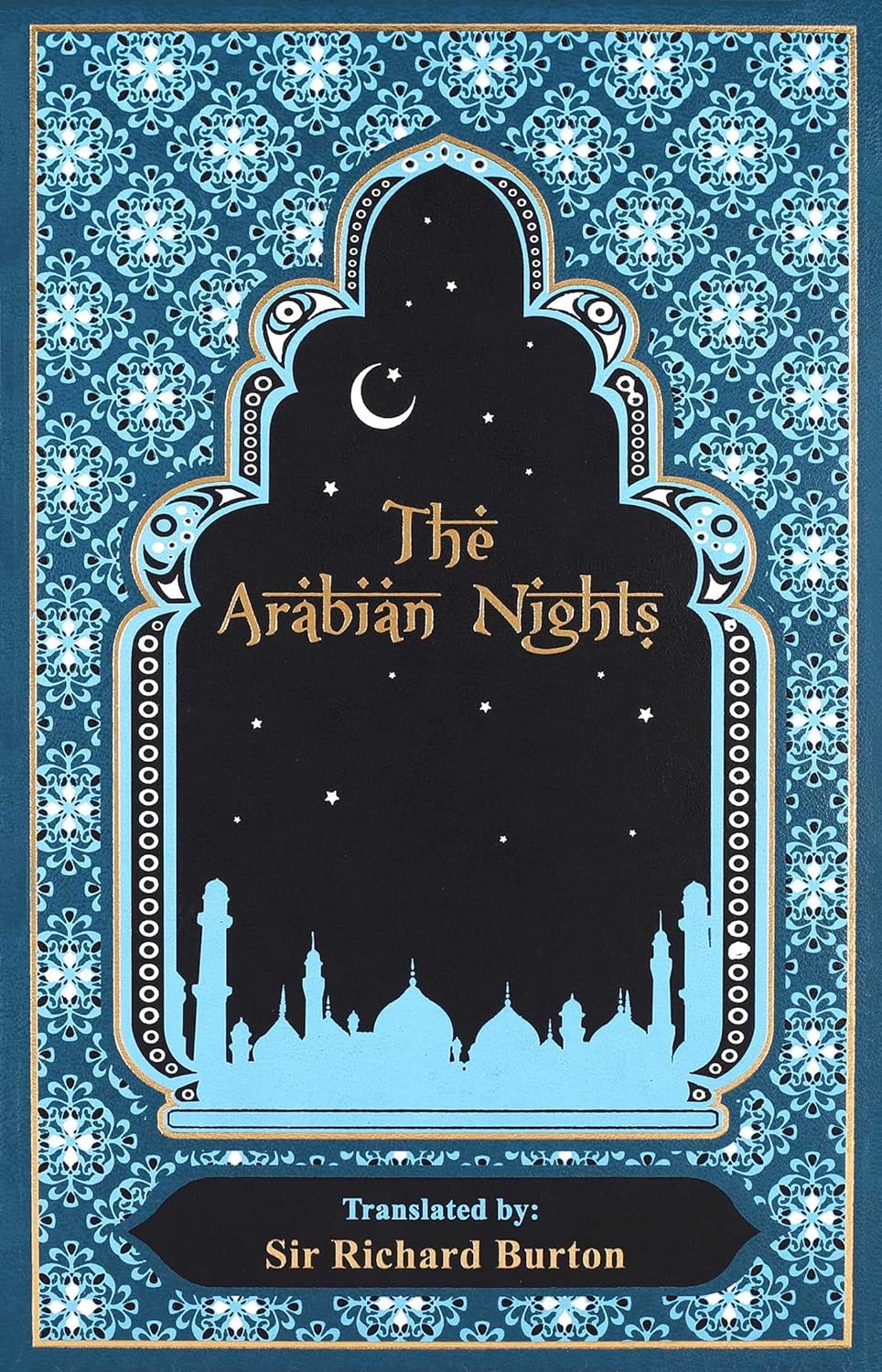
The Arabian Nights — trans. Sir Richard Francis Burton (1885–1888)
The Victorian classic — extravagant, annotated, historically essential
Sir Richard Francis Burton's translation — originally published between 1885 and 1888 in sixteen privately printed volumes — is one of the great monuments of Victorian scholarship and one of the most eccentric works in the English language. Burton was an explorer, linguist (he spoke over forty languages), intelligence officer, and incorrigible provocateur, and all of these qualities are present in his Nights. His prose is deliberately archaic and Arabised, full of unfamiliar words and elaborate constructions, intended to produce in English the sense of distance and strangeness that the Arabic would have produced for its medieval readers. His footnotes — thousands of them, covering history, ethnography, folklore, sexual practices, and Islamic law — are as famous as the translation itself, and in places more interesting. The result is not a clean or simple text: Burton's version has been criticised for inaccuracy, for reflecting his own obsessions, and for the elaborate obscurantism of its style. But it is also unlike anything else, and readers who give themselves to it often find it impossible to put down. This edition offers a curated selection with an introduction by Ken Mondschein for readers who want to experience Burton without committing to the full sixteen volumes.
Buy on Amazon → As an Amazon Associate, I earn from qualifying purchases.