Demons (Бесы, 1872) is the novel Dostoevsky wrote in white heat after the murder of the student Ivanov by the radical Sergei Nechaev's underground cell in 1869. The killing — by a group of idealists who had talked themselves into the conviction that political violence was justified — became the template for Dostoevsky's portrait of a revolutionary cell in a provincial Russian town, led by the demonic Pyotr Verkhovensky and the spiritually tormented Nikolai Stavrogin. The novel is Dostoevsky's most savage political satire and one of his deepest psychological portraits — Stavrogin is among the most haunting figures in all of Russian literature, a man whose emptiness and moral paralysis destroy everyone around him.
The title has been translated three ways in English: Constance Garnett called it The Possessed (reflecting the novel's epigraph from Luke, in which demons leave a man and enter swine); later translators have preferred Demons or The Devils as more accurate renderings of the Russian "Бесы." The choice of title tracks larger shifts in how the novel has been read — whether as a story about spiritual possession or about political nihilism. All three translations discussed here cover the complete text.
The Pevear and Volokhonsky translation is this guide's primary recommendation. It is the most widely used modern English version and the sharpest in capturing the novel's political and psychological intensity.
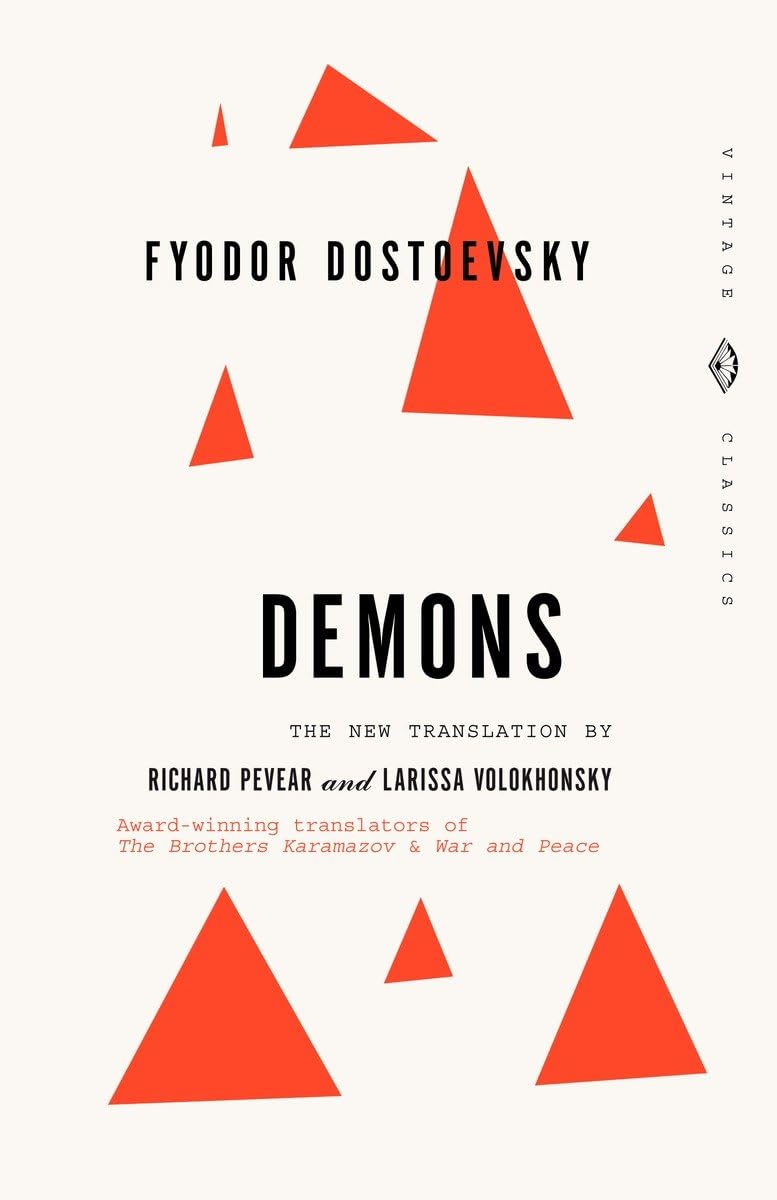
Demons: A Novel in Three Parts — trans. Richard Pevear & Larissa Volokhonsky (1994)
First translation, recommended for most readers
Pevear and Volokhonsky's Vintage Classics edition is the standard modern English Demons — the translation most widely taught in universities and most commonly cited in critical writing in English. P&V bring to Dostoevsky their characteristic method: Volokhonsky produces a very literal draft closely tracking Russian idiom, syntax, and register; Pevear then works that draft into English that preserves the roughness and tonal variety of the original rather than smoothing it into standard literary prose. Demons is one of Dostoevsky's most stylistically varied novels — the political comedy is broad and grotesque, the Stavrogin chapters are quiet and devastating, and the prose swings between registers in ways that earlier translations had muted. The P&V edition restores that range. For any reader coming to the novel for the first time, this is the version to choose.
Buy on Amazon → 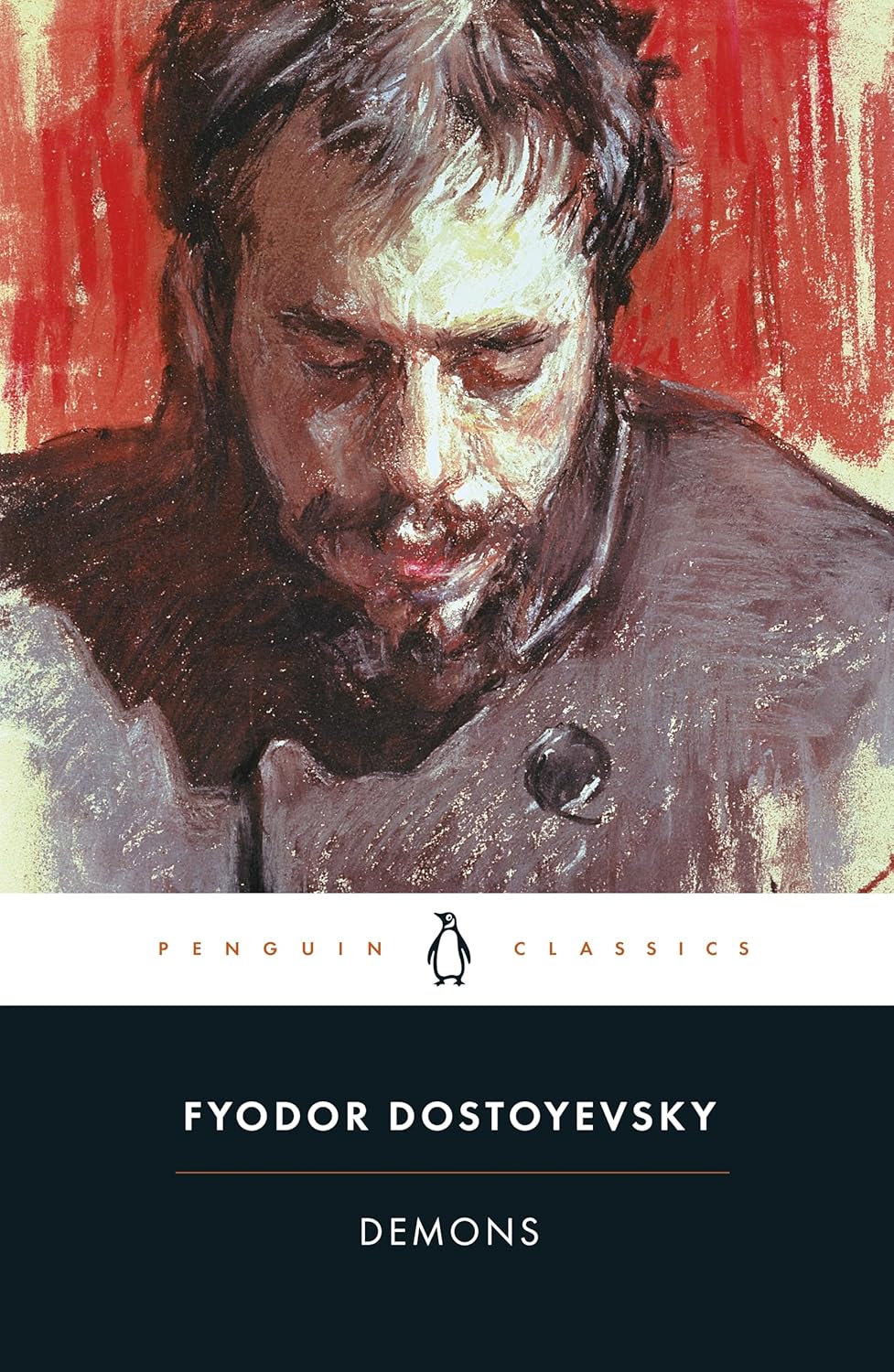
Demons — trans. Robert Maguire (2008)
Most readable alternative — fluid prose with strong scholarly notes
Robert Maguire's Penguin Classics translation, introduced and annotated by Maguire and edited by Ronald Meyer, is the most literary and readable alternative to P&V. Maguire was one of the leading American scholars of Russian literature — his critical writing on Dostoevsky and on Russian modernism is essential — and his translation reflects that scholarly depth without sacrificing narrative momentum. Where P&V sometimes preserve Russian syntactic patterns even at the cost of English fluency, Maguire prioritises clean, direct prose that moves quickly through the novel's dense political scheming. Many readers who find P&V stilted prefer Maguire; many who value precision prefer P&V. The Penguin Classics edition includes substantive notes on the historical context — Nechaev, the Russian revolutionary movement, the political landscape of the 1860s — that are indispensable for a reader unfamiliar with the period. A strong choice, especially for readers who are new to Dostoevsky.
Buy on Amazon → 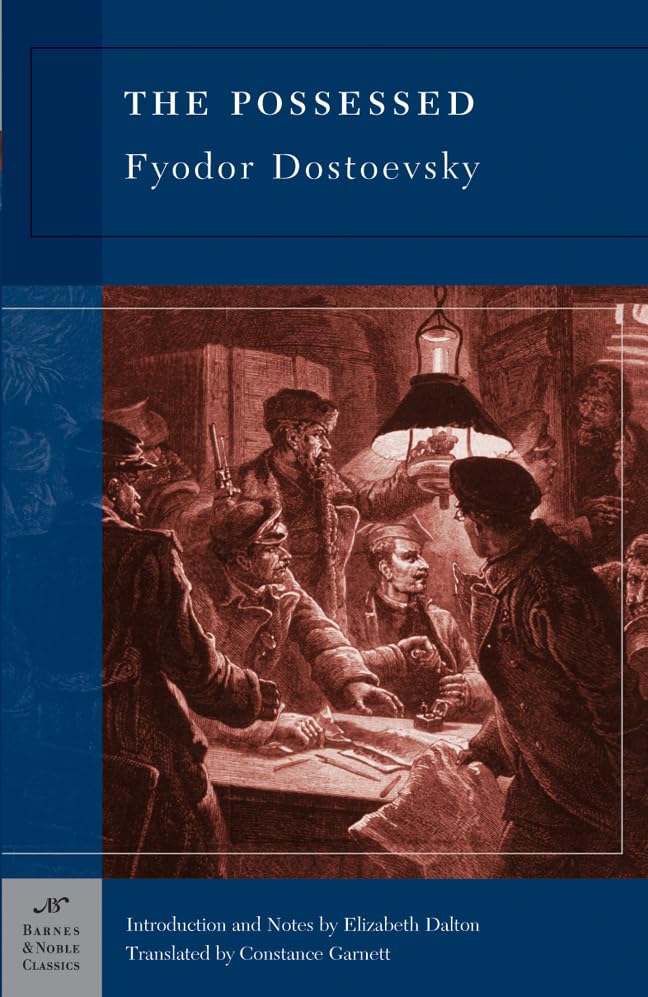
The Possessed — trans. Constance Garnett (1913)
The classic translation — historically important, now showing its age
Constance Garnett's 1913 translation, published as The Possessed, was the version through which most English-speaking readers first encountered Dostoevsky across most of the twentieth century. Garnett worked at extraordinary speed — she translated the bulk of Russian fiction's nineteenth-century canon almost single-handedly — and her Dostoevsky shaped generations of anglophone writers including Hemingway, Faulkner, and Woolf. Her version is remarkably fluent and readable even today; the Victorian literary English she uses feels appropriate to the period and gives the novel a certain gravity. The limitations are well-documented: Garnett had a tendency to smooth out Dostoevsky's stranger stylistic tics, to normalise his syntactic eccentricities, and occasionally to skip difficult passages. The Barnes & Noble Classics edition, with an introduction by Elizabeth Dalton, is the most widely available print version. For historical interest and to understand the tradition, the Garnett is worth reading alongside a modern translation — but for a first encounter with the novel, P&V or Maguire will bring you closer to what Dostoevsky wrote.
Buy on Amazon → As an Amazon Associate, I earn from qualifying purchases.