Goethe's Faust is the central work of German literature and one of the most ambitious poems ever attempted in any language. Part One (1808) follows the scholar Heinrich Faust's pact with Mephistopheles and his destruction of the innocent Gretchen — a tragedy of desire, knowledge, and guilt. Part Two (1832), completed in the last weeks of Goethe's life and published posthumously, is something stranger: an allegorical journey through classical antiquity, political power, and cosmic redemption that Goethe himself described as something only the initiated could fully understand. The two parts together span sixty years of composition and contain Goethe's entire intellectual and spiritual life.
Most readers come to Faust through Part One, which is self-contained, dramatically coherent, and one of the greatest works in the European tradition. Part Two rewards study but demands patience — it is less a continuous drama than a series of set pieces, masques, and philosophical allegories. Any edition that includes both parts is complete; whether to read beyond Part One on a first encounter is a matter of temperament and ambition.
The Martin Greenberg translation is this guide's primary recommendation. It is the most complete, most carefully revised modern English verse translation and the natural first choice for a reader who wants the full work.

Faust: A Tragedy, Parts One and Two — trans. Martin Greenberg (2014, fully revised)
First translation, recommended for most readers
Martin Greenberg's Yale University Press translation is the most highly regarded modern English verse rendering of both parts of Faust. Greenberg worked on it for decades — the first edition appeared in 1992 and covered Part One; the fully revised edition of 2014 extends to both parts and incorporates a lifetime of engagement with the German. His approach is to render Goethe's varying verse forms — rhymed couplets, blank verse, song, doggerel, elevated ode — into English equivalents that preserve something of the original's tonal range rather than levelling everything into a single neutral register. The result is the most tonally varied and poetically alive English Faust available. W. Daniel Wilson's introduction to the revised edition provides excellent critical orientation. For a reader who wants both parts in a single authoritative volume, Greenberg is the clear choice.
Buy on Amazon → 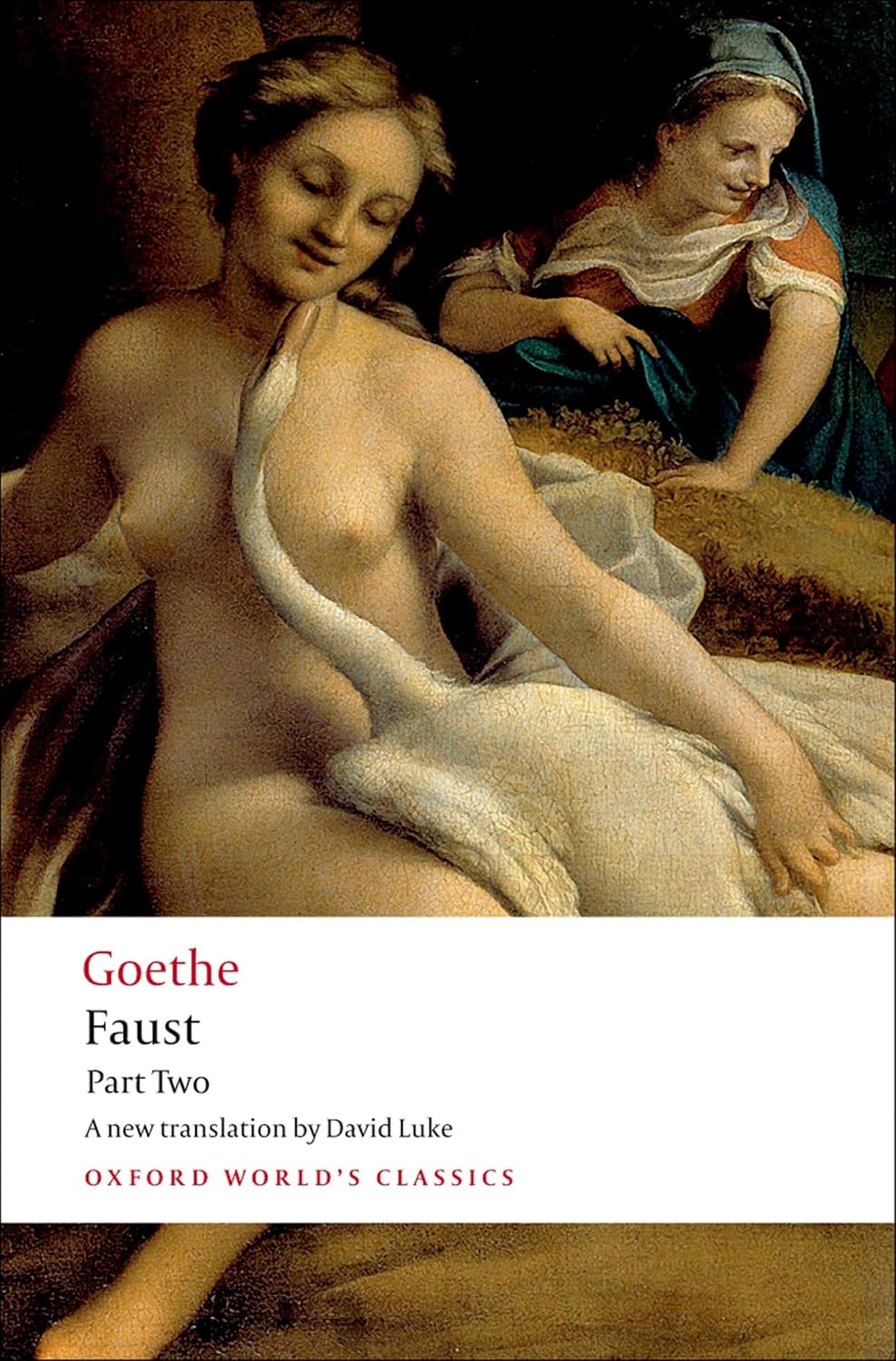
Faust: Part Two — trans. David Luke (Oxford World's Classics)
Most scholarly Oxford edition — verse translation with extensive notes
David Luke's Oxford World's Classics translations of Faust have long been the standard scholarly English edition. Luke translated the two parts separately: Part One (1987) was for many years considered the finest English verse translation of that volume, praised for its accuracy and for the elegance with which it handles Goethe's variety of verse forms. Part Two followed. Luke was a professor of German at Oxford and brought exceptional philological care to both volumes. His editions include detailed notes, introductions, and commentary that situate each scene within the German literary tradition. The Part One Oxford edition is currently out of print, though often available through used sellers; this link is to the Part Two, which completes the work and is the same standard. For readers engaged in academic study of Faust, or for anyone who wants the most carefully annotated English edition, Luke's Oxford volumes remain the reference point.
Buy on Amazon → 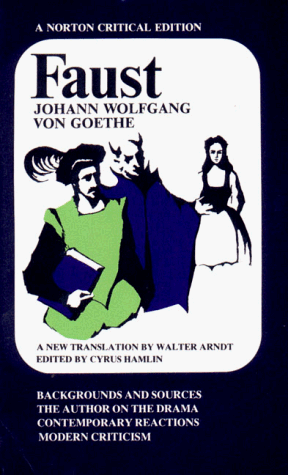
Faust: A Tragedy — trans. Walter Arndt, ed. Cyrus Hamlin (Norton Critical Editions)
Best for academic study — verse translation with critical essays and sources
Walter Arndt's Norton Critical Edition of Faust, edited by the Goethe scholar Cyrus Hamlin, is the standard academic text for English-language courses on the play. Arndt was a distinguished literary translator — his translations of Pushkin won the Bollingen Prize — and his Faust renders Goethe's verse forms with precision and metrical discipline. The Norton Critical apparatus is the real argument for this edition: in addition to Hamlin's editorial notes, the volume includes excerpts from Goethe's own writings on Faust, contemporary reactions (Schiller, A. W. Schlegel), and a substantial selection of modern critical essays spanning the nineteenth and twentieth centuries. For a student writing about Faust, or for any reader who wants to understand the work's reception history alongside the text itself, the Norton Critical is indispensable. The Greenberg or Luke translations may read more naturally; the Arndt provides the most complete scholarly context.
Buy on Amazon → As an Amazon Associate, I earn from qualifying purchases.