Jules Verne's Vingt mille lieues sous les mers (1870) is one of the most influential novels ever written — a founding text of science fiction, a template for the submarine adventure, and an early portrait of ecological wonder. Captain Nemo, his mysterious Nautilus, and the luminous undersea world Verne invented have shaped cinema, literature, and imagination for a hundred and fifty years. The novel's reputation, however, rests partly on a fiction: for most of that time, English readers were not reading Verne's novel at all.
The 1873 Lewis Page Mercier translation — the one that dominated the English-speaking world for over a century — cut approximately twenty-five percent of Verne's text, mangled the science, softened Nemo's anti-colonialism, and introduced thousands of errors. Mercier did not read French well and invented passages that do not exist in the original. When this translation was the only one available, critics could dismiss Verne as a writer of simple adventure tales for boys. The dismissal was based on a distortion.
Modern scholarly translations have changed the picture entirely. William Butcher's Oxford World's Classics translation (1998) and F.P. Walter's meticulous complete translation restored what the Victorian bowdlerizers cut — including Nemo's furious politics, Verne's mathematical precision, and passages of underwater description whose strangeness and beauty anticipate literary modernism. Butcher's translation is this guide's primary recommendation for first-time readers wanting the full scholarly apparatus. Walter's edition, paired with the Édouard Riou illustrations that ran in the original French serialization, is the choice for readers who want to encounter the book as Verne's first audience did.
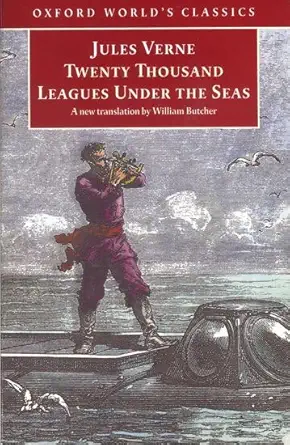
Twenty Thousand Leagues Under the Seas — trans. William Butcher (1998)
Oxford World's Classics — the standard modern scholarly translation, complete and fully annotated
William Butcher's translation, published by Oxford World's Classics in 1998, is widely regarded as the best English version of the novel available. Butcher — a Verne scholar who has spent decades studying the manuscripts and the science — produced a translation that is both rigorously accurate and genuinely readable. Where the Mercier translation cut, Butcher restores; where Mercier invented, Butcher translates; where Mercier domesticated Verne's prose into Victorian comfortable adventure, Butcher preserves the strangeness and the precision. The result is a considerably stranger and more interesting book than most readers expect. Nemo emerges as a figure of genuine menace and tragic grandeur — a man of brilliant intellect fuelled by anti-imperialist rage — rather than the romantic eccentric of the Disney adaptation. The underwater sequences, with their obsessive scientific cataloguing of species, minerals, and depths, read as something close to lyric prose. Butcher's edition includes an introduction placing the novel in the context of Verne's biography and the scientific knowledge of the 1860s, extensive notes explaining the natural history and technology, and a note on the Mercier mistranslation. For any reader encountering the novel for the first time, this is the edition to choose.
Buy on Amazon → 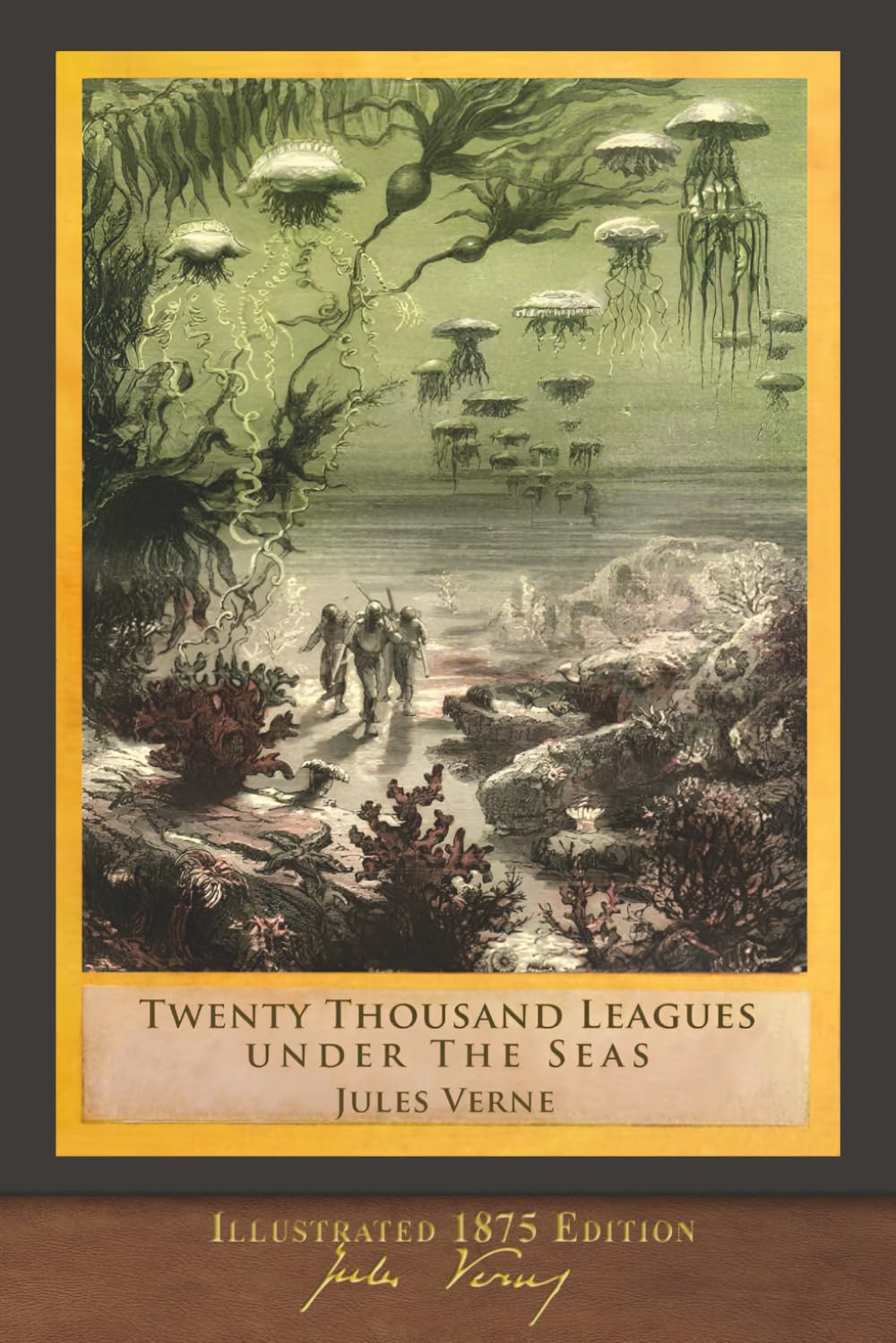
Twenty Thousand Leagues Under the Seas — trans. F.P. Walter (Illustrated 1875 Edition)
Complete scholarly translation with Édouard Riou's original illustrations — the novel as Verne's first readers knew it
Frederick Paul Walter's translation is a scholar's labour of love: a meticulous, complete rendering of the novel that Walter undertook specifically to correct the record after decades of the Mercier distortion. Walter, an academic who translated from the original French with close attention to the scientific and technical vocabulary, aimed for maximum fidelity — where Butcher occasionally makes small stylistic adjustments for flow, Walter tends toward the literal. The translation is presented here in the Illustrated 1875 Edition, which pairs Walter's text with the original engravings by Édouard Riou that accompanied the novel's first French book publication. Riou's illustrations — stiffly heroic figures in diving suits, enormous tentacled creatures surging from the deep, the Nautilus cutting through phosphorescent ocean — belong to the novel's DNA in the same way Tenniel's drawings belong to Alice in Wonderland. Reading the book with these images is to encounter it in the form closest to Verne's own intentions, in an era when illustration was not supplementary decoration but integral to the reading experience. For readers interested in Verne as a nineteenth-century author rather than a genre precursor, or for those who want a second complete translation to compare against Butcher, Walter's edition is a rewarding choice.
Buy on Amazon → As an Amazon Associate, I earn from qualifying purchases.