The Oresteia is the only complete trilogy to survive from ancient Greek tragedy. Aeschylus wrote it in 458 BCE, two years before his death, and it was performed at the Festival of Dionysus in Athens to considerable acclaim. The three plays — Agamemnon, The Libation Bearers, The Eumenides — trace a cycle of vengeance through three generations of the house of Atreus: Agamemnon returns from Troy and is murdered by his wife Clytemnestra; their son Orestes avenges the murder by killing his mother; the Furies pursue Orestes for matricide; Athena intervenes to found a court of law. The trilogy ends not in further bloodshed but in the invention of justice — the replacement of vendetta with deliberation.
Aeschylus wrote in a dense, archaic, enormously compressed Greek that makes him one of the hardest ancient authors to translate. His language is often described as weighty, dark, and full of long compound words that have no English equivalents. A translation of the Oresteia must decide how much of that density to preserve and how much to open up for a reader who cannot feel the weight of the original. The three best translations in English make different choices at every level, from individual word choices to meter to the framing of the whole.
The Robert Fagles translation is this guide's primary recommendation for first-time readers. It is the most dramatically alive version in English and the one most likely to make the plays feel urgent.
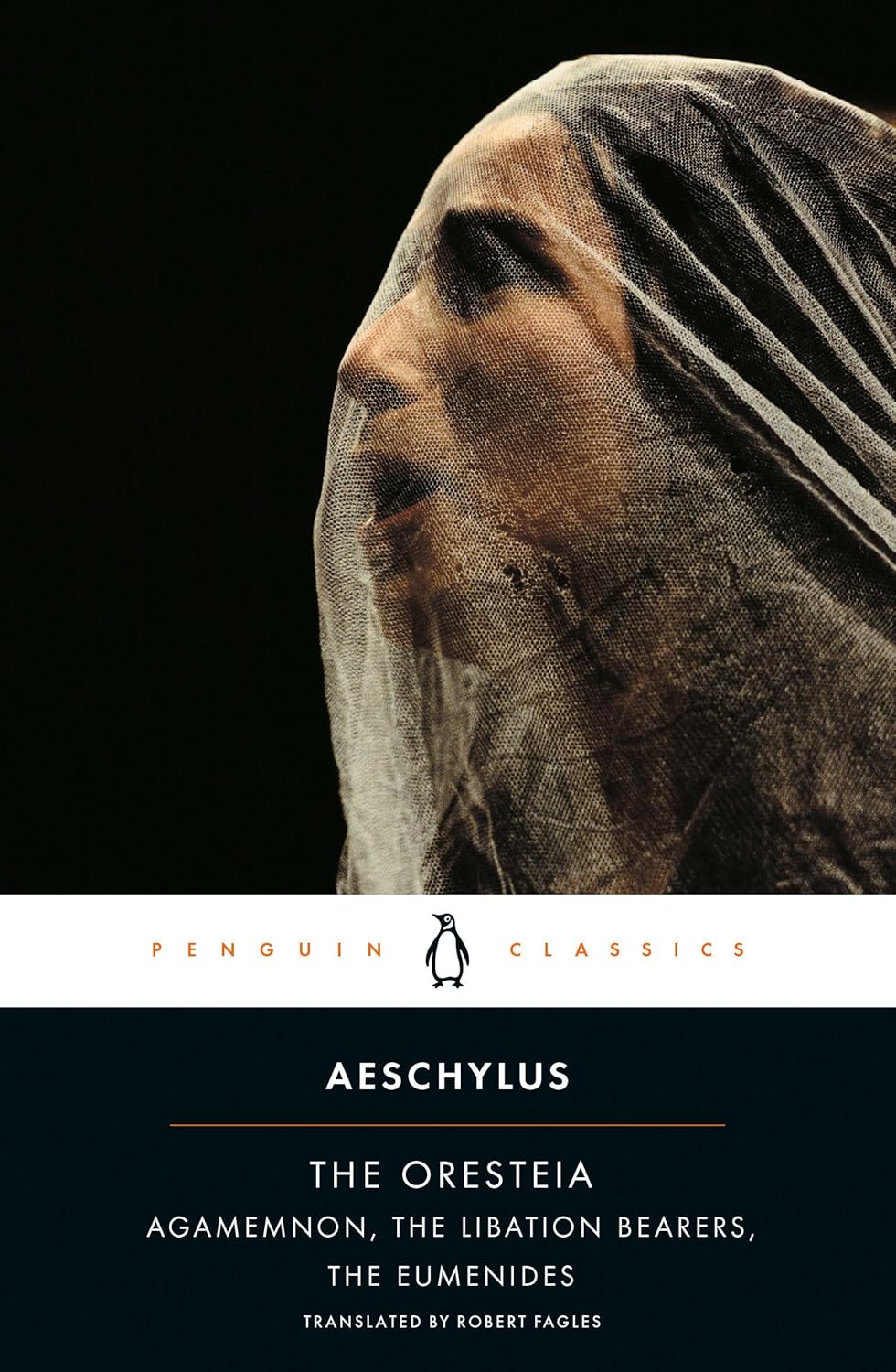
The Oresteia — trans. Robert Fagles (1977)
First translation, recommended for most readers
Fagles's Oresteia — published in 1977 and still the best-selling English version — is the translation that makes the Oresteia feel like theater rather than literature, and that distinction matters enormously for a text that was written to be performed. Fagles worked closely with Bernard Knox, the great classical scholar, and the result is a translation that balances fidelity to the Greek with theatrical energy in English. His Agamemnon is particularly admired: the long watchman's speech that opens the trilogy, the carpet scene, Cassandra's prophecies — each arrives with a dramatic force that earlier versions had muted. Fagles does not try to reproduce Aeschylus's metrical structures in English; instead he finds free-verse rhythms that carry the weight of the lines. The Penguin Classics edition includes Knox's substantial introduction, which is essential reading on its own. This is the version for anyone approaching the Oresteia for the first time.
Buy on Amazon → 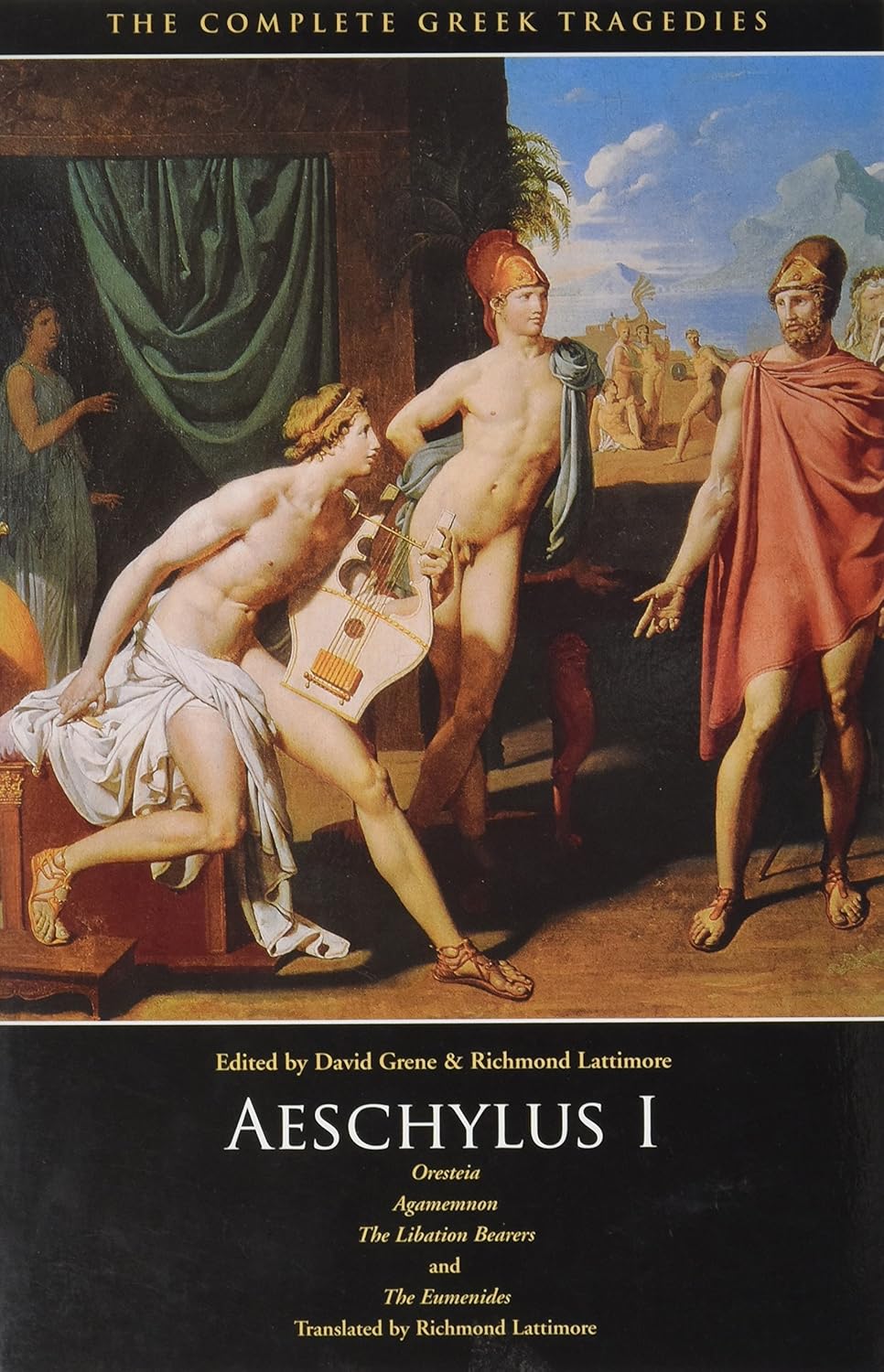
The Oresteia — trans. Richmond Lattimore (1953)
Most faithful to the Greek — best for academic study
Lattimore's 1953 translation, published in the University of Chicago's Complete Greek Tragedies series, is the great scholarly Oresteia in English — the one assigned in classics departments for seven decades and the one that has influenced the most subsequent translators. Where Fagles reaches for dramatic immediacy, Lattimore reaches for fidelity: he works line by line, preserving Aeschylus's density, his compound words, his syntactic difficulty, his metrical character. The result is harder to read than Fagles but closer to what Aeschylus actually wrote, and readers who persist with it will find their understanding of the Greek deeper than any more accessible version can provide. Lattimore's translation rewards slow, attentive reading and rereading. It is the version to choose if you are studying the plays academically or if you want to experience as much of Aeschylus's actual language as a non-Greek-reader can. The Chicago edition is affordable and includes the complete trilogy.
Buy on Amazon → 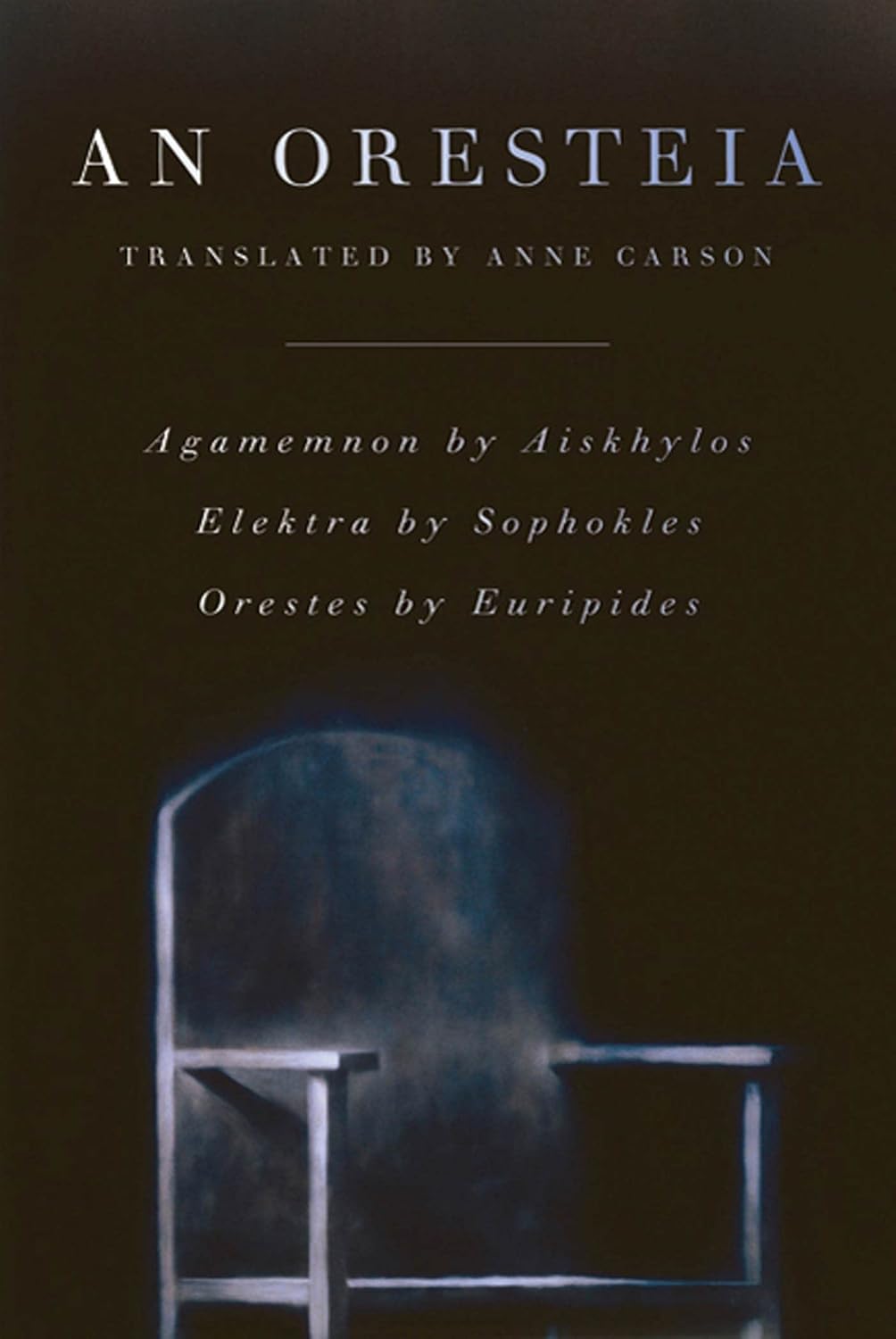
An Oresteia — trans. Anne Carson (2009)
Most unconventional — essential for readers already familiar with the trilogy
Anne Carson's "An Oresteia" is not a translation of Aeschylus's trilogy alone. It is a compilation: Carson translates Agamemnon by Aeschylus, then Sophocles' Elektra (the same story from a different playwright's angle), then Euripides' Orestes. The resulting arc covers the same mythological ground as the Aeschylus trilogy but from three different tragic sensibilities — austere, naturalistic, ironic — placed in conversation. Carson is one of the most celebrated contemporary classicists and poets in the English language, and her translations are linguistically inventive and often surprising: she does not smooth Aeschylus into conventional English but preserves and even amplifies his strangeness. Carson's Agamemnon in particular is widely considered one of the most powerful renderings of that play available. This is not the starting point — read Fagles first. But for a reader who has encountered the Oresteia and wants to see it through a radically different lens, Carson is indispensable.
Buy on Amazon → As an Amazon Associate, I earn from qualifying purchases.