Demian: What It's About & Best Translation
Hesse's novel of initiation and the divided self — translated by Damion Searls
As an Amazon Associate, we earn from qualifying purchases.
Demian follows Emil Sinclair's journey of self-discovery, guided by the enigmatic Max Demian. It explores themes of duality, spirituality, and the quest for authenticity.
Translation Comparison at a Glance
| Translation | Readability | Accuracy | Tone | Best For |
|---|---|---|---|---|
| Searls (2022) | Very high | Excellent | Meditative and alive | Modern readers, first-time Hesse |
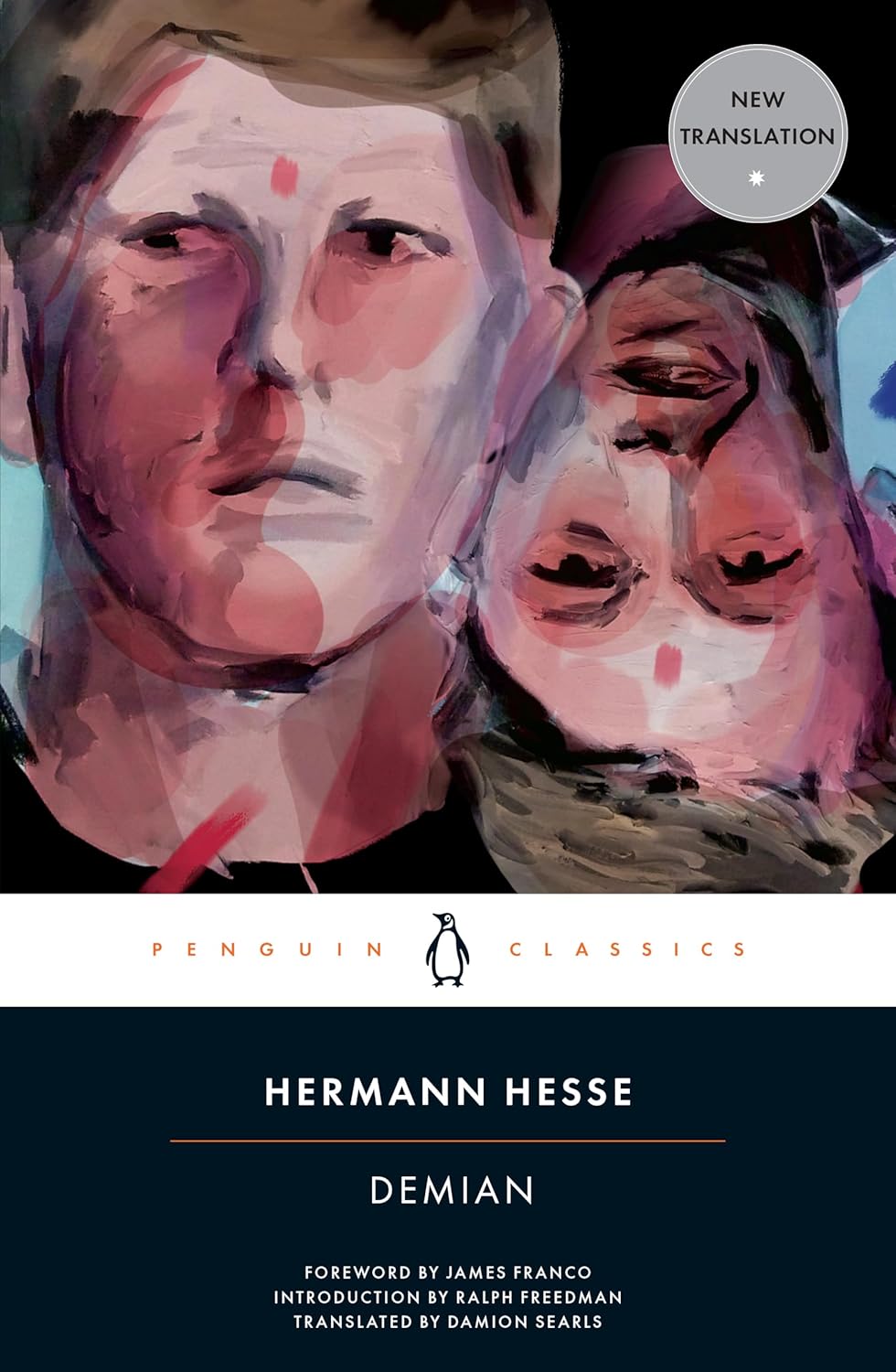
#1 — Demian — trans. Damion Searls (2022)
- Readability: Very high — preserves the hypnotic cadence without flattening it.
- Accuracy: Excellent — faithful to Hesse's meditative voice and references.
- Tone: Meditative and alive, genuinely thinking through the past.
- Accessibility: Ideal for contemporary readers new to Hesse.

Woodman's nuanced narration captures the introspective and mystical tone of Hesse's work, while Dunne's translation preserves the philosophical depth and lyrical quality of the original German.
Listen on Audible →Which translation is right for you?
- Choose Searls if you want the most readable, accurate, and contemporary rendering of Hesse's meditative prose.
About the Translator
Damion Searls (2022, Penguin Classics): One of the most prolific and distinguished literary translators working in English today, with major translations of Proust's In Search of Lost Time (selections), Rilke's Letters to a Young Poet, Uwe Johnson's Anniversaries, Robert Walser, Peter Handke, and many others. His decision to translate Demian for Penguin was part of a larger project of renewing Hesse in English; his translations of Siddhartha and Steppenwolf have also been reconsidered. Searls brings a poet's attention to Hesse's meditative prose — the slightly hypnotic quality that earlier English versions sometimes flattened into earnestness — while making the Gnostic and Nietzschean references available to contemporary readers.
Michael Roloff and Michael Lebeck (Harper, 1965): The standard English translation for much of the twentieth century, now superseded. Roloff was a literary translator and editor associated with the Suhrkamp publishing house and its American networks. The translation served its purpose but acquired the patina of its era. Readers who encountered Demian through the Roloff-Lebeck version — as many did during the 1960s and 1970s, when Hesse's American revival made him a counterculture staple — will find Searls's version considerably more alive.
Themes
The two worlds. Hesse opens the novel with Emil Sinclair's perception, from childhood, of two irreconcilable realms: the lit, ordered world of his parents' house — meals, lessons, Sunday church, the whole apparatus of bourgeois virtue — and a darker world beyond it, glimpsed through encounters with street violence, petty criminals, and the shadow of guilt. The novel is about the recognition that these worlds are not opposed but continuous, and that conventional morality suppresses this recognition at enormous cost.
Abraxas and the unity of good and evil. The Gnostic deity Abraxas — who encompasses both divine and demonic, both creation and destruction — is the novel's central symbol. What Demian teaches Sinclair is not a new morality but a deeper one: that the exclusion of darkness from the self is a lie, and that authenticity requires owning what conventional religion condemns. Hesse draws this from Gnosticism, Nietzsche, and his own experience in Jungian analysis during the war years.
The generational wound of World War I. Published in 1919, the novel was received by German youth who had survived the war as a direct address. Hesse did not set out to write a generational manifesto, but Demian became one — an account of the bankruptcy of the pre-war world that felt personally true to people who had watched that world destroy itself. The explosive reception is inseparable from this historical moment.
Key Characters
Emil Sinclair — the narrator; a middle-aged man looking back on his adolescence and young adulthood; sensitive, self-aware, and haunted by the question of whether he has fully become himself. His narration has the quality of genuine self-excavation rather than retrospective performance.
Max Demian — Emil's schoolmate and initiatory guide; serene, slightly uncanny, apparently always a step ahead of the world; he introduces Emil to the mark of Cain as a sign not of guilt but of independence. He disappears and reappears in Emil's life at significant moments, and the question of how real or symbolic he is remains genuinely open.
Frau Eva — Demian's mother; the embodiment of the Abraxas principle made flesh; she represents the synthesis Emil has been seeking — maternal and erotic, compassionate and powerful — and his relationship with her is the novel's emotional and spiritual climax.
Franz Kromer — the bully who first introduces Emil to the darker world; he blackmails Emil with a childish lie and the experience of guilt and entrapment this produces is Emil's first initiation into complexity.
Recommended Sources
For further reading on Hesse and Demian:
- German Quarterly (American Association of Teachers of German) — the primary English-language venue for current scholarship on German literature, including Hesse.
- Ralph Freedman, Hermann Hesse: Pilgrim of Crisis (1978) — the standard English-language biography; Freedman's introduction to the Penguin Classics edition is an accessible version of his arguments.
- Theodore Ziolkowski's The Novels of Hermann Hesse (Princeton, 1965) — still the most thorough English-language critical study of Hesse's major fiction.
Searls's 2022 Penguin Classics translation is the edition to read. It supersedes the Roloff-Lebeck version on every criterion that matters — fidelity, readability, and the capacity to render Hesse's meditative prose as something alive rather than as period artefact. The Penguin edition is in print and readily available.
Frequently Asked Questions
What is Demian about?
Demian follows Emil Sinclair's journey of self-discovery, guided by the enigmatic Max Demian. It explores themes of duality, spirituality, and the quest for authenticity.
Is Demian hard to read?
Demian can be challenging due to its philosophical themes, but Searls's translation offers contemporary readability, making it accessible to modern readers.
Which Demian translation is best?
Damion Searls's 2022 Penguin Classics translation is the modern standard and the edition to choose.
Searls vs Roloff — which should I choose?
Choose Searls for contemporary readability and fidelity to Hesse's meditative cadence; Roloff-Lebeck (1965) is now superseded.
Which translation is easiest to read?
Searls's version is the most readable, preserving the hypnotic quality without flattening it into earnestness.
Which translation is most accurate?
Searls's 2022 translation is the most accurate and alive to contemporary readers.
Is the Roloff-Lebeck translation still worth reading?
It served readers for decades but has been superseded by Searls on every major criterion.
This guide is based on reading the translation(s) and reviewing scholarly commentary. Last reviewed: June 2026.
As an Amazon Associate, I earn from qualifying purchases.
Looking for another classic? Browse all our translation guides →
Hesse readers should also see our guide to the best Siddhartha translation.
For more Hesse, compare editions in our Steppenwolf translation guide.
Thomas Mann's work is thematically close — see our Magic Mountain translation guide.
Another strong German modernist choice is our Death in Venice translation guide.