On the Nature of Things: What It's About & Best Translation
Everything is made of atoms falling through the void — and nothing, not even death, should frighten you
As an Amazon Associate, we earn from qualifying purchases.
On the Nature of Things is a philosophical poem by Lucretius that explores Epicurean physics and ethics. It explains the nature of the universe, the atomic theory, and argues against the fear of death and superstition.
Translation Comparison at a Glance
| Translation | Readability | Accuracy | Tone | Best For |
|---|---|---|---|---|
| Stallings (2007) | Very high | Very good | Energetic, rhyming fourteeners | First-time readers, poetry lovers |
| Melville (1997) | High | Excellent | Sober, literal blank verse | Close study, scholarly readers |
| Latham / Godwin (1994) | High | Good | Clear, direct prose | Philosophy-focused readers |
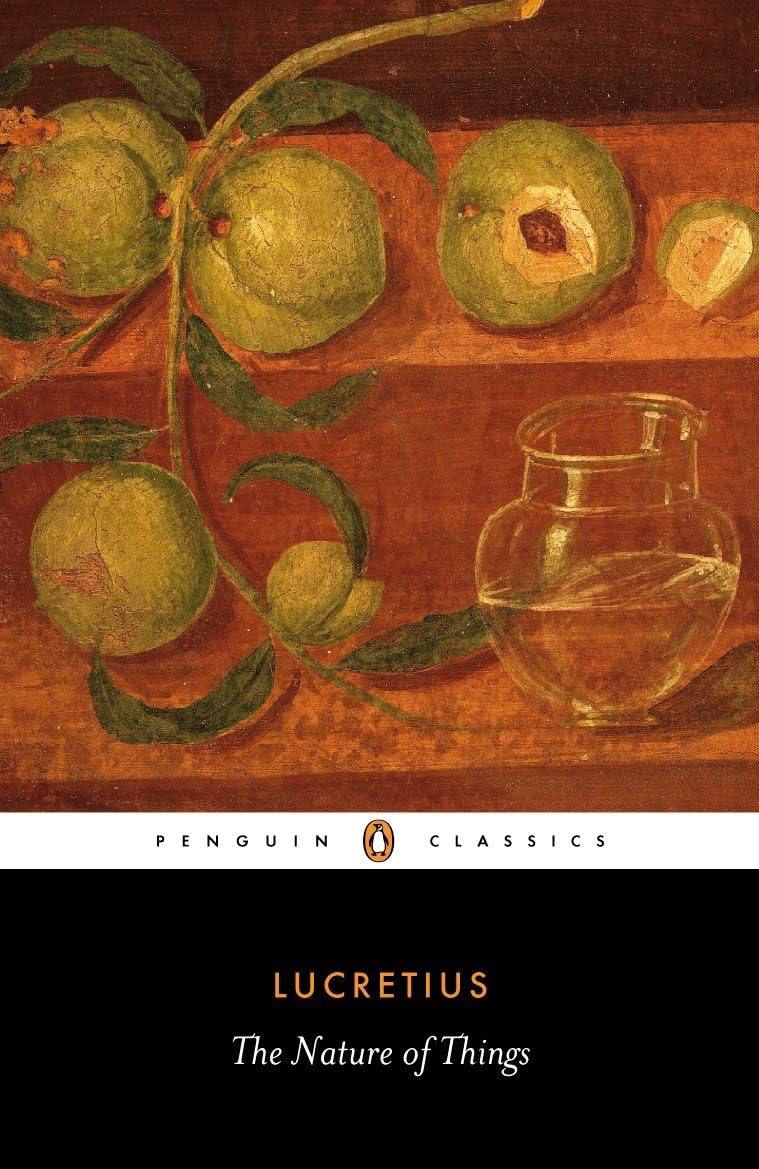
#1 — The Nature of Things — trans. A. E. Stallings (2007)
- Readability: Rhyming fourteeners give forward momentum and breathless energy.
- Accuracy: Remarkably faithful while remaining formally inventive.
- Tone: Lyrical yet precise, matching Lucretius's blend of philosophy and poetry.
- Accessibility: Excellent entry point for first-time readers.
Which translation is right for you?
- Choose Stallings if you want the most readable verse translation that captures both poetry and argument.
- Choose Melville if you want precise blank verse with the best scholarly notes and apparatus.
- Choose Latham if you prefer clear prose focused purely on the philosophy.
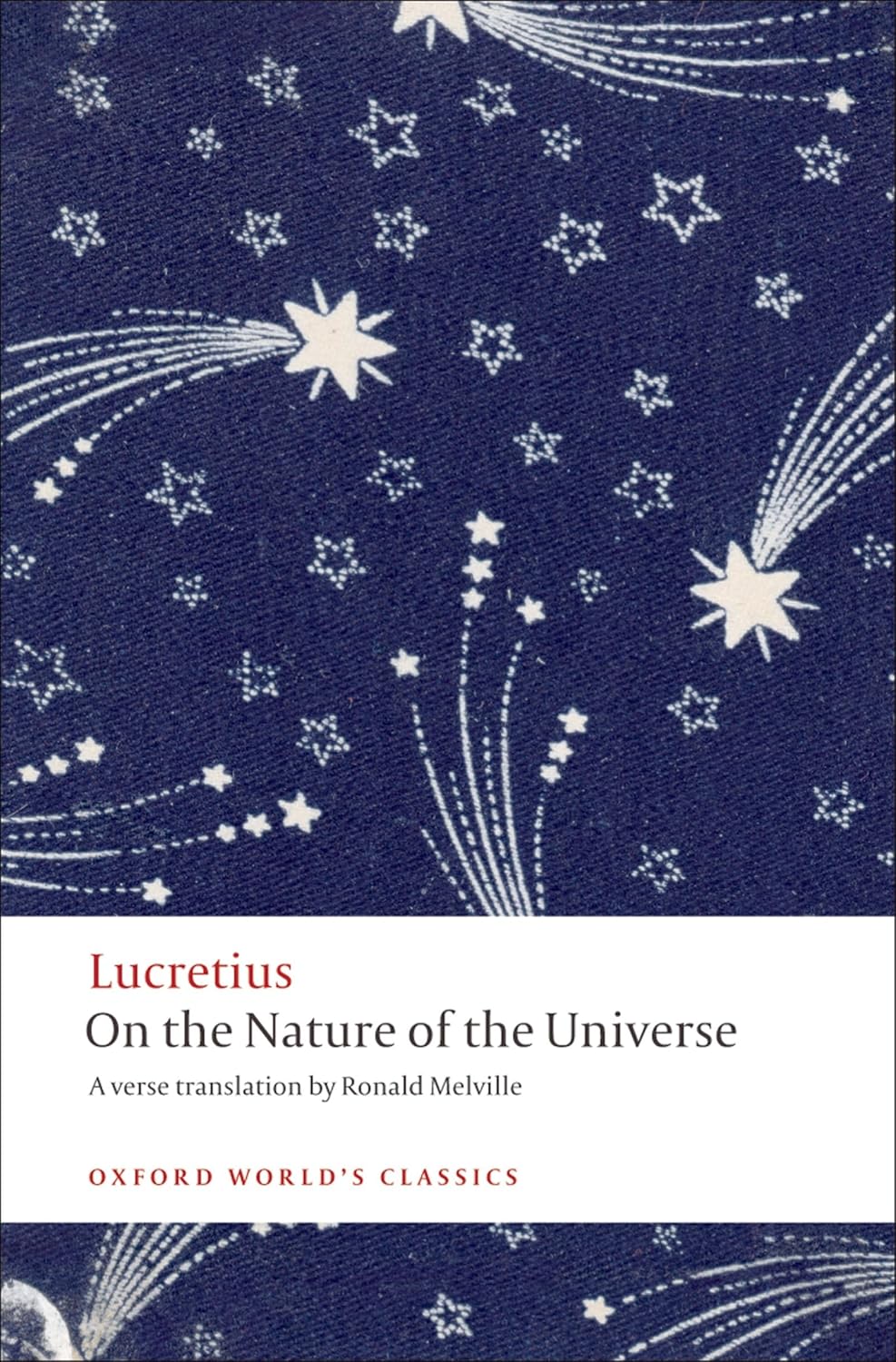
#2 — On the Nature of the Universe — trans. Ronald Melville (1997)
- Readability: Sober blank verse that stays close to Latin sentence structure.
- Accuracy: Highly literal with excellent scholarly support.
- Tone: Transparent and measured, ideal for following the argument.
- Accessibility: Best when paired with its rich notes and introduction.
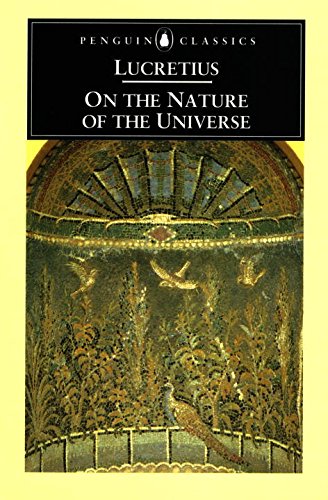
#3 — On the Nature of the Universe — trans. R. E. Latham, rev. John Godwin (1951; rev. 1994)
- Readability: Lucid and direct in plain English.
- Accuracy: Excellent for technical argument without metrical constraints.
- Tone: Straightforward prose focused on clarity.
- Accessibility: Ideal entry point for philosophy-first readers.
About the Translators
A.E. Stallings (Penguin Classics, 2007): Poet, classicist, and MacArthur Fellow, Stallings has lived in Athens for many years and is one of the few translators who is equally distinguished as a practising poet and a scholar of classical languages. Her other translations include Hesiod's Works and Days. Her decision to translate Lucretius in rhyming fourteeners — seven-stress lines rhymed in couplets — was deliberate and controversial: the fourteener is an unfashionable metre, but Stallings chose it because it gives the poem the forward momentum and breathless energy of the Latin hexameter better than blank verse or free verse can. The introduction by Richard Jenkyns in the Penguin edition provides excellent scholarly context.
Ronald Melville (Oxford World's Classics, 1997): A classical scholar who worked in blank verse, producing a more sober and literal Lucretius that stays close to the structure of the Latin sentences. The scholarly advantage of the Oxford edition is its notes and introduction by Don Fowler and Peta Fowler, two of the most important Lucretian scholars of the late twentieth century, whose apparatus enriches the text throughout.
R.E. Latham, revised by John Godwin (Penguin Classics, 1951; revised 1994): Latham's prose translation was the standard English Lucretius for over fifty years — clear, direct, focused on the philosophy rather than the poetry. Godwin's 1994 revision corrects errors and adds an introduction covering the Epicurean philosophical background. The trade-off is inevitable: without verse, the great set pieces lose much of their power.
Themes
The fear of death as the root of all misery. Lucretius's central therapeutic argument is that human beings are made wretched not by death itself but by the fear of it — and that this fear can be dissolved by understanding what death actually is: the dispersal of atoms that had temporarily combined to form a person. There is no afterlife, no punishment, no continuation of consciousness. Death is therefore nothing, and nothing to fear.
Atomic materialism. Everything — matter, mind, sensation, the motions of the heavens, the history of civilisation — is explained by the behaviour of invisible atoms moving through infinite void. The poem is an attempt to give this philosophical system the emotional force and beauty that would make it not just intellectually persuasive but personally liberating.
The critique of superstition and religion. Lucretius is consistently and explicitly anti-religious — not in the modern sense of casual atheism but in the ancient sense of opposition to the belief that supernatural powers intervene in human affairs and must be propitiated. Tantum religio potuit suadere malorum — so great was the evil that religion could induce — is one of the poem's most famous lines, and its argument is that the fear of the gods is inseparable from the fear of death.
The plague of Athens. The poem ends not with the tranquillity that Epicurean philosophy promises but with a terrifying account of the plague of Athens — drawn from Thucydides — in which all social bonds dissolve and the dead go unburied. Why Lucretius chose this ending is one of the great interpretive puzzles of Latin literature.
Key Characters
Titus Lucretius Carus — the poet; about whom almost nothing is known historically. St. Jerome's claim that he went mad from a love potion and killed himself is almost certainly false — a later hostile tradition. The poem itself presents a consciousness of great power and urgency, driven by the conviction that it has something to say that matters.
Gaius Memmius — the poem's Roman dedicatee, a politician to whom Lucretius addresses his arguments; he is present at the opening of each book but is otherwise marginal to the work, functioning as a fictional interlocutor for the philosophical argument.
Epicurus — the founder of the philosophical school Lucretius expounds; praised in the poem with language that borders on religious worship, as the man who freed humanity from the fear of the gods and death. Lucretius's account of Epicurus is itself one of the poem's most remarkable performances: it praises the defeat of superstition in terms that sound almost devotional.
Venus — the poem's opening invocation; the goddess of generative force in nature, whose power is used to frame the poem's argument about atoms and creation. The irony — invoking a goddess at the start of a poem that argues there are no gods who intervene in human affairs — is deliberate and unresolved.
Recommended Sources
For further reading on Lucretius and De Rerum Natura:
- Stephen Greenblatt, The Swerve: How the World Became Modern (2011) — the accessible narrative of the poem's rediscovery in 1417 by Poggio Bracciolini; won the Pulitzer Prize and introduced Lucretius to a wide contemporary audience.
- Martha Nussbaum, The Therapy of Desire (Princeton, 1994) — the most important philosophical treatment of Epicurean and Stoic arguments about the emotions; essential context for Lucretius's therapeutic aims.
- Classical Quarterly (Cambridge University Press) — the leading British journal for classical scholarship; the primary venue for current Lucretian studies.
Stallings's Penguin Classics translation is the right choice for virtually every reader — it captures both the argument and the extraordinary poetry of Lucretius in a single remarkable volume. Melville's Oxford edition is the essential alternative for readers who want the most scholarly apparatus alongside a competent verse translation. Latham's prose, in the revised Godwin edition, remains the clearest entry point to the philosophy for readers who are primarily interested in the argument rather than the poetry.
Frequently Asked Questions
What is On the Nature of Things about?
On the Nature of Things is a philosophical poem by Lucretius that explores Epicurean physics and ethics. It explains the nature of the universe, the atomic theory, and argues against the fear of death and superstition.
Is On the Nature of Things hard to read?
The difficulty varies by translation. Stallings offers a readable version with poetic momentum, while Melville provides a more literal translation with scholarly notes. Latham's prose is clear but lacks poetic elements.
Which Lucretius translation is best?
A.E. Stallings's Penguin Classics translation is the primary recommendation for most readers. It captures both the argument and the extraordinary poetry of Lucretius in a single remarkable volume.
Stallings vs Melville — which should I choose?
Choose Stallings for poetic momentum and readability in rhyming fourteeners. Choose Melville for precise blank verse supported by the best scholarly notes and introduction from leading Lucretian scholars.
Which translation is easiest to read?
Stallings's rhyming fourteeners give the poem forward momentum and are widely praised for readability while remaining faithful to the original.
Which translation is most accurate?
Melville's blank verse stays closer to the structure of the Latin sentences and benefits from the depth of philological knowledge in its scholarly apparatus.
Should I read the prose Latham translation or a verse version?
Latham's prose is clearest for the philosophy alone, but verse translations like Stallings are needed to experience the poem's great set pieces at full power.
This guide is based on reading all three translations and reviewing scholarly commentary. Last reviewed: June 2026.
As an Amazon Associate, I earn from qualifying purchases.
Looking for another classic? Browse all our translation guides →
Virgil's epic deserves the same attention—see our guide to the best Aeneid translations.
For more Roman poetry, compare the best Metamorphoses translations of Ovid.
Explore another Roman philosophical classic in our Meditations translation guide.
Virgil's other major work is covered in the best Georgics translations comparison.