The Tin Drum: What It's About & Best Translation
Günter Grass's century-spanning novel of war, guilt, and Oskar Matzerath — and why the 2009 re-translation matters
As an Amazon Associate, we earn from qualifying purchases.
The Tin Drum follows Oskar Matzerath, who decides at age three to stop growing as a protest against the adult world. Set in Danzig, the novel explores themes of war, guilt, and the grotesque.
Translation Comparison at a Glance
| Translation | Readability | Accuracy | Tone | Best For |
|---|---|---|---|---|
| Mitchell (2009) | Moderate | Excellent | Preserves long sentences and musical patterning | Definitive reading experience |
| Manheim (1962) | High | Good | Normalised and simplified prose | Historic reception study |
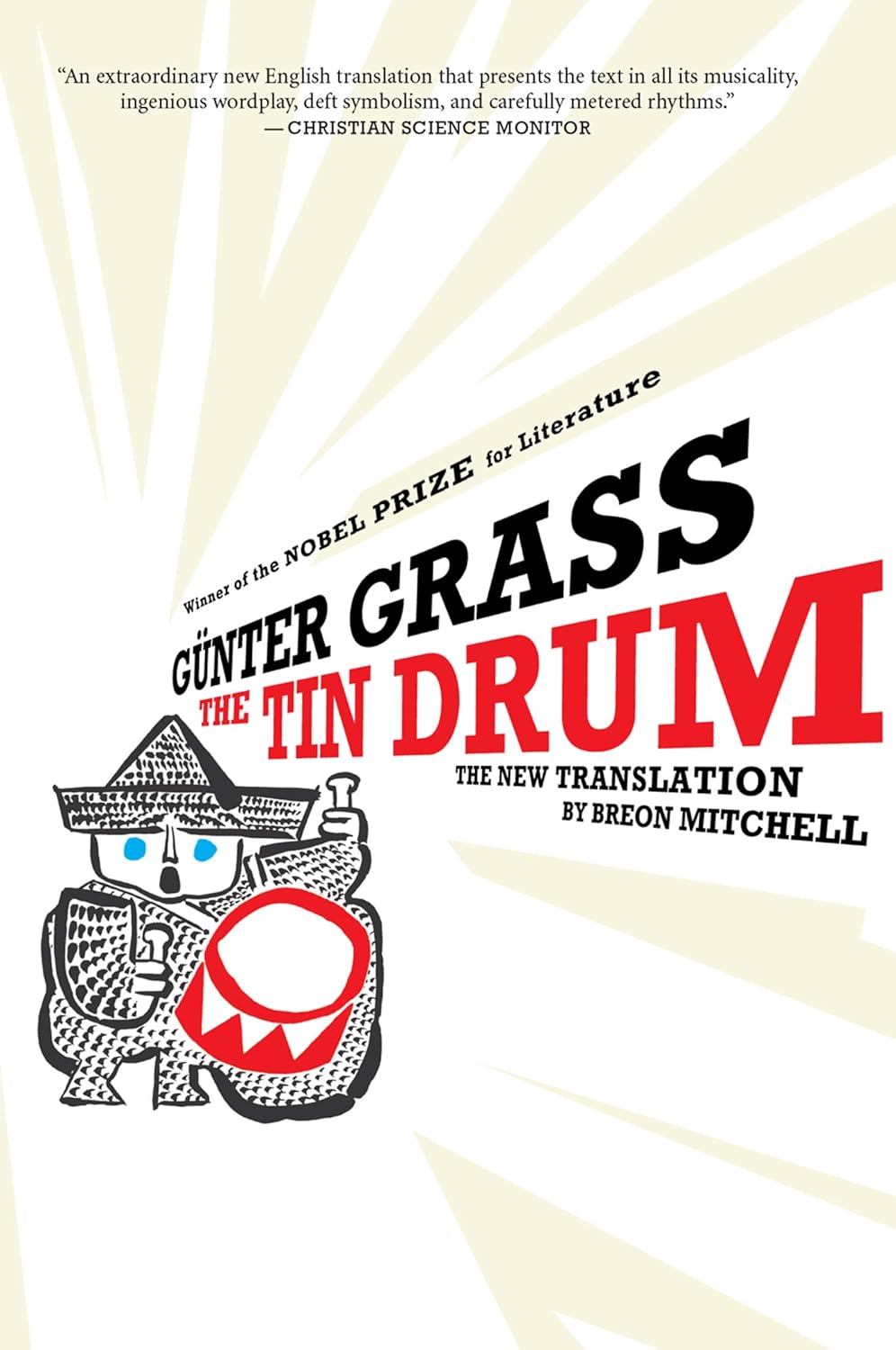
#1 — The Tin Drum — trans. Breon Mitchell (2009)
- Readability: Moderate — preserves long, musical sentences
- Accuracy: Excellent — restores dialect, wordplay and rhythmic architecture
- Tone: Faithful to Grass's grotesque and lyrical density
- Accessibility: Best for readers seeking the definitive text
Which translation is right for you?
- Choose Mitchell if you want the most faithful rendering of Grass's rhythmic architecture, dialect, and wordplay, produced with the author's collaboration.
- Choose Manheim if you are interested in the historic 1962 version through which the novel first reached English readers and built its international reputation.
About the Translators
Breon Mitchell (2009, Mariner Books): Professor of Germanic Studies and Comparative Literature at Indiana University; a Kafka scholar whose other translations include Kafka's The Trial (Schocken series) and Amerika. He produced the 2009 retranslation in close consultation with Grass and with access to the original manuscript, including material Grass had cut before publication. His translation won the PEN American Center Award for Translation and is the version Grass himself considered definitive.
Ralph Manheim (1907–1992, 1962, Pantheon): American; one of the most prolific translators of the twentieth century, responsible for English versions of Céline's Death on the Installment Plan, Brecht's plays, Hitler's Mein Kampf, and many others. His 1962 translation was the only English text of The Tin Drum for nearly fifty years and is the version through which the novel built its international reputation; its merits are real, and its simplifications have only become visible in comparison with Mitchell's more faithful retranslation.
Themes
Oskar's refusal to grow as political act. Oskar's decision at three to stop growing — a will-powered arrest of his own development — is the novel's founding conceit and its deepest symbol. To refuse to grow is to refuse to become complicit: to decline the role of German adult, soldier, perpetrator. Oskar observes the rise of National Socialism, the war, and the postwar from a position of deliberate childishness, and his position is both a satirical device (the grotesque innocent who sees clearly) and a moral problem (can refusal be a form of participation?).
Danzig as the novel's geographic soul. The novel is set primarily in Danzig (now Gdańsk), the Baltic port city that was German in culture, Polish in ambiguity, and claimed by both nations throughout the twentieth century. Grass was born there in 1927 and expelled from his family home in 1944; the city's particular history — German, Polish, Free City, contested, destroyed, rebuilt — gives the novel its sense of a world where identities are never stable and where the ground beneath any certainty has already shifted.
The grotesque as the mode of historical truth. The events of the novel — the massacre of the Polish Post Office defenders, the invasion of France, the occupation, the liberation — are refracted through Oskar's drum and his glass-shattering voice, through episodes of carnival violence, sexual comedy, and sudden horror. Grass's grotesque is drawn from Rabelais and from Grimm, but its purpose is specifically post-Holocaust: it is the only register adequate to describing what happened without either aestheticising or trivialising it.
Key Characters
Oskar Matzerath — the narrator, who tells his story from a mental institution in the 1950s; a dwarf who decided at three to stop growing, who possesses a tin drum and a voice capable of shattering glass, and who is an unreliable narrator in the most fundamental sense: his version of events is coloured by his complicity, his vanity, and his need to transform the unbearable into grotesque comedy.
Agnes Matzerath — Oskar's mother; a woman trapped between two men and two cultures — her husband Alfred and her cousin Jan Bronski; she overeats herself to death in a manner the novel presents as both tragedy and absurdist comedy.
Jan Bronski — Agnes's Polish cousin and probable biological father of Oskar; one of the defenders of the Danzig Post Office in September 1939, executed by the Germans after the building falls. His death is one of the novel's most politically charged scenes.
Maria — the young woman who becomes Alfred's wife after Agnes's death and Oskar's obsessive love; she is the mother of Kurt, who may be Oskar's son, and she represents the postwar Germany of practicality, accommodation, and small-business normality.
Recommended Sources
For further academic reading on Grass and The Tin Drum:
- German Life and Letters (Wiley-Blackwell) — the leading British journal for German literature; essential for The Tin Drum in its postwar German literary and historical context.
- Monatshefte (University of Wisconsin) — the primary American journal for German literary studies; key venue for Grass scholarship including the novel's reception history and relationship to the Danzig material.
- Holocaust and Genocide Studies (Oxford University Press) — important for the novel's engagement with German memory and responsibility; the Post Office massacre and the novel's treatment of complicity are key topics.
The Mitchell translation (Mariner Books, 2009) is the current standard and the version to read — it is more faithful to Grass's rhythmic and dialectal complexity, was produced with Grass's active collaboration, and won the PEN Translation Award. The Manheim (Pantheon, 1962) is the historic version through which the novel built its international reputation; it remains in print and worthwhile for readers interested in the novel's reception history, but new readers should begin with Mitchell.
Frequently Asked Questions
What is The Tin Drum about?
The Tin Drum follows Oskar Matzerath, who decides at age three to stop growing as a protest against the adult world. Set in Danzig, the novel explores themes of war, guilt, and the grotesque.
Is The Tin Drum hard to read?
The Tin Drum can be challenging due to its complex prose and themes. Mitchell's translation preserves the original complexity, while Manheim's is more simplified and accessible.
Which The Tin Drum translation is best?
Breon Mitchell's 2009 translation is the best. It is the current standard, the most faithful to Grass's intentions, and the translation that Grass himself approved and championed.
Mitchell vs Manheim — which should I choose?
Choose Mitchell for the most faithful rendering of Grass's rhythmic and dialectal complexity. Choose Manheim if you are interested in the novel's historic reception and the version through which it first reached English readers.
Which translation is easiest to read?
Manheim's 1962 version is often easier because it normalises and simplifies Grass's long sentences and complex prose.
Which translation is most accurate?
Mitchell's 2009 translation is the most accurate. It restores the rhythmic architecture, dialect, and wordplay that Manheim simplified.
Why was a new translation of The Tin Drum needed after 1962?
Manheim worked at speed on a technically demanding novel and made consequential compromises. Mitchell had access to the original manuscript and worked with Grass, restoring features that had been normalised.
This guide is based on reading the translation(s) and reviewing scholarly commentary. Last reviewed: June 2026.
As an Amazon Associate, I earn from qualifying purchases.
Looking for another classic? Browse all our translation guides →
Breon Mitchell also produced the modern standard for Kafka — see our guide to the best Trial translation.
For more postwar German literature, compare the best Magic Mountain translations by Thomas Mann.
Thomas Mann's shorter masterwork is covered in our Death in Venice translation guide.
Readers of Grass often enjoy Hermann Hesse — our Steppenwolf translation guide recommends the modern Horrocks edition.