Telemachus in the Odyssey
The son who never knew his father, and the four books that are his own
As an Amazon Associate, we earn from qualifying purchases.
- Who
- Prince of Ithaca, about twenty years old
- Family
- Son of Odysseus and Penelope; grandson of Laertes
- Known for
- The "Telemachy": his own journey in search of news of his father
- Guided by
- Athena, disguised as Mentes and then as Mentor
- Appears in
- Books 1–4Books 15–24
Telemachus is the son of Odysseus and Penelope. He was a baby when his father sailed for Troy, so he is about twenty when the Odyssey begins and has never known him. The poem opens with him, not with Odysseus: the first four books, often called the Telemachy, follow a young man learning to act like a king's son.
A son without a father
When Athena, disguised as a family friend named Mentes, asks whether he is Odysseus's son, his answer is bitter:
"My mother tells me I am son to Ulysses, but it is a wise child that knows his own father."
The suitors are eating his inheritance and mocking him in his own house, and he has done nothing. Athena tells him to act, and holds up Orestes, who avenged his father Agamemnon, as the example to follow.
The Telemachy: Books 1 to 4
- Book 2. He calls the first assembly on Ithaca in twenty years and demands the suitors leave. They laugh at him. With Athena's help, now disguised as the old family friend Mentor, he slips away by ship.
- Book 3. At Pylos the aged king Nestor receives him. Nestor has no news of Odysseus, but tells how the Greeks scattered after Troy.
- Book 4. At Sparta, Menelaus and Helen welcome him, and Menelaus passes on what a sea-god told him: Odysseus is alive, held on an island by the nymph Calypso. Back on Ithaca, the suitors plan to ambush him on his way home.
The journey teaches him how kings and guests behave, and gives him what a boy at home could not have: a name of his own among his father's old comrades.
Father and son (Books 15 and 16)
Warned by Athena, Telemachus avoids the ambush and lands secretly, going first to the hut of the swineherd Eumaeus, where Odysseus, disguised as a beggar, is already staying. There, in Book 16, the two meet for the first time. Odysseus reveals himself:
"I am no god, why should you take me for one? I am your father, on whose account you grieve and suffer so much at the hands of lawless men."
From then on the son works beside his father, keeping the secret from everyone, including his mother. What they do with it fills the rest of the poem.
Telemachus after Homer
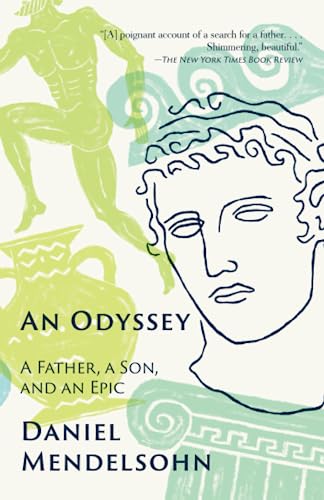
Homer leaves his future open. A lost later epic, the Telegony, gives him a strange one, which Madeline Miller uses in Circe. Daniel Mendelsohn's memoir An Odyssey, about teaching the poem with his elderly father in the class, is the best modern book on fathers and sons in the Odyssey. For novels, see our Odyssey retellings; for the poem itself, which Odyssey translation to read.
As an Amazon Associate, I earn from qualifying purchases.
Ready for the poem itself? See which Odyssey translation is best for you, or browse our translation guides.