The Odyssey in Art
Twenty paintings, in the order of the poem
Painters have been retelling the Odyssey for five hundred years, from a Renaissance fresco of Penelope at her loom to Waterhouse's Sirens and Turner's blazing sea. These twenty works follow the story from Ithaca to the wanderings and home again. Each caption gives the book of the poem it shows, and what the painter chose to show or invent.
Ithaca waits Books 1–4
Before Odysseus appears, the poem shows the house he left: Penelope at her loom, the suitors at the door.
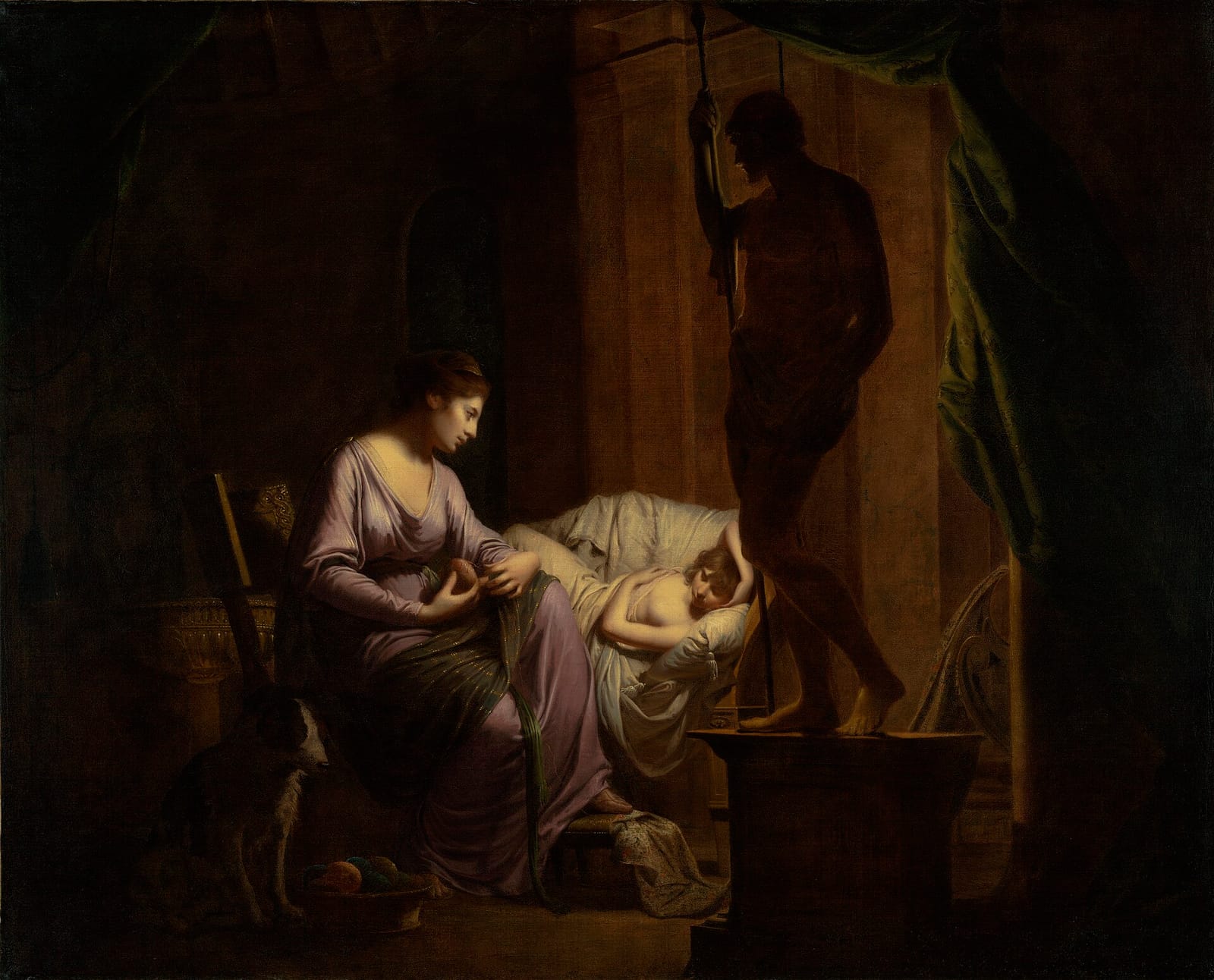
Penelope Unravelling Her Web
Book 2 tells Penelope's trick: she promised the suitors she would remarry once she finished a shroud for Odysseus's father, then unpicked each day's weaving at night. Wright, the English painter of candlelight, shows the secret half of the trick. By a single lamp she works beside her sleeping son, while a statue of the absent Odysseus stands over them in the dark.
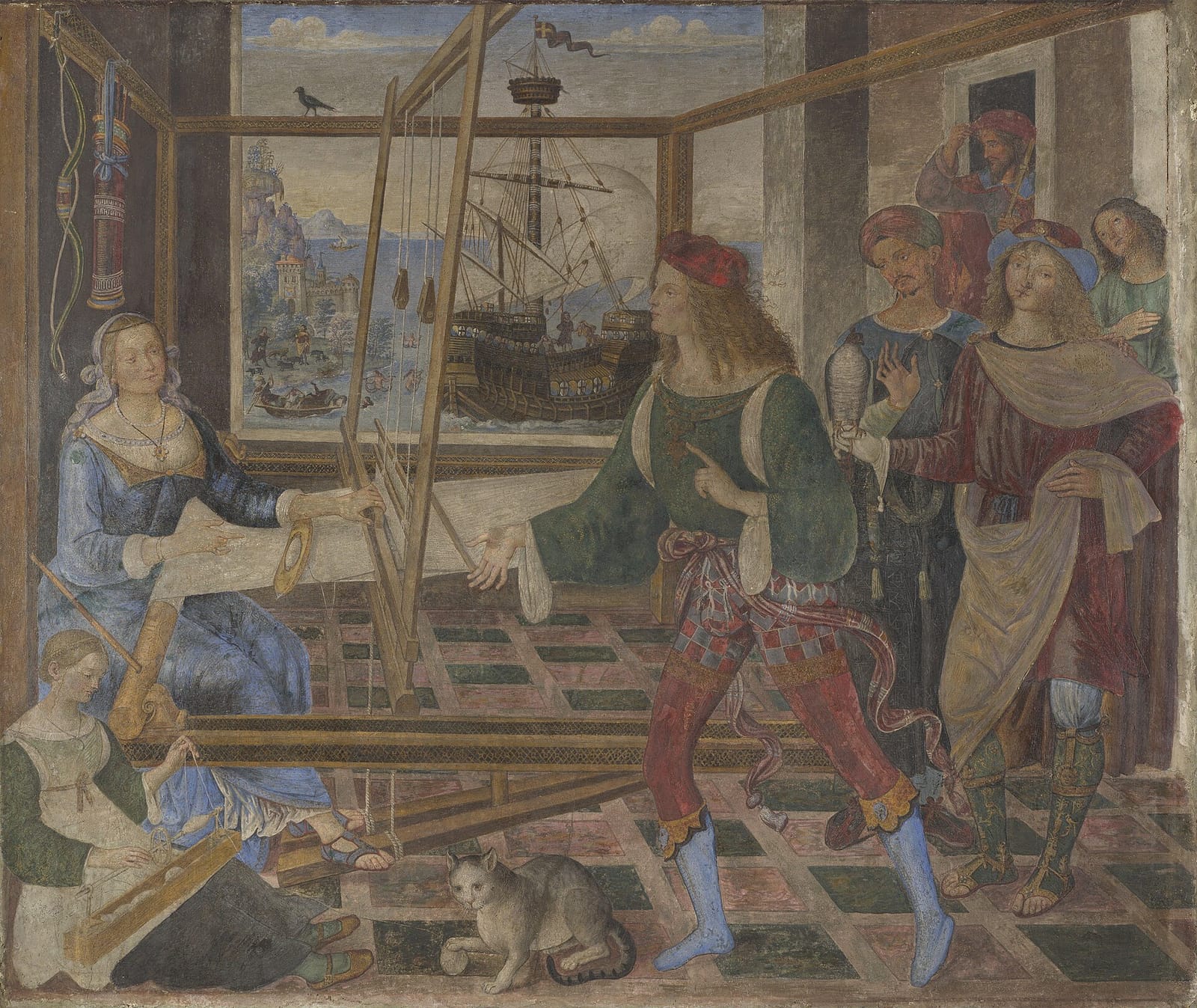
Penelope with the Suitors
Painted for a palace in Siena, this fresco gathers the whole situation on Ithaca into one room. Penelope sits at her loom with a maid, the suitors crowd in at the door, and through the window a ship sails on: Odysseus's voyage, still under way. At her feet a cat plays with a ball of her wool.
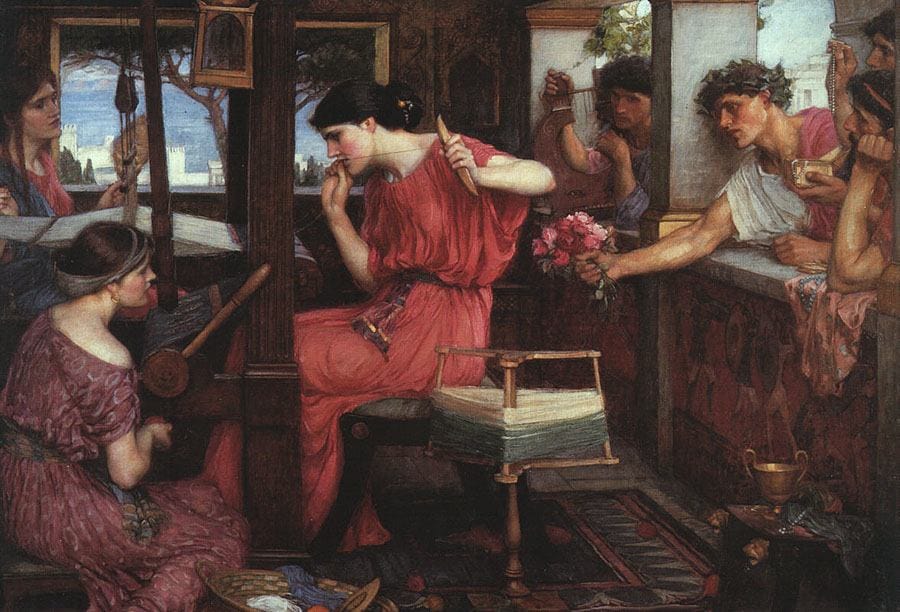
Penelope and the Suitors
Waterhouse came back to the Odyssey twenty years after his Circe and his Sirens. Penelope bites off a thread at her loom with her back to the suitors, who lean in at the window with flowers and jewels. One maid plays the lyre, another winds wool. Her refusal is the whole composition: she does not even look up.
The wanderings Books 5–12
Calypso's island, the Phaeacian court, and the adventures Odysseus tells there himself: the Cyclops, Circe, the Underworld, the Sirens.
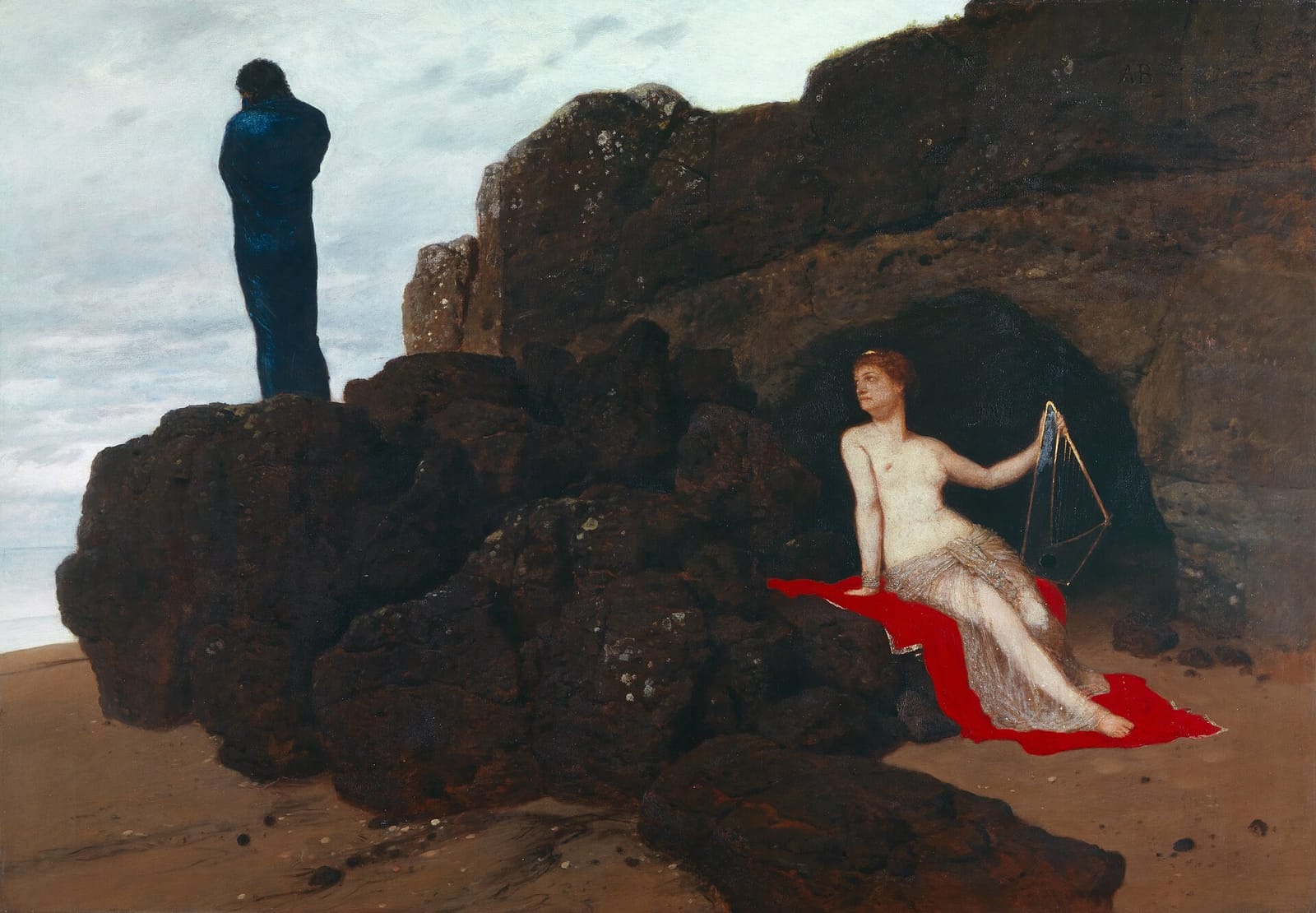
Odysseus and Calypso
The poem's first sight of its hero, in Book 5: Odysseus on the shore of Calypso's island, longing for home. Böcklin turns him into a dark, faceless column of grief against the sky, his back to the goddess. Calypso sits at the mouth of her cave on a red cloth, a stringed instrument beside her, as far from him as the rock allows.
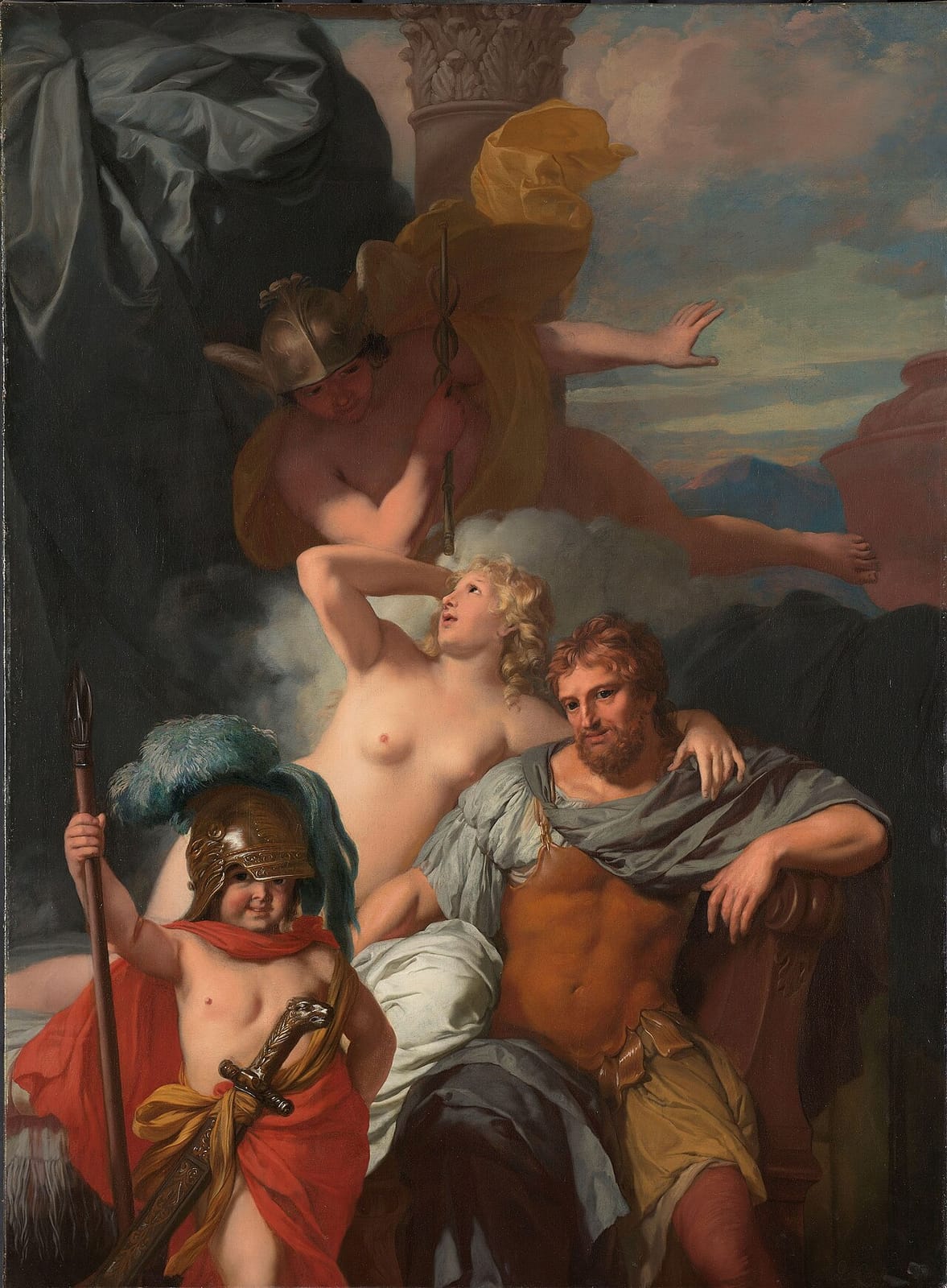
Mercury Orders Calypso to Release Odysseus
Hermes (Mercury to the Romans) swoops in with the gods' order: Calypso must let Odysseus go. De Lairesse catches the moment of interruption. Calypso clings to Odysseus and looks up in dismay, while a cupid plays with his helmet. In the poem she obeys, but protests that the gods begrudge goddesses their mortal lovers.
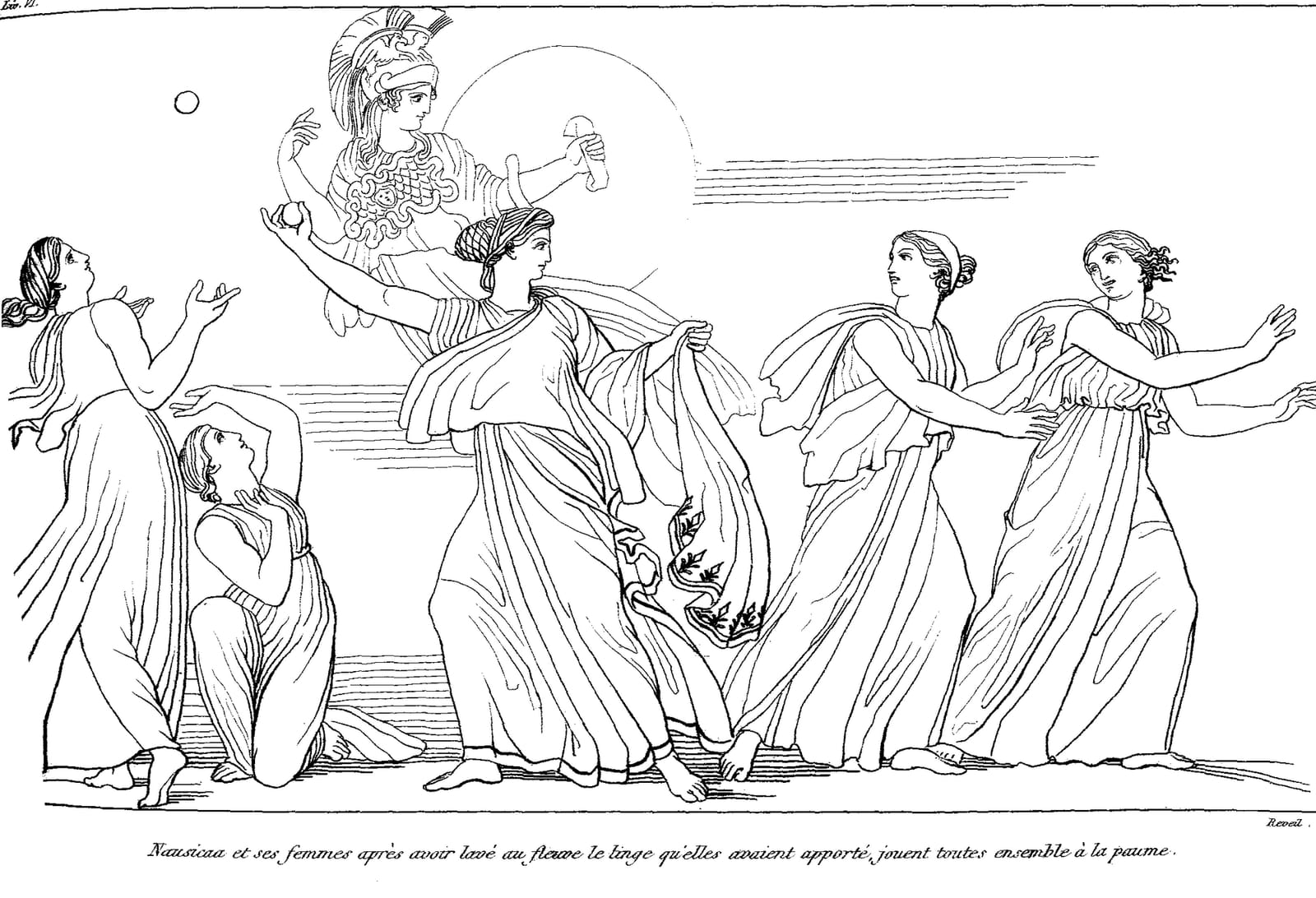
Nausicaa and Her Maids at Play
Before Odysseus wakes on the shore, Nausicaa and her maids have washed the palace linen in the river and are playing ball, as Book 6 tells it, while Athena, who arranged the outing, looks on. Flaxman's outline designs of 1793 shaped how a generation pictured Homer, in clean lines borrowed from Greek vase painting. This print comes from a French edition.
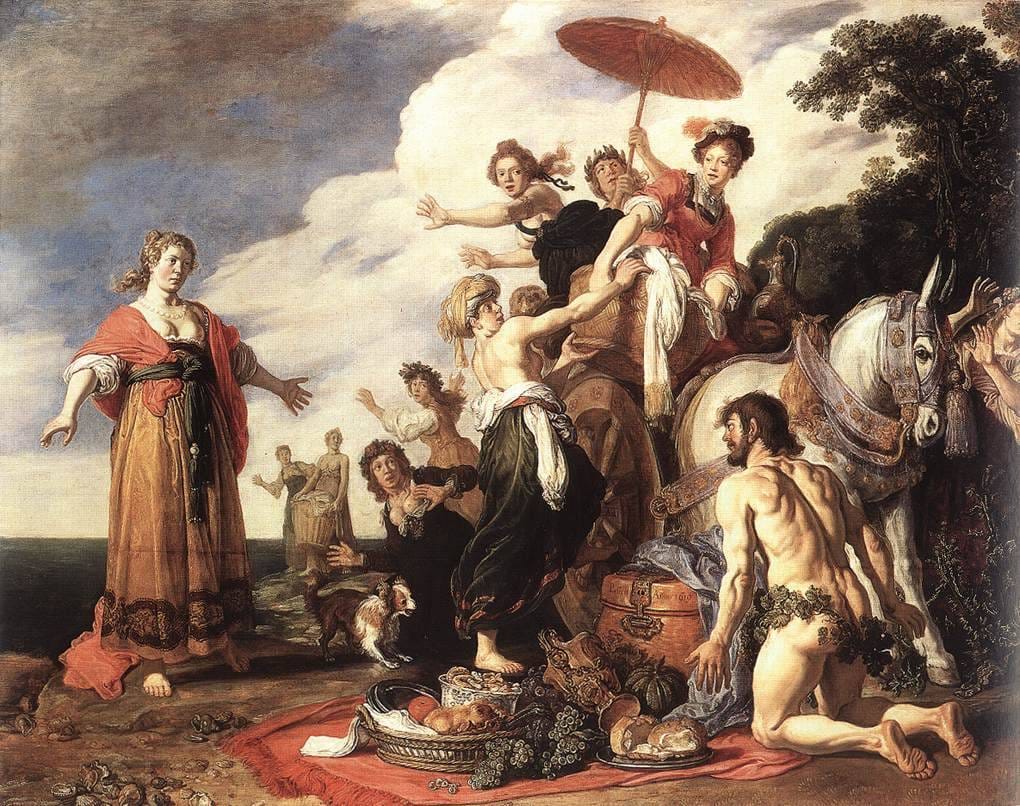
Odysseus and Nausicaa
Shipwrecked and naked but for a few leaves, Odysseus kneels to beg help from the princess Nausicaa. Her maids scatter in panic around the laundry cart; only Nausicaa stands her ground, as Athena has prompted her to. Lastman, who later taught Rembrandt, plays the scene for its comedy and its courage at once.
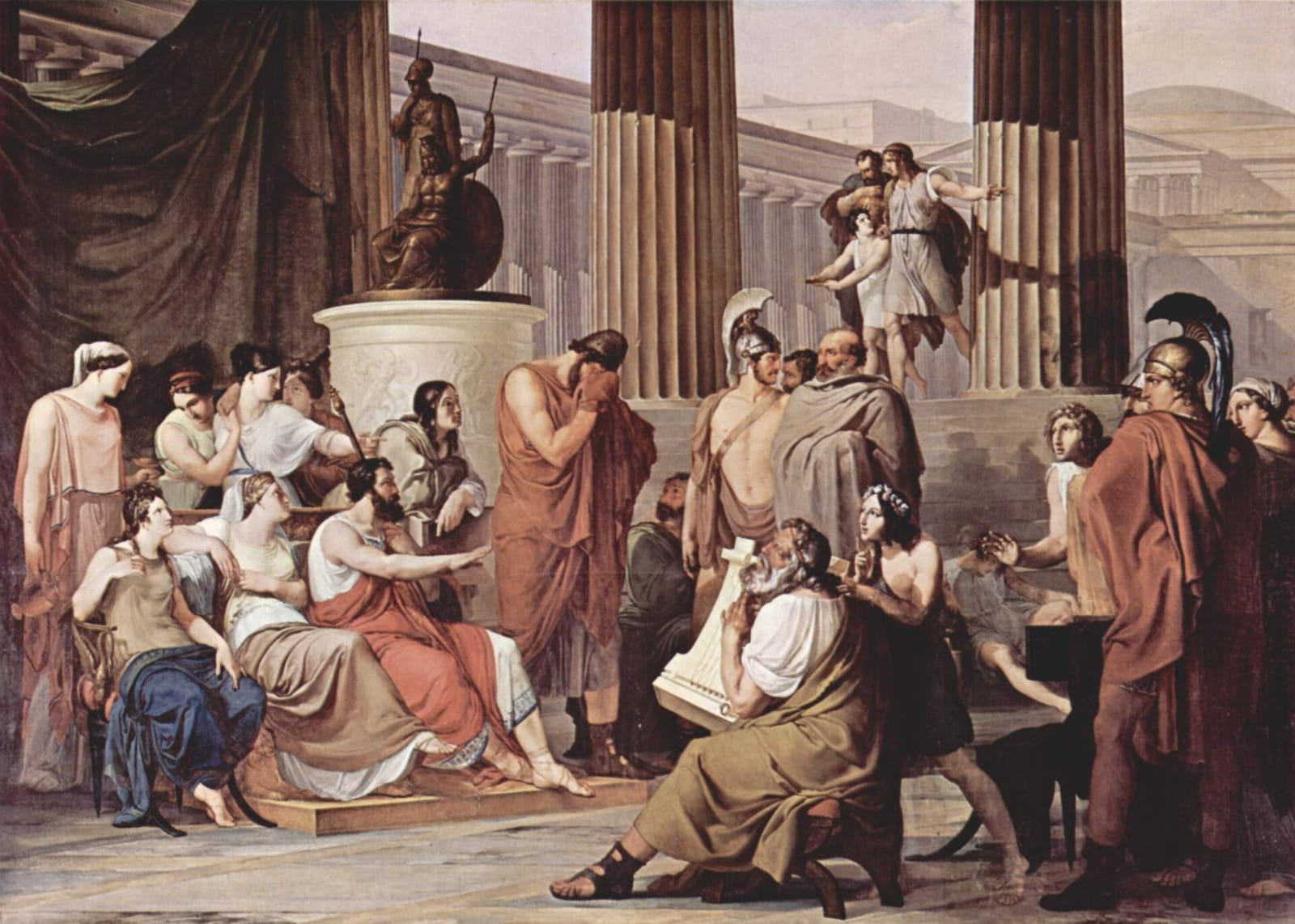
Ulysses at the Court of Alcinous
At the Phaeacian court in Book 8, the blind bard Demodocus sings of Troy and the wooden horse, and the unknown guest hides his face in his cloak and weeps. Only King Alcinous notices. Hayez painted it as a young man, setting the hero's grief in the middle of a cheerful feast. In the next book, the guest tells them who he is.
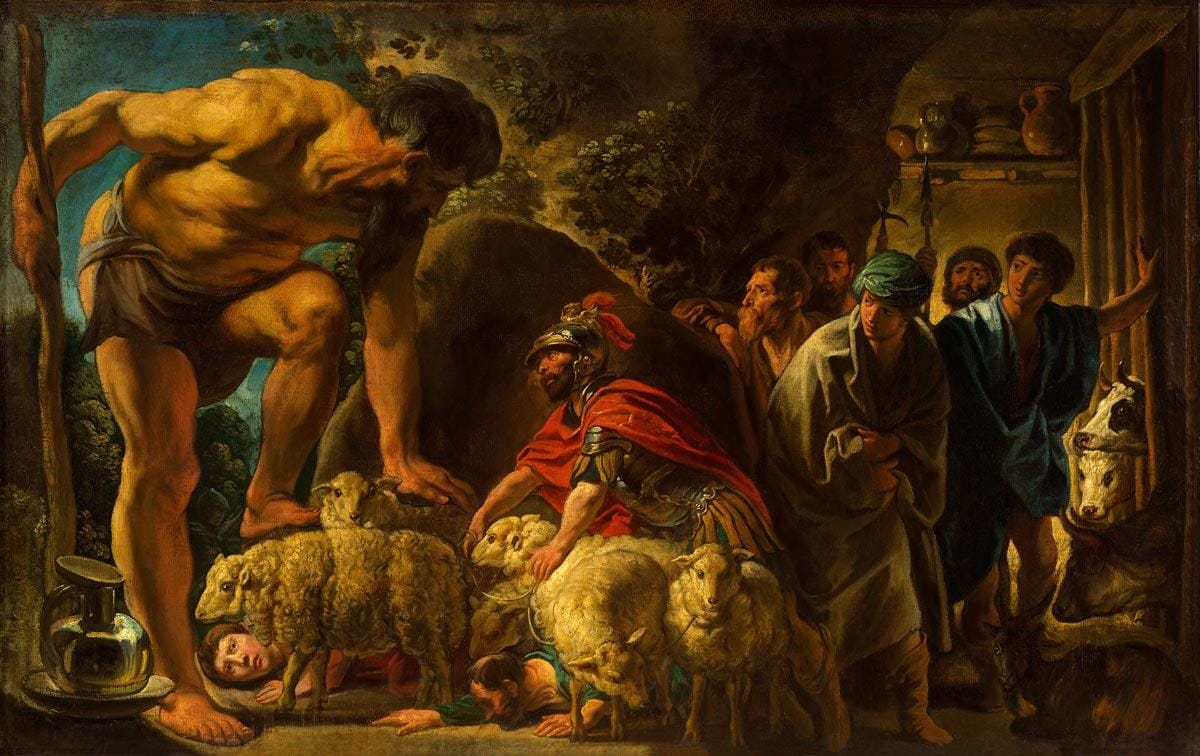
Odysseus in the Cave of Polyphemus
The escape from the Cyclops' cave in Book 9. Blinded, Polyphemus feels the backs of his rams as they go out to pasture, so Odysseus and his men slip out beneath them. Jordaens, the Antwerp painter of Rubens's generation, packs the scene into the dark cave: the giant bent over his flock, and the men's faces as they wait their turn.
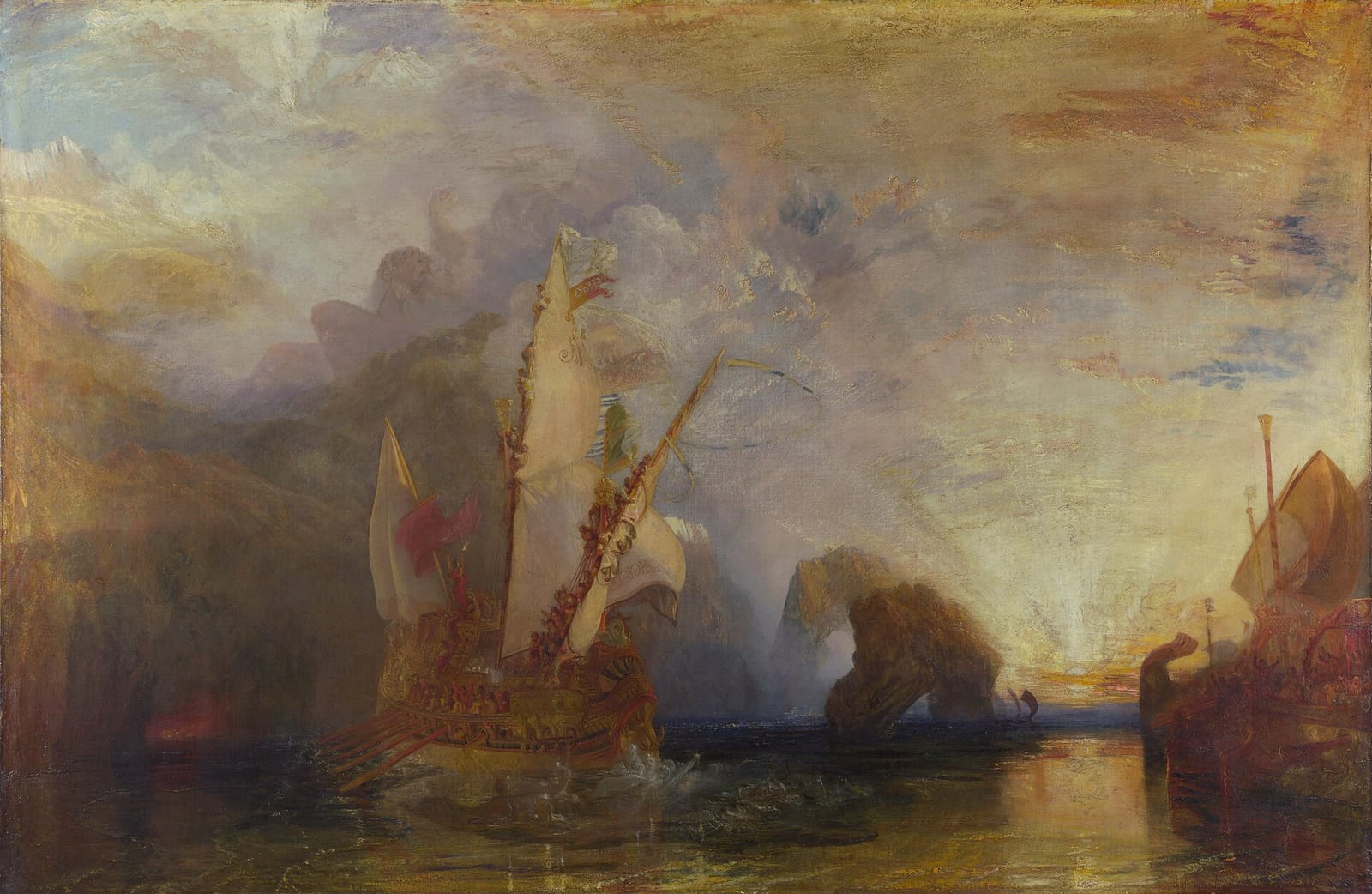
Ulysses Deriding Polyphemus
Safely at sea, Odysseus shouts his real name back at the blinded Cyclops, the boast that brings Poseidon's anger down on him for ten years. Turner turns the moment into a sea of light: the ship's golden sails and red flags blaze, the sun rises, and the giant is a dim shape among the clouds above the cliffs. Ruskin called it the central picture of Turner's career.
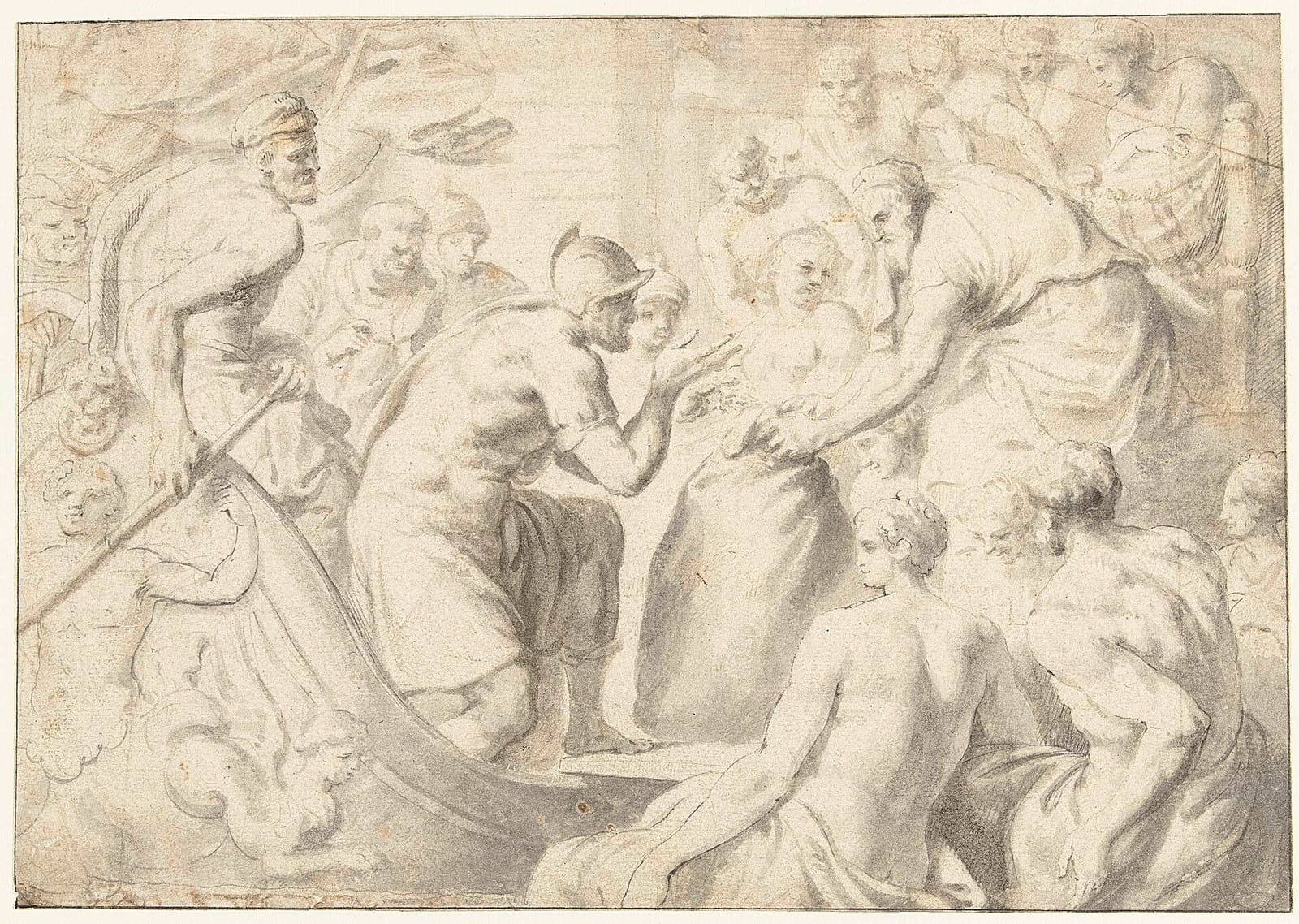
Odysseus's Companions Open the Bag of Winds
Aeolus, keeper of the winds, gave Odysseus every storm wind tied up in a leather bag. Within sight of Ithaca his crew opened it, thinking it held treasure, and were blown all the way back (Book 10). Van Thulden drew this in Paris to record the Gallery of Ulysses at Fontainebleau, painted by Primaticcio's workshop and destroyed in the 1730s.
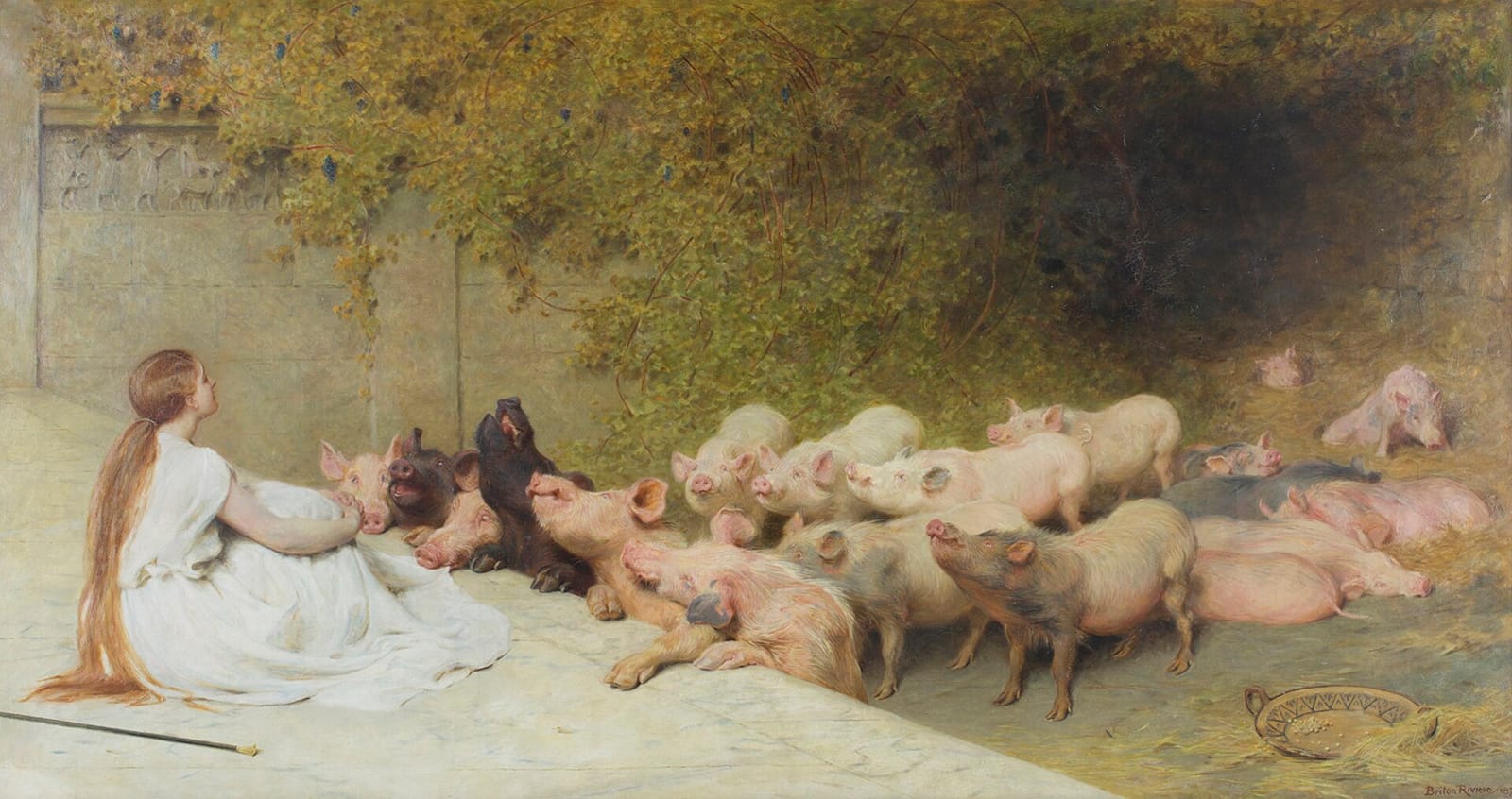
Circe and the Friends of Ulysses
Circe has turned Odysseus's scouting party into pigs, though, as Book 10 says, they keep their human minds. Rivière, the leading Victorian painter of animals, gives her a crowd of very real pigs pressing towards her, while the young sorceress sits apart, her wand dropped at her side. The painting finds something close to comedy in the horror, and pity too.
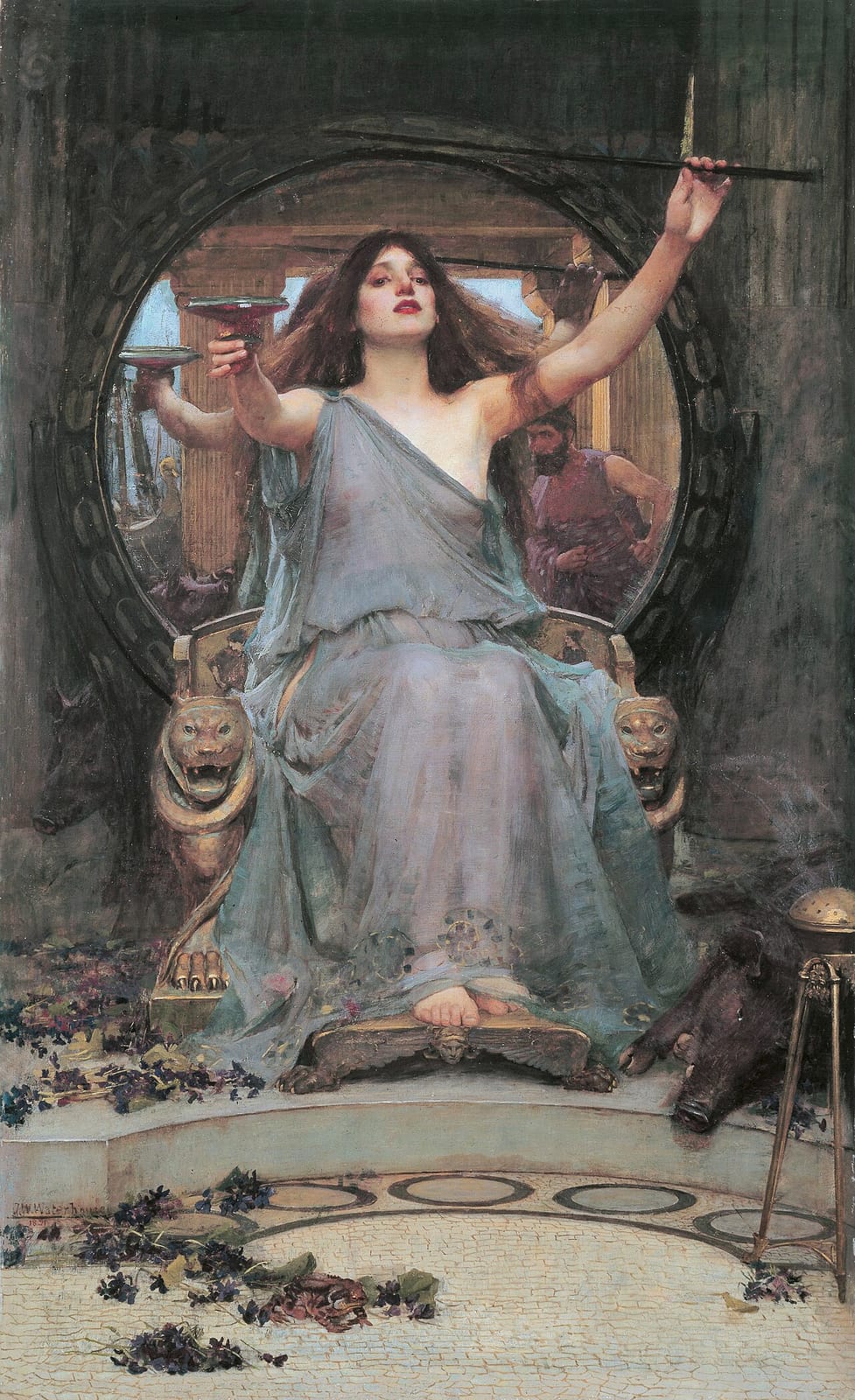
Circe Offering the Cup to Ulysses
Circe holds out the drugged cup and raises her wand, looking straight at us. We stand where Odysseus stands: he appears only in the round mirror behind her throne, and a pig, one of his transformed men, lies beside it. Protected by the herb moly from Hermes, Odysseus will drink and not change. Waterhouse makes the viewer the next guest.
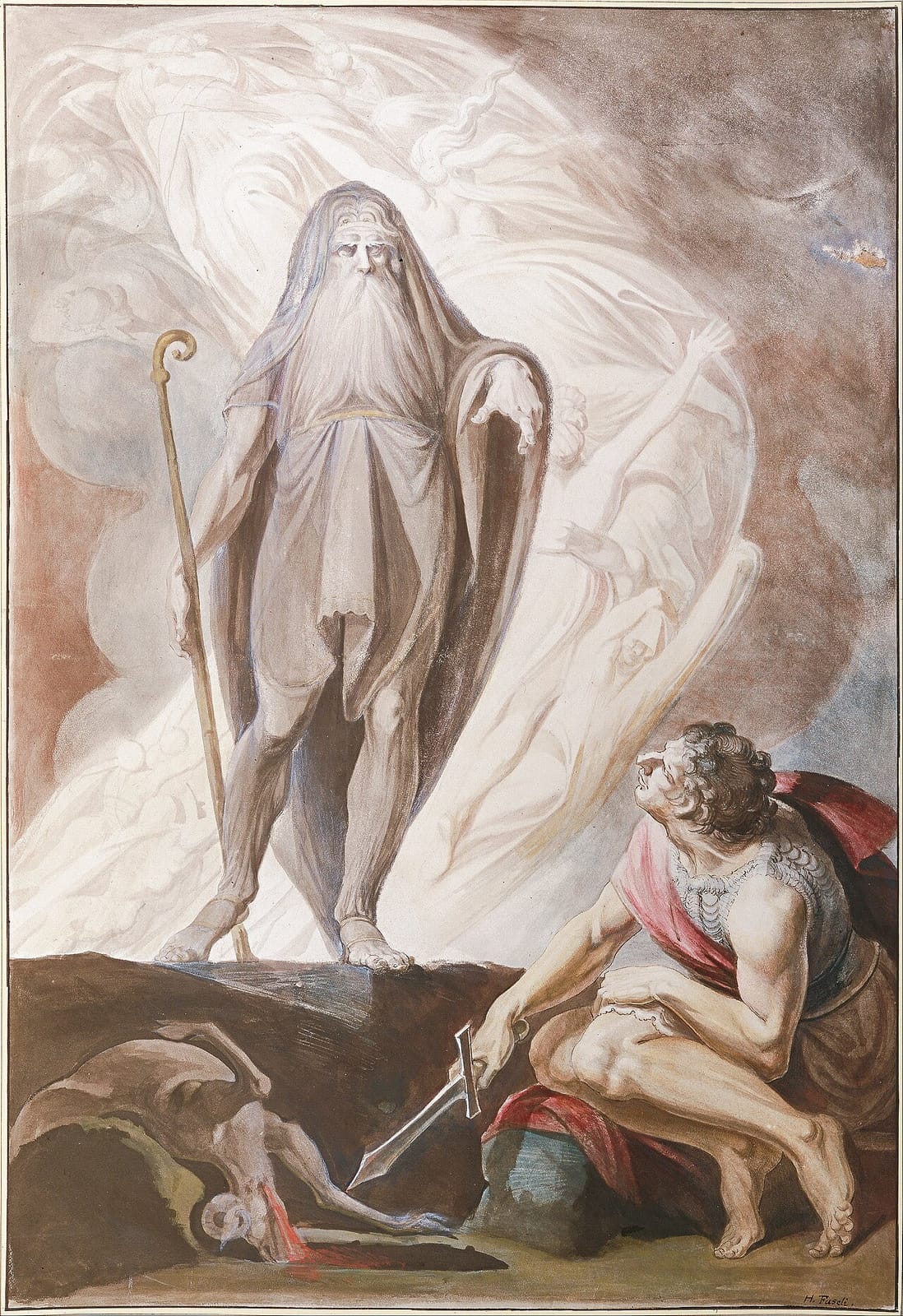
Tiresias Foretells the Future to Odysseus
In the Underworld (Book 11), Odysseus fills a pit with the blood of sacrificed sheep, which the ghosts must drink before they can speak, and holds them back with his sword until the prophet Tiresias comes. Fuseli makes the seer a towering, veiled figure in a blaze of pale light, and the hero a crouching mortal at his feet.
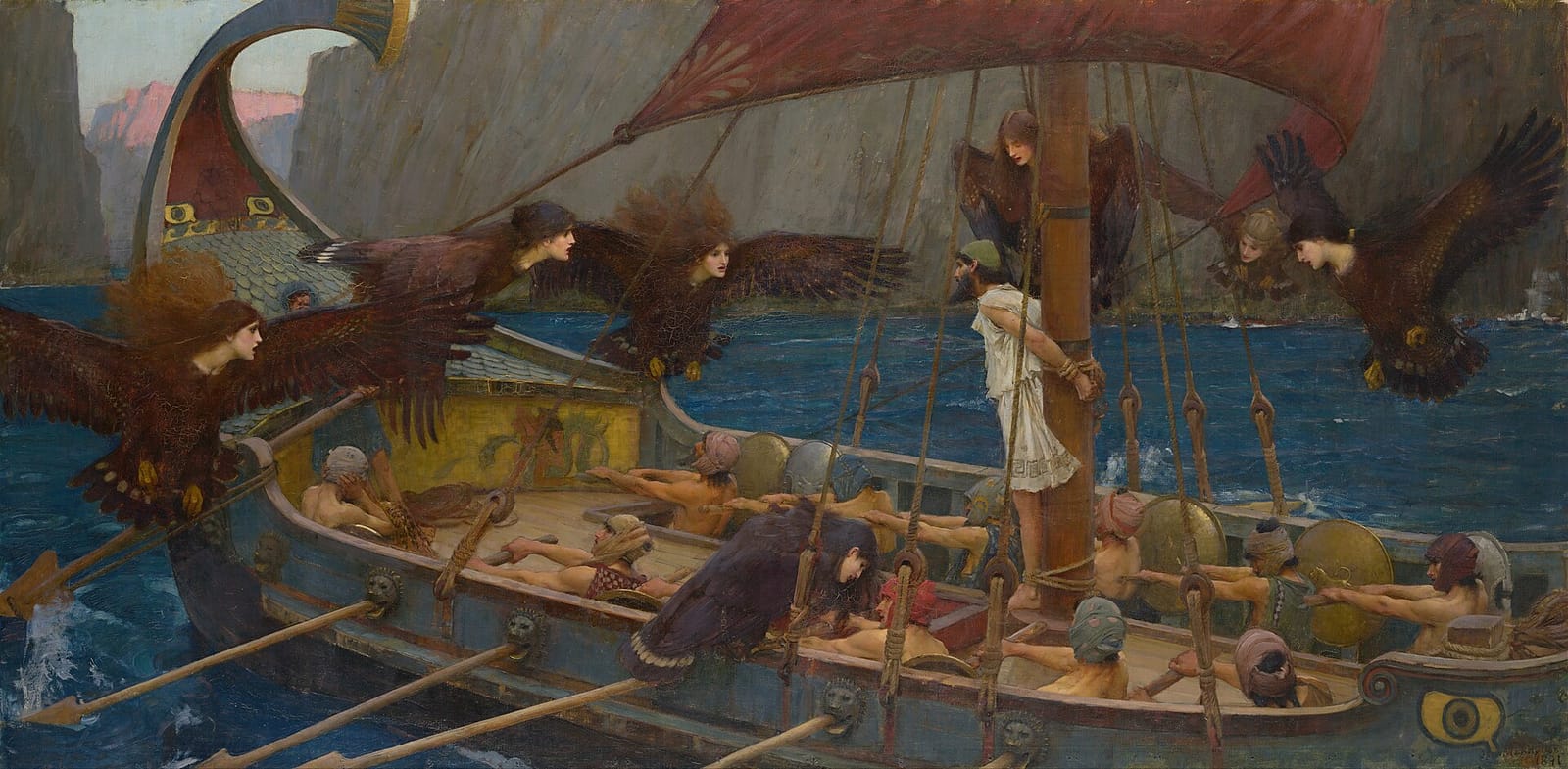
Ulysses and the Sirens
Homer never says what the Sirens look like. Waterhouse follows Greek vase painters, who showed them as birds with women's heads, circling the ship and perching on its rail. Odysseus is lashed to the mast, eyes open, while his crew row on with their ears stopped with wax, one of them glancing up in fear (Book 12).
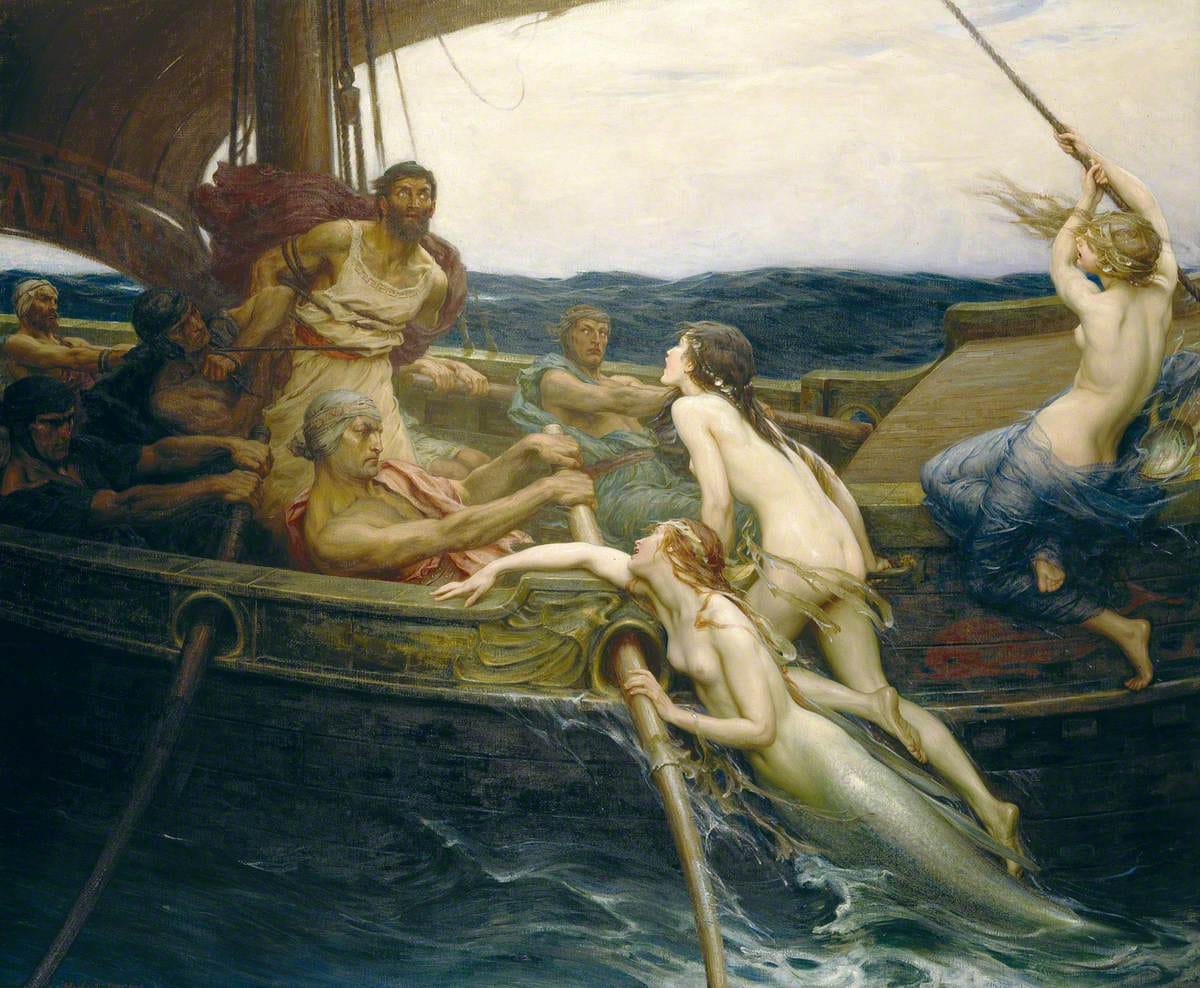
Ulysses and the Sirens
Eighteen years after Waterhouse, Draper's Sirens are not birds but the sea-maidens of Victorian imagination: they climb aboard over the side, one with a fish's tail, while Odysseus strains against the ropes and the oarsmen pull on. Set beside Waterhouse's, it shows how much of the Siren we picture comes from later painters, not from Homer.
Odysseus between Scylla and Charybdis
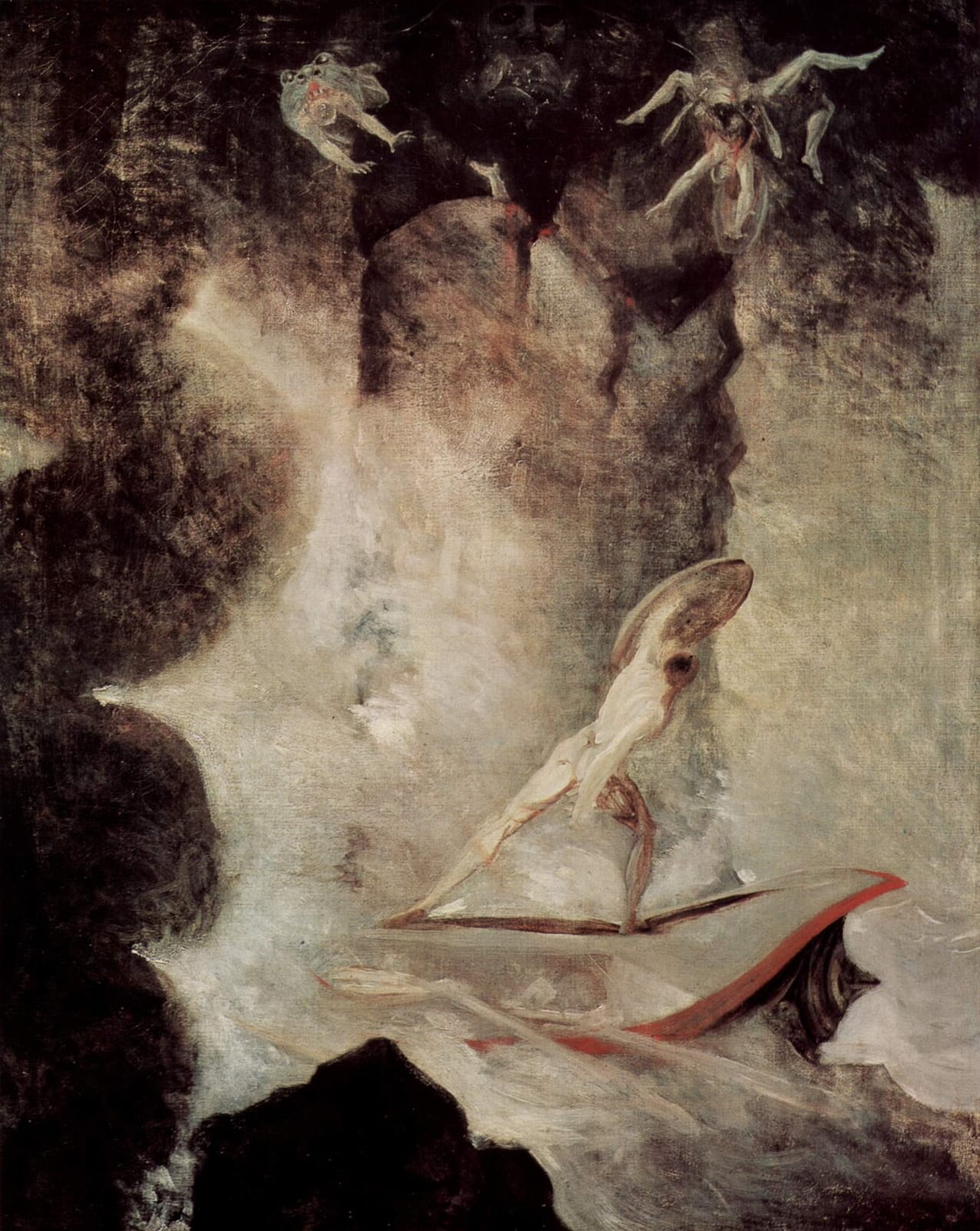
Circe warned Odysseus that he must sail between Scylla, a six-headed monster in a cliff-side cave, and Charybdis, the whirlpool, and lose six men rather than the whole ship. Fuseli, the painter of nightmares, reduces the hero to a small pale figure on the prow, dwarfed by the rock and the churning water, while his men are snatched into the air above (Book 12).
The homecoming Books 13–24
Back on Ithaca in disguise: the dog who knows him, the slaughter in the hall, and the long night with Penelope.
Ulysses and Argus
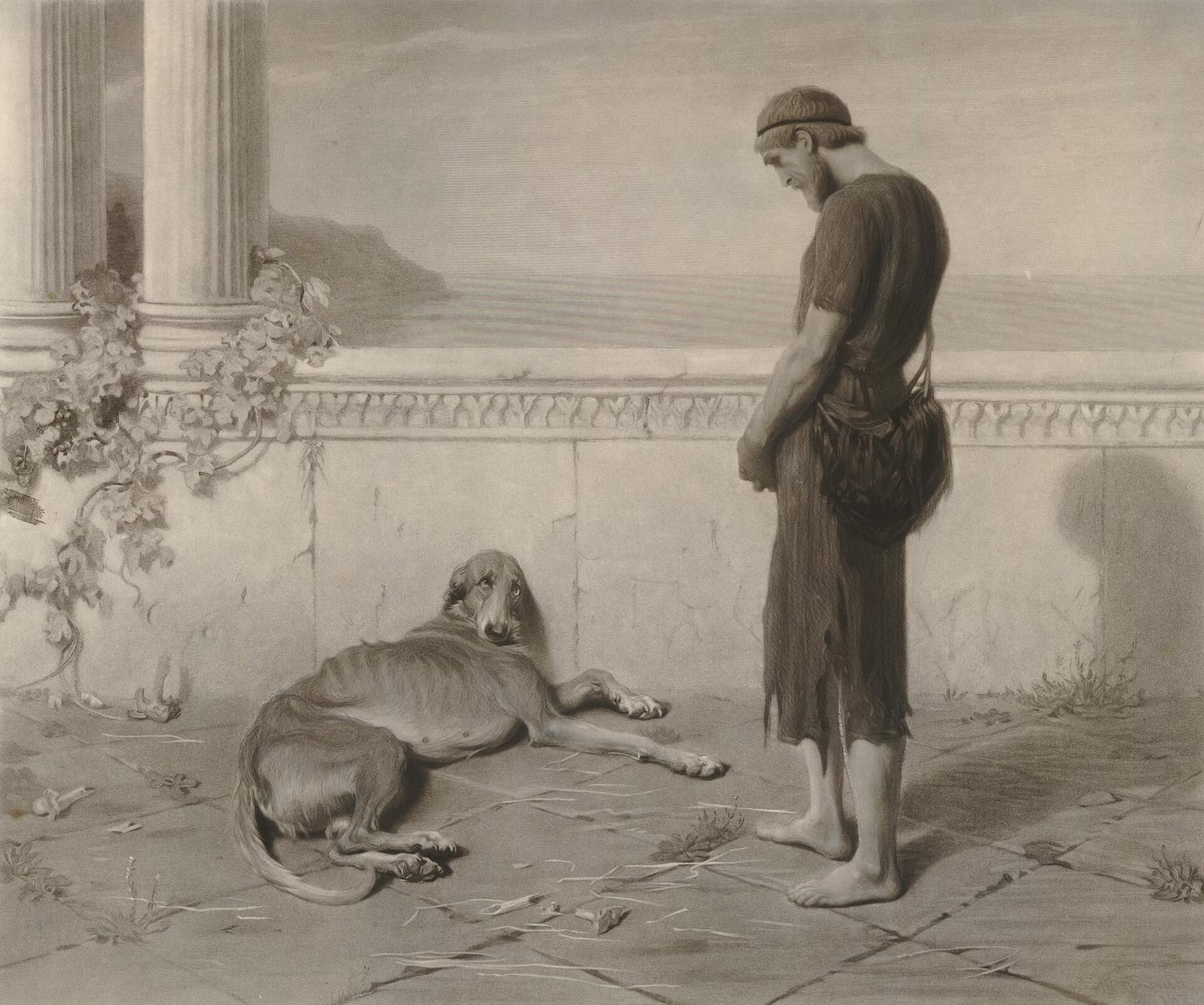
Home in disguise after twenty years, Odysseus passes his old hunting dog lying neglected by the doors. Argus knows him at once, but can only drop his ears and wag his tail (Book 17). Rivière, the great Victorian painter of dogs, shows the beggar looking down in silence, unable to greet him without giving himself away.
The Suitors
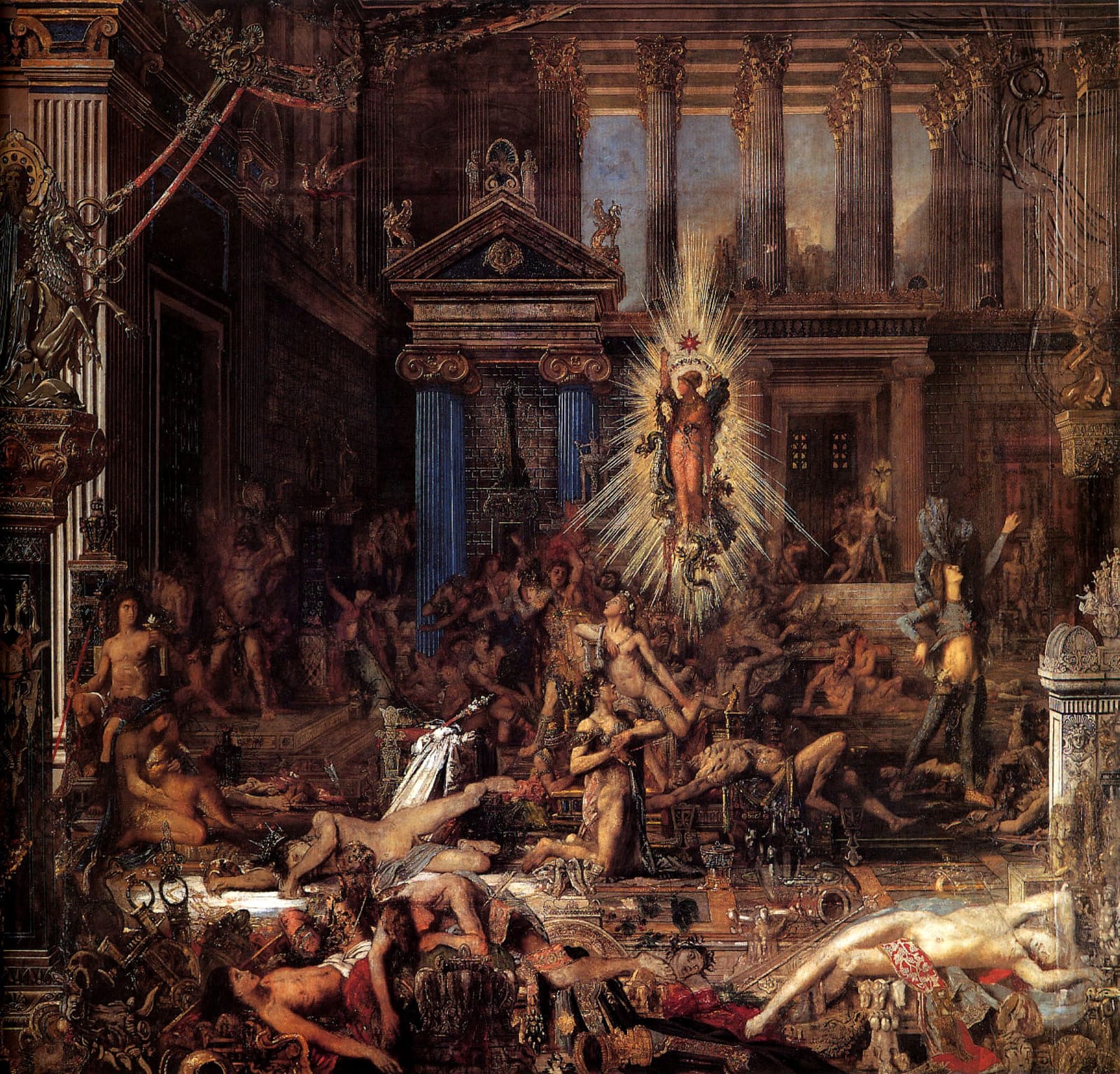
The slaughter of the suitors as a nightmare of luxury: bodies sprawl across a gilded hall while Athena appears above them in a blaze of light. Moreau worked on this huge canvas, nearly four metres high, for more than thirty years and never finished it. Critics have long noticed that the painting's sympathy seems to lie with the dying young men.
Ulysses and Penelope
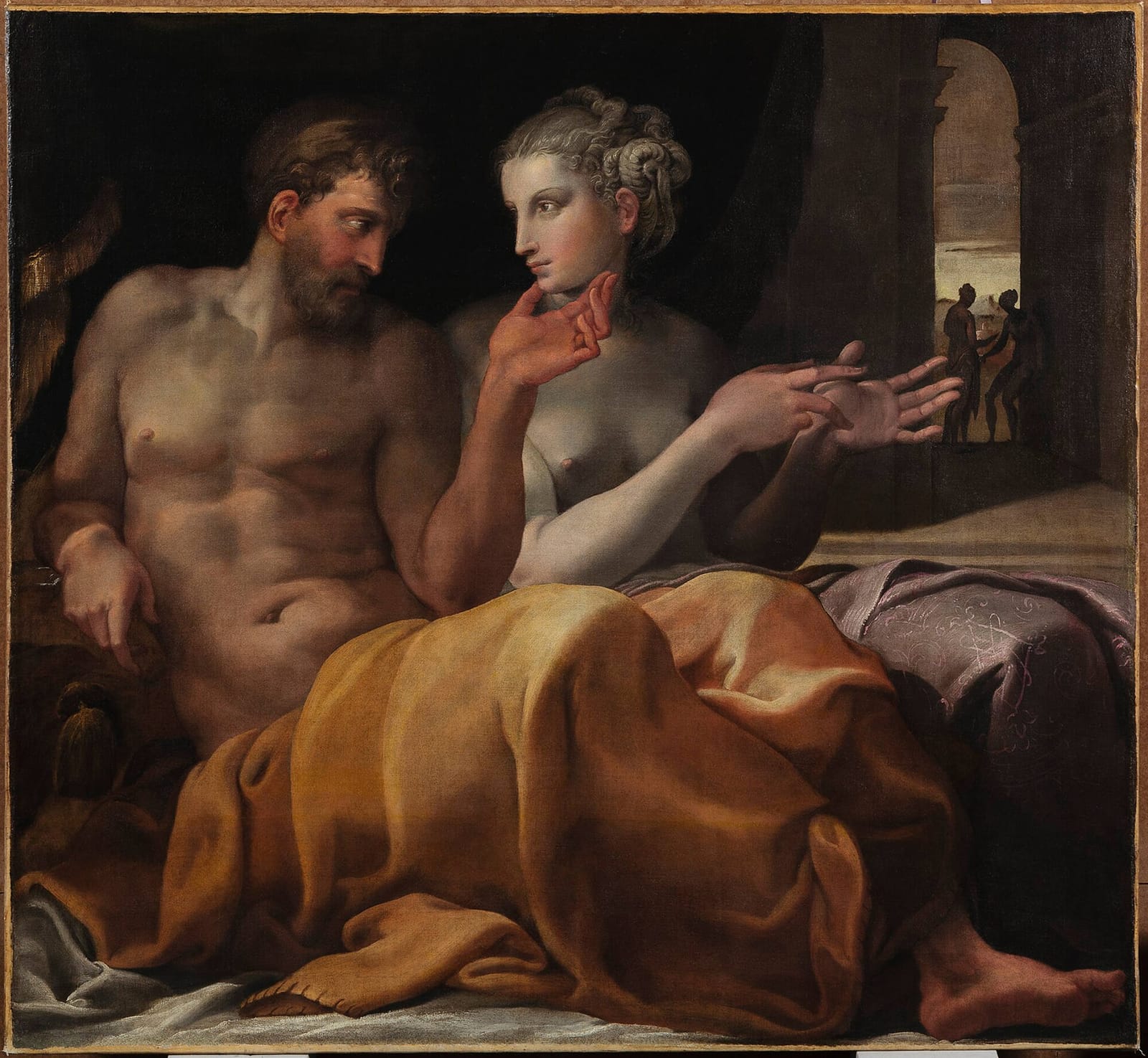
After twenty years apart, Odysseus and Penelope talk through the night, and Athena holds back the dawn to give them time (Book 23). Primaticcio, who designed the Gallery of Ulysses at Fontainebleau, shows the couple in bed: he touches her chin, and her hand is raised in the middle of a story. It is a painting of the ending about conversation, not killing.
About these images
Every work here is in the public domain: each artist died more than seventy years ago. The images come from Wikimedia Commons, mostly from the holding museums' own photographs; follow a credit below for the source. Click any painting to open it full size.
- Joseph Wright of Derby, Penelope Unravelling Her Web, 1783–84. J. Paul Getty Museum, Los Angeles. Source
- Pinturicchio, Penelope with the Suitors, about 1509. National Gallery, London. Source
- John William Waterhouse, Penelope and the Suitors, 1912. Aberdeen Art Gallery. Source
- Arnold Böcklin, Odysseus and Calypso, 1882. Kunstmuseum Basel. Source
- Gerard de Lairesse, Mercury Orders Calypso to Release Odysseus, about 1680. Rijksmuseum, Amsterdam. Source
- after John Flaxman, Nausicaa and Her Maids at Play, designed 1793. engraving from Flaxman's illustrations to the Odyssey. Source
- Pieter Lastman, Odysseus and Nausicaa, 1619. Alte Pinakothek, Munich. Source
- Francesco Hayez, Ulysses at the Court of Alcinous, 1814–15. Museo di Capodimonte, Naples. Source
- Jacob Jordaens, Odysseus in the Cave of Polyphemus, 1630–35. Pushkin Museum, Moscow. Source
- J. M. W. Turner, Ulysses Deriding Polyphemus, 1829. National Gallery, London. Source
- Theodoor van Thulden, Odysseus's Companions Open the Bag of Winds, 1631–33. Rijksmuseum, Amsterdam. Source
- Briton Rivière, Circe and the Friends of Ulysses, 1871. private collection. Source
- John William Waterhouse, Circe Offering the Cup to Ulysses, 1891. Gallery Oldham. Source
- Henry Fuseli, Tiresias Foretells the Future to Odysseus, 1780–85. Albertina, Vienna. Source
- John William Waterhouse, Ulysses and the Sirens, 1891. National Gallery of Victoria, Melbourne. Source
- Herbert James Draper, Ulysses and the Sirens, 1909. Ferens Art Gallery, Hull. Source
- Henry Fuseli, Odysseus between Scylla and Charybdis, 1794–96. Aargauer Kunsthaus, Aarau. Source
- Frederick Stacpoole, after Briton Rivière, Ulysses and Argus, engraving 1885, after the painting of 1875. British Museum (this impression). Source
- Gustave Moreau, The Suitors, about 1852–1885, unfinished. Musée Gustave Moreau, Paris. Source
- Francesco Primaticcio, Ulysses and Penelope, about 1560. Toledo Museum of Art, Ohio. Source


For the story behind each scene, see the book-by-book synopsis, the journey map and the character guide.
Ready for the poem itself? See which Odyssey translation is best for you, or browse our translation guides.