2666: What It's About & Best Translation
Bolaño's posthumous masterpiece — and the indispensable Wimmer translation
As an Amazon Associate, we earn from qualifying purchases.
2666 is a sprawling novel that intertwines the lives of four literary scholars, a Chilean professor, a sports journalist, and a mysterious German author, all set against the backdrop of a series of unsolved murders in a Mexican border town. The novel explores themes of violence, the nature of evil, and the interconnectedness of human experiences.
Translation Comparison at a Glance
| Translation | Readability | Accuracy | Tone | Best For |
|---|---|---|---|---|
| Wimmer (2008) | High | Excellent | Precise, register-sensitive | Definitive reading |
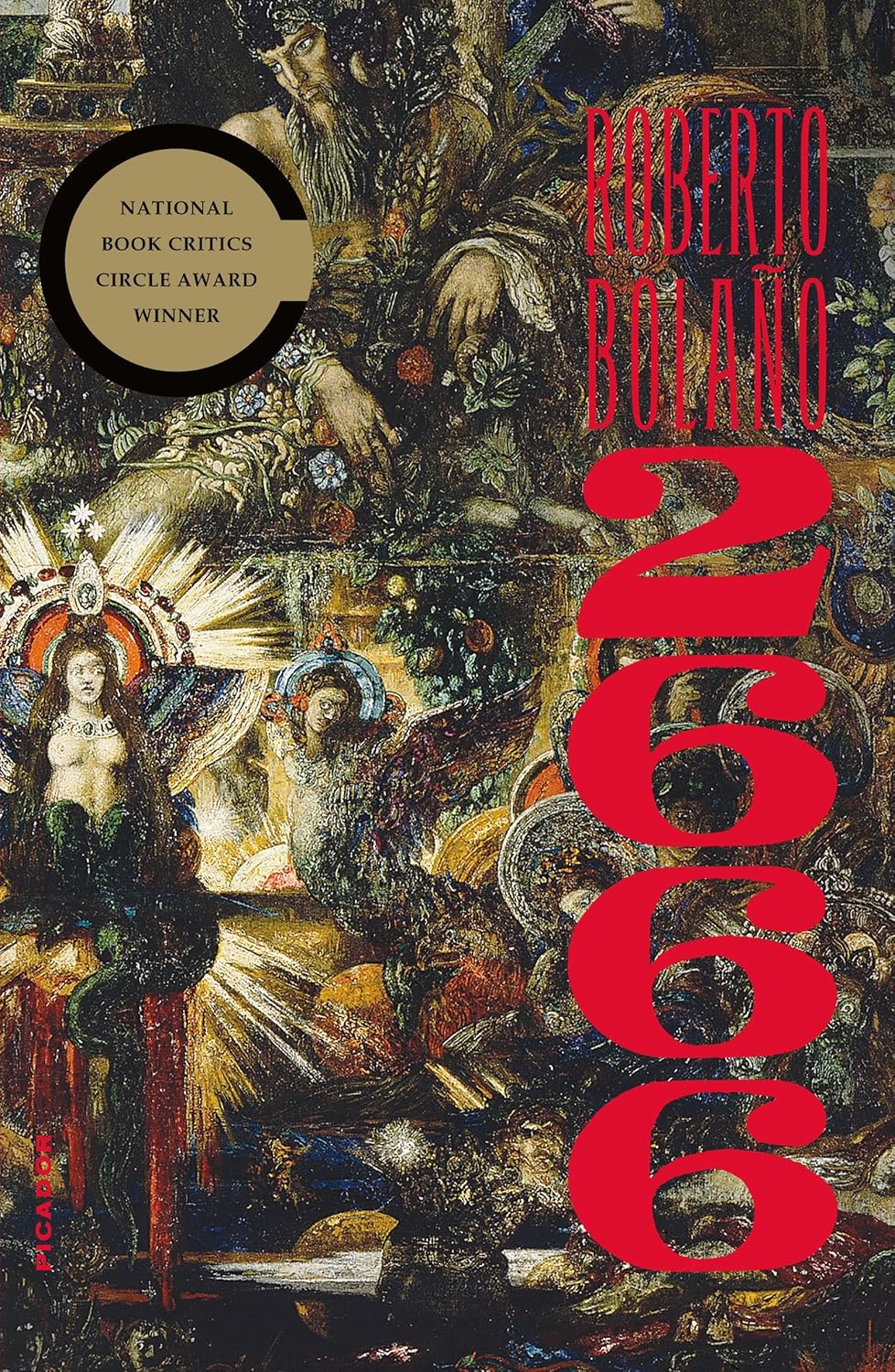
#1 — 2666 — trans. Natasha Wimmer (FSG / Picador, 2008)
- Readability: High — preserves Bolaño's movement between lyrical, journalistic and philosophical registers.
- Accuracy: Excellent — faithful to the original's range and the flat documentary style of the crimes section.
- Tone: Precise and register-sensitive, never imposing a single voice.
- Accessibility: Excellent for serious readers; the only English edition available.
Which translation is right for you?
- Choose Wimmer if you want the definitive English text of Bolaño's masterpiece, rendered with fidelity to its shifting registers and documentary power.
About the Translator
Natasha Wimmer (b. 1972, 2008, FSG / Picador): American translator; she had already translated Bolaño's The Savage Detectives (2007) — the novel that first introduced English-language readers to Bolaño's scope and earned him a devoted international readership — before undertaking 2666. Her experience with the earlier novel gave her a deep familiarity with Bolaño's movement between registers: the lyrical, the journalistic, the philosophical, and the grimly documentary. Her translation of 2666 was recognised as a major achievement in its own right, one of the outstanding works of literary translation of the 2000s. She is also the translator of Bolaño's essays and of several other works from Latin American literature.
Themes
Literature and violence in adjacent worlds. The novel's architecture is designed to make a point: four literary scholars pursue a celebrated German author with passionate intellectual devotion while, in the same Mexican border city, hundreds of women are being murdered and no one in any position of authority is looking. The relationship between high culture and organised violence — between the world of literary prizes and critical essays and the world of serial feminicide — is the novel's deepest subject. Bolaño does not moralise about this relationship; he simply places the two worlds in the same geography and lets the reader feel the obscenity of their proximity.
The "enormous black hole" at the novel's centre. Bolaño described his novel as organised around an enormous black hole to which all five parts are drawn. That black hole is "The Part About the Crimes," the fourth section — nearly three hundred pages of documentary-style chronicle of the murders of women in and around Santa Teresa. The section's method — the same forensic phrase patterns repeating as each new victim is described — creates an effect of horror that accumulates without catharsis. The other four parts orbit this centre, approaching and receding from it, each arriving by a different path.
The Second World War and the persistence of atrocity. "The Part About Archimboldi," the novel's fifth and final section, reveals that the German author the critics have been seeking was a soldier on the Eastern Front and witnessed the full horror of the war's atrocities. Bolaño presents Nazi violence and the feminicides of Santa Teresa as connected manifestations of the same human capacity for systematic murder — a connection that the novel refuses to make explicit but which gives its architecture its moral weight.
Key Characters
The four critics — Jean-Claude Pelletier (French), Manuel Espinoza (Spanish), Piero Morini (Italian), and Liz Norton (English): four scholars whose lives have been shaped by devotion to the work of Benno von Archimboldi. Their professional relationships, romantic entanglements, and collective pursuit of the elusive author constitute the novel's most conventionally novelistic section — and are revealed, by the novel's architecture, to be a kind of elaborate distraction from what is happening in the world they enter.
Oscar Amalfitano — a Chilean philosophy professor in Santa Teresa; in "The Part About Amalfitano," he begins to hear voices and hangs a geometry textbook on his clothesline, in the manner of Marcel Duchamp. His section is the novel's most formally surreal, and his gradual dissolution is presented with both sympathy and dark comedy.
Oscar Fate — an African-American sports journalist from New York who arrives in Santa Teresa to cover a boxing match and cannot avoid learning about the murders. His outsider's perspective gives "The Part About Fate" its particular quality: an American trying to understand a violence that is both utterly foreign and uncomfortably recognisable.
Hans Reiter / Benno von Archimboldi — the German author the scholars seek; in "The Part About Archimboldi," his life is revealed: a rural North German childhood, service on the Eastern Front, a chance encounter with a Jewish writer's hidden manuscripts, and a post-war existence in which he became one of the great writers of the century while remaining entirely invisible to the world that celebrated his work.
Recommended Sources
For further academic reading on Bolaño and 2666:
- Latin American Literary Review (Pittsburgh) — the primary English-language journal for Latin American literature; essential for Bolaño in the context of the Latin American literary tradition he simultaneously inherited and rejected.
- Hispanic Review (University of Pennsylvania) — the leading American journal for Spanish and Latin American literary studies; key venue for scholarship on 2666's formal structure and political dimensions.
- Comparative Literature (Duke University Press) — essential for reading 2666 in relation to the world literary tradition — Sebald, Mann, Borges — that Bolaño explicitly engages.
There is only one English translation of 2666. Natasha Wimmer's FSG / Picador edition is the translation through which the novel became one of the defining works of twenty-first century fiction in English, and there is no competing version. It is one of the outstanding works of literary translation of recent decades.
Frequently Asked Questions
What is 2666 about?
2666 is a sprawling novel that intertwines the lives of four literary scholars, a Chilean professor, a sports journalist, and a mysterious German author, all set against the backdrop of a series of unsolved murders in a Mexican border town. The novel explores themes of violence, the nature of evil, and the interconnectedness of human experiences.
Is 2666 hard to read?
2666 can be challenging due to its complex narrative structure and shifting perspectives. Natasha Wimmer's translation captures the novel's varying tones, making it accessible yet demanding for readers.
Which 2666 translation is best?
Natasha Wimmer's 2008 translation is the only English edition and is universally recognised as a major translation achievement.
Wimmer — the only choice?
Yes. No competing English translation exists; Wimmer's version, published simultaneously by FSG and Picador, has been accepted as definitive.
Which translation is easiest to read?
Wimmer's rendering balances Bolaño's shifting registers while preserving the flat, documentary tone of the crimes section.
Which translation is most accurate?
Wimmer's translation is the only one available in English and has been praised for its fidelity to Bolaño's range of styles.
How does Wimmer handle the notorious "Part About the Crimes"?
She maintains the repetitive, forensic phrasing that creates the section's accumulating horror without aestheticising the violence.
This guide is based on reading the translation and reviewing scholarly commentary. Last reviewed: June 2026.
As an Amazon Associate, I earn from qualifying purchases.
Looking for another classic? Browse all our translation guides →
Exploring more Latin American fiction? Our One Hundred Years of Solitude translation guide examines Gregory Rabassa's definitive version.
For another García Márquez masterpiece, see our Love in the Time of Cholera translation guide on Edith Grossman's edition.
Readers of Mexican border narratives may want our Pedro Páramo translation guide comparing Peden and Weatherford.
Bolaño's literary lineage runs through Borges — our Borges in English guide compares Collected Fictions and Labyrinths.