The Adolescent: What It's About & Best Translation
Dostoevsky's most overlooked major novel
As an Amazon Associate, we earn from qualifying purchases.
The Adolescent follows Arkady Dolgoruky, a 19-year-old illegitimate son of a nobleman, as he navigates his ambitions and complex family dynamics in 1870s Russia. The novel explores themes of identity, power, and the search for belonging.
Translation Comparison at a Glance
| Translation | Readability | Accuracy | Tone | Best For |
|---|---|---|---|---|
| Pevear & Volokhonsky (2003) | High | Excellent | Breathless, diary-like | First-time readers, modern voice |
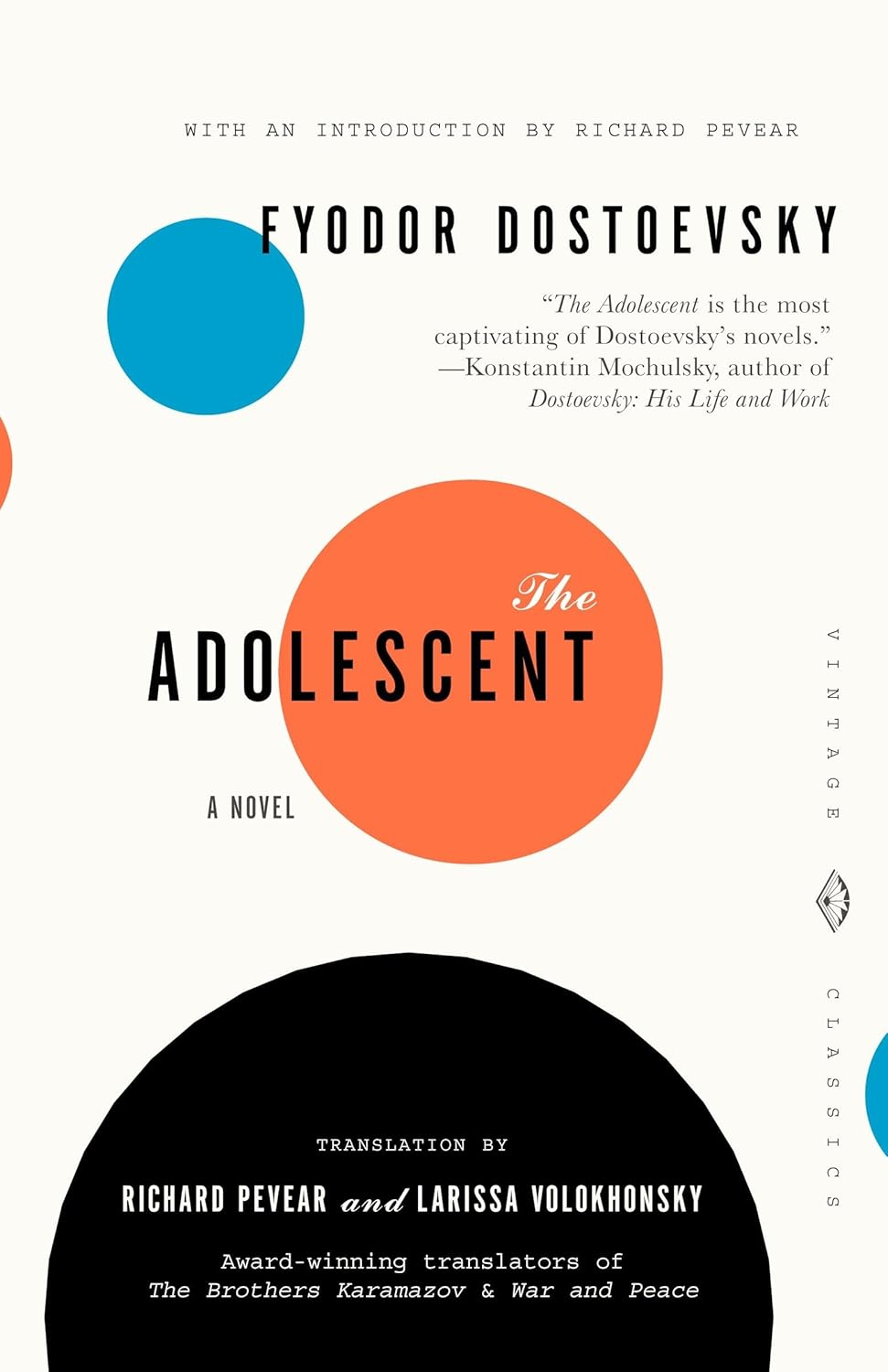
#1 — The Adolescent — trans. Richard Pevear & Larissa Volokhonsky (2003)
- Readability: Modern English that preserves the urgent, over-heated voice without dated phrasing.
- Accuracy: Excellent fidelity to Arkady's self-justifying narration and philosophical weight.
- Tone: Breathless diary-entry quality with intense dialogue scenes.
- Accessibility: Most accessible introduction for contemporary readers.
Which translation is right for you?
- Choose Pevear & Volokhonsky if you want the most widely available modern translation that captures Arkady's breathless self-justification and the novel's philosophical intensity.
About the Translators
Richard Pevear & Larissa Volokhonsky published their Adolescent in 2003, completing their translations of all five of Dostoevsky's major novels. The translation brought renewed critical attention to a novel largely neglected in English since Garnett's version and is now the clear standard. Their characteristic method — preserving the breathless, diary-entry quality of Arkady's first-person narration — suits this novel particularly well.
Constance Garnett (1861–1946) published her translation in 1916 as A Raw Youth — a title that has contributed to the novel's relative neglect in English, since it accurately describes Arkady but suggests a simpler bildungsroman rather than the stranger, more philosophically charged novel Dostoevsky actually wrote. Her version remains in print in various low-cost digital and print editions as an out-of-copyright text; it reads with Victorian fluency but shows its age in handling Dostoevsky's more eccentric passages.
Themes
Arkady's obsession with becoming a Rothschild — accumulating money not to spend it but as a form of secret, inviolable power — is the novel's central conceit and its satirical target. Dostoevsky is partly mocking the materialism spreading through Russian youth in the 1870s and partly sympathetic: the dream of wealth as protection is also a dream of becoming invulnerable to humiliation. For a young man who is illegitimate, without a recognized father, and without social footing, the fantasy is comprehensible. The novel tracks what happens when reality collides with it.
The father question runs beneath everything. Arkady is the illegitimate son of Versilov, who has never properly acknowledged him — a man of genuine brilliance and fundamental irresponsibility. Arkady's complex relationship with him — admiration, resentment, desperate need for recognition — drives the narrative as powerfully as any external plot. The Adolescent is, among its other concerns, a novel about what it does to a person to grow up wanting approval from someone constitutionally incapable of giving it.
The novel is set during the rapid industrialization of 1870s Russia, when old social structures were dissolving faster than new ones could form. Dostoevsky positions Arkady at the intersection of several Russias: the old Orthodox Russia (Makar, the wandering pilgrim), the Westernized intellectual Russia (Versilov), and the new commercial Russia (the Rothschild dream). That Arkady belongs fully to none of them — a product of all of them and heir to none — is the novel's structural argument about a generation without inheritance.
Key Characters
Arkady Dolgoruky — The narrator, nineteen years old, illegitimate son of Versilov. His narration is retrospective — he is writing months after events, trying to understand what happened — which gives the novel a distinctive quality of self-examination that is still incomplete. He is wrong about many things, and he knows it, and he cannot always say yet how. One of Dostoevsky's most intimate first-person voices.
Andrei Versilov — Arkady's father: a wandering nobleman of extraordinary intelligence and fundamental unreliability. His ideas about Russia, about the West, about the Russian people as potential mediators between European civilization and something older — are among the most interesting in the novel. His inability to live up to them is its central dramatic problem.
Makar Dolgoruky — Arkady's nominal father, the peasant legally married to Arkady's mother, now a wandering pilgrim of simple and genuine holiness. He represents the Orthodox Russia that Dostoevsky believed still existed beneath the Westernized surface, and his scenes with Arkady are the novel's most unexpectedly moving passages.
Sofya Andreyevna — Arkady's mother, Versilov's companion. Long-suffering and devoted to both Versilov and Makar simultaneously, in a domestic arrangement that is never quite explicable but entirely convincing. Her quiet endurance is the moral center the novel orbits without ever quite naming.
Recommended Sources
Slavic and East European Journal — The flagship peer-reviewed publication of the American Association of Teachers of Slavic and East European Languages (AATSEEL). Regularly publishes translation criticism and Dostoevsky scholarship. Available through JSTOR.
Slavic Review — Published by Cambridge University Press on behalf of the Association for Slavic, East European, and Eurasian Studies. One of the two leading English-language journals in Russian literary and cultural studies, with extensive coverage of Dostoevsky and translation reception.
Dostoevsky Studies — The journal of the International Dostoevsky Society, published annually and dedicated entirely to Dostoevsky scholarship across all major languages. The most specialized peer-reviewed venue for close work on Dostoevsky's texts and translation history.
Which translation is right for you?
For almost all readers, Pevear and Volokhonsky is the answer — it is the most widely available modern translation in print, and it is very good. Garnett's A Raw Youth (1916) is the only widely available alternative, and while it can be found in low-cost digital editions, its dated English and misleading title make it a poor first choice. Read P&V; return to Garnett only if you're curious about how an earlier century received this novel, or want to compare a specific passage.
Frequently Asked Questions
What is The Adolescent about?
The Adolescent follows Arkady Dolgoruky, a 19-year-old illegitimate son of a nobleman, as he navigates his ambitions and complex family dynamics in 1870s Russia. The novel explores themes of identity, power, and the search for belonging.
Is The Adolescent hard to read?
The Adolescent can be challenging due to its philosophical depth and complex characters. Pevear and Volokhonsky's translation is recommended for its modern readability and faithful capture of Dostoevsky's style.
Which The Adolescent translation is best?
Pevear and Volokhonsky's 2003 Vintage Classics translation is the clear choice — it is the most widely available modern translation in print, and it is very good.
Pevear & Volokhonsky vs Garnett — which should I choose?
Pevear and Volokhonsky capture Arkady's breathless self-justification and the diary-entry quality of the prose with genuine intensity, especially in the dialogue between Arkady and Versilov. Garnett's version reads with Victorian fluency but shows its age.
Which translation is easiest to read?
Pevear and Volokhonsky's modern English is the most accessible, preserving the urgent, over-heated voice without dated Victorian phrasing.
Which translation is most accurate?
Pevear and Volokhonsky's translation is the most accurate to Dostoevsky's distinctive first-person narration and the novel's philosophical weight.
Why has The Adolescent been neglected in English compared to Dostoevsky's other major novels?
Constance Garnett's 1916 title A Raw Youth contributed to its relative neglect by suggesting a simpler bildungsroman rather than the stranger, more philosophically charged novel Dostoevsky wrote.
This guide is based on reading the translation(s) and reviewing scholarly commentary. Last reviewed: June 2026.
As an Amazon Associate, I earn from qualifying purchases.
Looking for another classic? Browse all our translation guides →
If you're exploring Dostoevsky, see our guide to the best Brothers Karamazov translation.
Our Crime and Punishment translation guide compares Pevear & Volokhonsky against Ready and McDuff.
For another major novel, read our comparison of the best Idiot translations.
Also consider our guide to the best Demons translation by Pevear & Volokhonsky.