The Bhagavad Gita: What It's About & Best Translation
Three translations for three kinds of reader — the meditator, the scholar, and the poet
As an Amazon Associate, we earn from qualifying purchases.
The Bhagavad Gita is a dialogue between Prince Arjuna and the god Krishna, who serves as his charioteer. Set on the battlefield of Kurukshetra, it addresses the moral and philosophical dilemmas faced by Arjuna as he prepares to go into battle, exploring themes of duty, righteousness, and devotion.
Translation Comparison at a Glance
| Translation | Readability | Accuracy | Tone | Best For |
|---|---|---|---|---|
| Easwaran (1985) | High | Very good | Devotional, accessible | Meditation and practice |
| Miller (1986) | Moderate | Excellent | Scholarly, precise | University courses |
| Mitchell (2000) | Very high | Good | Lyrical, direct | Poetry readers |
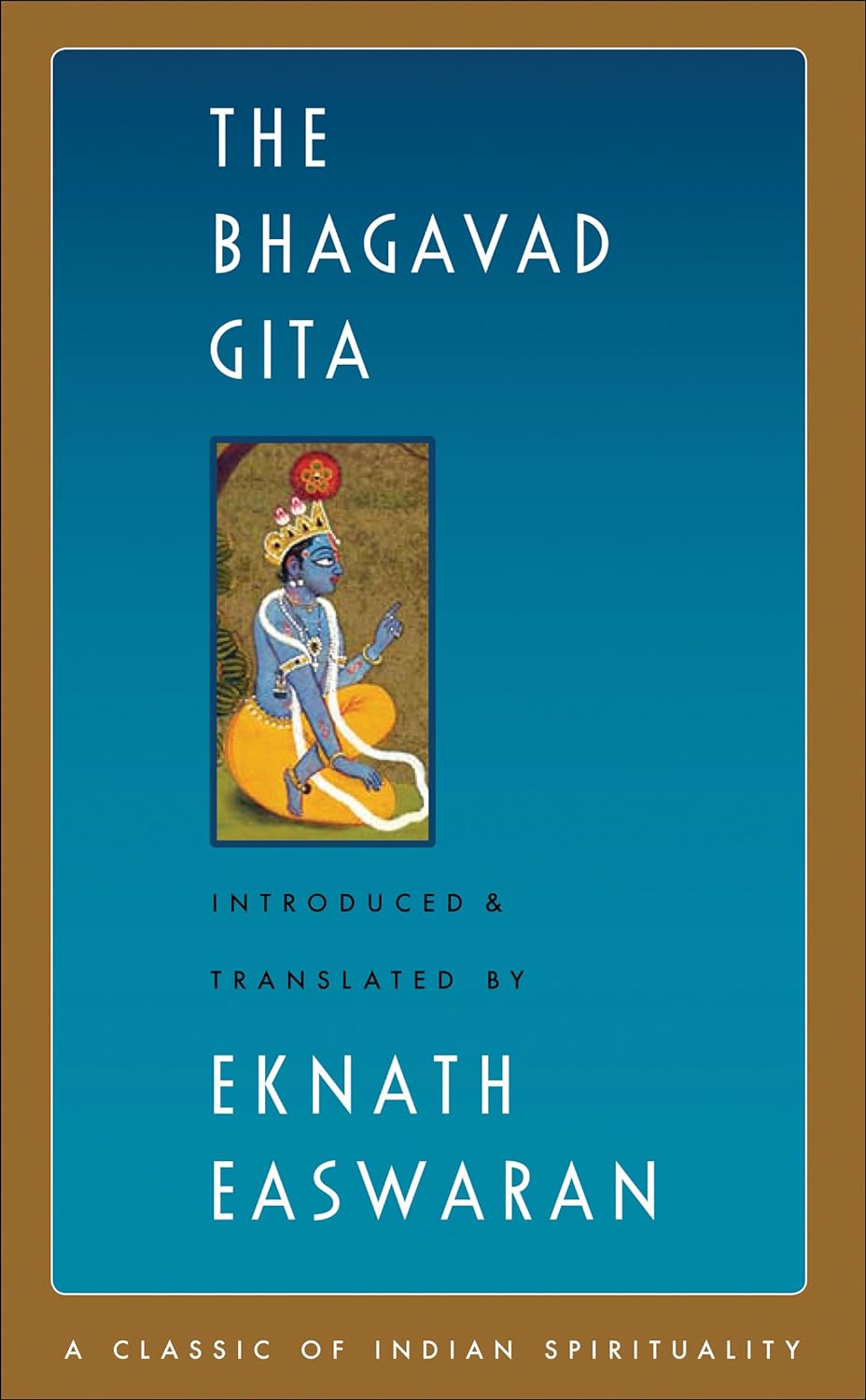
#1 — The Bhagavad Gita — trans. Eknath Easwaran (1985)
- Readability: Readable and dignified without being overly literal.
- Accuracy: Captures devotional register while explaining terms.
- Tone: Spiritual and practical, aimed at living practice.
- Accessibility: Excellent for readers new to Hindu philosophy.

Eknath Easwaran's narration brings both scholarly depth and spiritual warmth to his own acclaimed translation, making it the most accessible and authentic audio rendition of the Bhagavad Gita.
Listen on Audible →Which translation is right for you?
- Choose Easwaran if you are approaching the Gita as a spiritual practice and want practical chapter introductions.
- Choose Miller if you want rigorous scholarly framing and precise Sanskrit terminology for university study.
- Choose Mitchell if you are a reader of poetry seeking the most immediately beautiful and accessible English version.
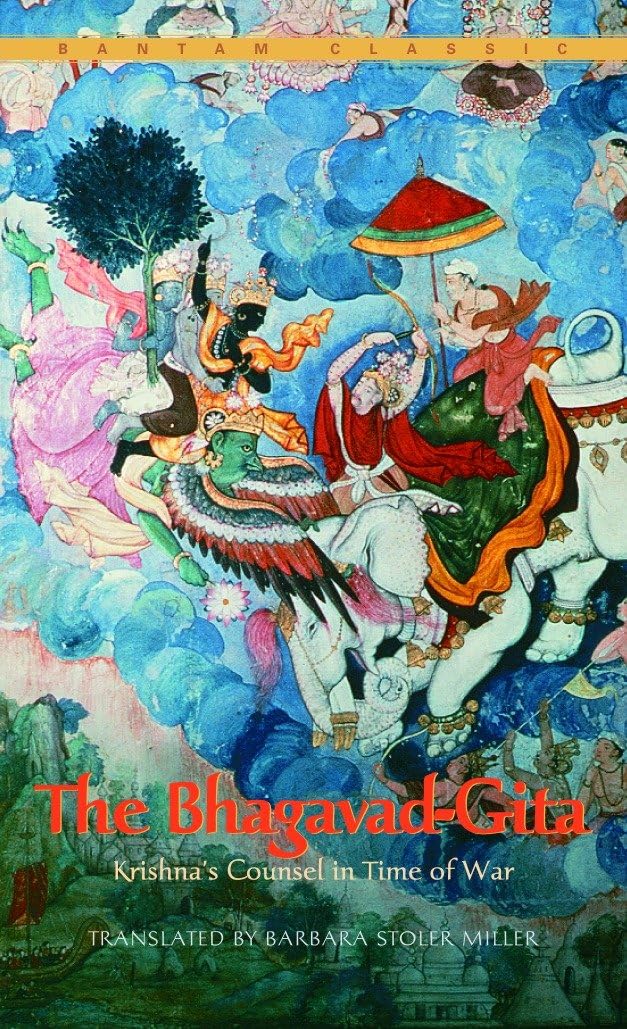
#2 — The Bhagavad-Gita: Krishna's Counsel in Time of War — trans. Barbara Stoler Miller (1986)
- Readability: Readable verse lines preserving metrical feel.
- Accuracy: Precise vocabulary with Sanskrit technical terms identified.
- Tone: Literary-scholarly, focused on epic context.
- Accessibility: Best with some background or for academic use.
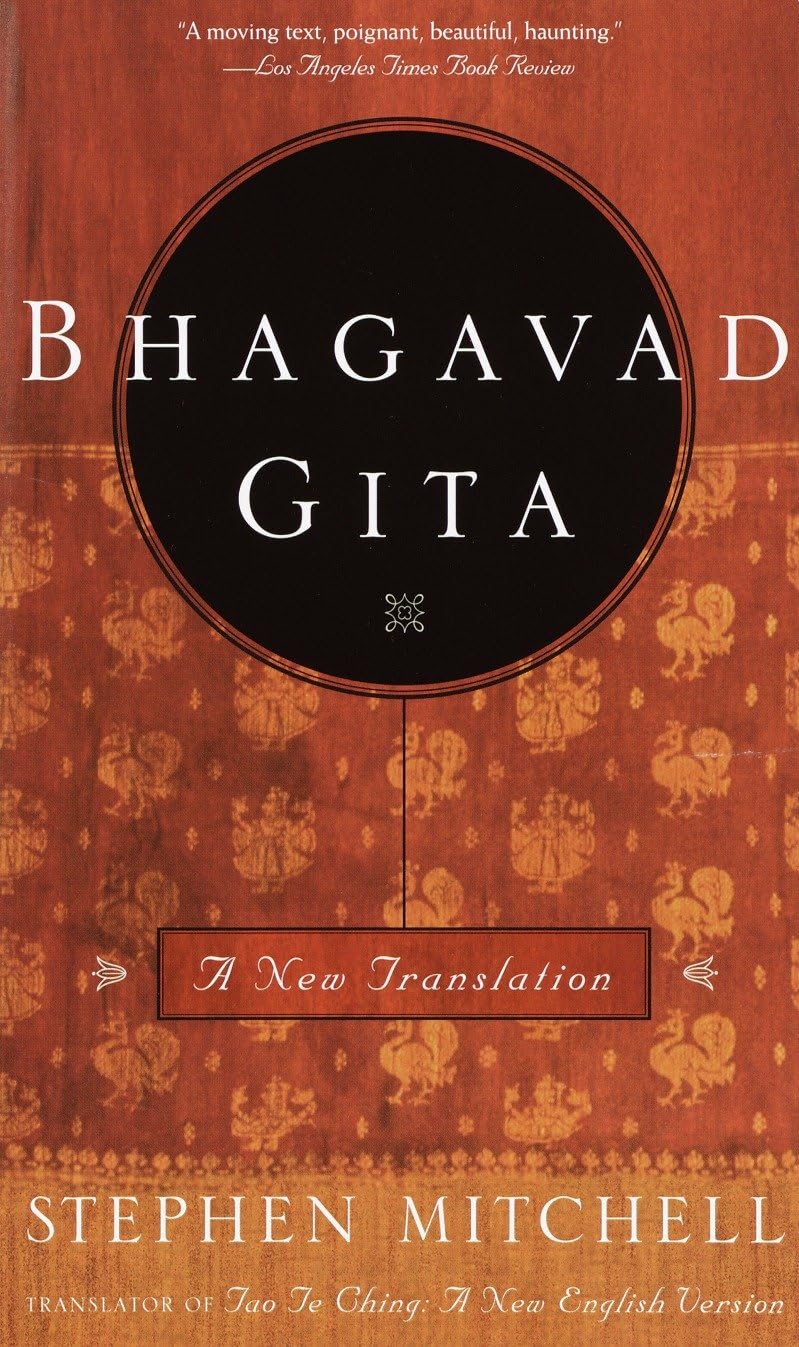
#3 — Bhagavad Gita: A New Translation — trans. Stephen Mitchell (2000)
- Readability: Most immediately accessible free-verse fluency.
- Accuracy: Good overall but occasionally smooths complexity.
- Tone: Lyrical, energetic, devotional intensity.
- Accessibility: Ideal for poetry readers new to the text.
About the Translators
Eknath Easwaran (1910–1999, 1985, Nilgiri Press): Indian spiritual teacher in the Gandhian tradition; founder of the Blue Mountain Center of Meditation in Tomales, California; his other translations for Nilgiri Press include the Upanishads and the Dhammapada. He worked on his Gita throughout his life, producing a revised second edition in 2007 that incorporated refinements developed through decades of teaching. His approach is that of the practitioner rather than the philologist: he explains the text from inside a living practice of meditation, and his chapter introductions are as valuable as the translation itself for readers approaching the text as a guide to life.
Barbara Stoler Miller (1940–1993, 1986, Bantam Classics): Professor of Asian Studies at Barnard College; one of the most distinguished American Sanskrit scholars of her generation; her other translations include Jayadeva's Gita Govinda; she died before completing her planned critical edition of the complete Mahabharata. Her translation was produced with the methods of the literary scholar: attentive to the poem's formal structure, its imagery, and its place in the Sanskrit epic tradition, with a subtitle — "Krishna's Counsel in Time of War" — that emphasises the dramatic situation rather than the text's later history as universal scripture.
Stephen Mitchell (b. 1943, 2000, Harmony Books / Three Rivers Press): American poet and translator; he does not read Sanskrit and worked from existing English versions with the consultation of Sanskrit scholars — an approach he describes openly in his preface. His other translations include the Tao Te Ching, Rilke's Letters to a Young Poet, Homer's Iliad, and the Book of Job. His aim in each case is not philological accuracy but a version that communicates the spiritual power of the original to a contemporary reader.
Themes
Dharma and the crisis of Arjuna. The poem begins in a specific moral emergency: Arjuna, one of the greatest warriors in the world, refuses to fight because he cannot reconcile his duty as a warrior with the devastation that fighting his own kinsmen will cause. The Gita is Krishna's response to this crisis, and the concept of dharma — the duty or right action that is specific to one's nature and station — is central to it. The teaching moves from the immediate question (should Arjuna fight?) to the universal (what is action, what is the self, what is the relationship between the individual and the divine?), establishing the crisis as an archetype of the human situation: the moment when one's duties conflict and no solution is obvious.
The yoga of action and non-attachment. The Gita's central practical teaching is the yoga of action — karma yoga — by which the practitioner acts fully, without attachment to the fruits of action. Arjuna is not asked to withdraw from the world but to engage with it differently: to do what his nature and duty require while surrendering the outcome to Krishna. This is the most practically influential teaching in the text, and the one that Gandhi elaborated most fully in his reading of the Gita as a guide to non-violent political action.
The divine in all things: Krishna's revelation. The climactic chapters of the Gita — particularly Chapter XI, in which Arjuna asks to see Krishna's universal form and is granted a vision of the divine in its totality — expand the poem's scope from the personal and ethical to the cosmological. Krishna is not merely Arjuna's divine advisor; he is the ground of all existence, the one in whom all things arise and return. This revelation — the vision of divinity in everything, including destruction and death — is the poem's metaphysical centre.
Key Characters
Arjuna — the warrior prince of the Pandava clan whose refusal to fight at Kurukshetra initiates the dialogue; devoted to Krishna, capable of extraordinary feats, and constitutionally susceptible to the compassion that temporarily unmans him. He is the poem's questioner, its student, and its human representative: we follow the dialogue through his growing understanding.
Krishna — Arjuna's charioteer and divine advisor; avatar of Vishnu; the teacher whose eighteen-chapter discourse constitutes the entire poem. He is at once an intimate friend and counsellor, a philosophical teacher of extraordinary scope, and a cosmic divine being whose true nature is gradually revealed. The poem's tonal movement — from the intimate conversation of the early chapters to the awe-inspiring revelation of Chapter XI and back to the personal closing — reflects his dual nature.
Dhritarashtra — the blind king to whom Sanjaya narrates the battle; a frame figure who establishes the poem's occasion (the blind king who cannot see the battle but whose sons are fighting in it).
Sanjaya — the narrator with divine sight granted by the sage Vyasa, who reports the entire dialogue to Dhritarashtra; the poem's framing voice, whose role is to transmit rather than interpret what he witnesses.
Recommended Sources
For further academic reading on the Bhagavad Gita:
- Philosophy East and West (University of Hawaii Press) — the primary English-language journal for comparative philosophy; essential for the Gita's philosophical tradition and its relationship to Western thought.
- Journal of the American Academy of Religion (Oxford University Press) — the leading journal for the academic study of religion; key for the Gita's place in Hindu religious thought and its modern interpretations.
- Journal of Hindu Studies (Oxford University Press) — the primary specialist journal; essential for Sanskrit-language scholarship, textual history, and the commentary tradition from Shankara to Gandhi.
Which translation is right for you?
Choose Easwaran (Nilgiri Press) if you are approaching the Gita as a spiritual practice — his chapter introductions are the most practically useful in any edition, his devotional register is appropriate to the text's character, and his is the translation most beloved in meditation and yoga communities. Choose Miller (Bantam Classics) for university or scholarly reading — her Sanskrit precision, verse translation, and literary-historical framing make it the recommended academic edition. Choose Mitchell (Harmony Books) if you are a reader of poetry and want the most immediately beautiful and accessible English version — he achieves a lyrical fluency that the other translations do not match, at the cost of some doctrinal precision.
Frequently Asked Questions
What is The Bhagavad Gita about?
The Bhagavad Gita is a dialogue between Prince Arjuna and the god Krishna, who serves as his charioteer. Set on the battlefield of Kurukshetra, it addresses the moral and philosophical dilemmas faced by Arjuna as he prepares to go into battle, exploring themes of duty, righteousness, and devotion.
Is The Bhagavad Gita hard to read?
The Bhagavad Gita can be challenging due to its philosophical depth. Easwaran's translation is accessible for spiritual practice, Miller's is precise for scholarly study, and Mitchell's is the most readable for poetry lovers.
Which Bhagavad Gita translation is best?
Easwaran's Nilgiri Press edition is best for most readers approaching the Gita as a spiritual practice.
Easwaran vs Miller vs Mitchell — which should I choose?
Choose Easwaran for meditation and practice, Miller for scholarly study, and Mitchell for poetic accessibility.
Which translation is easiest to read?
Stephen Mitchell's free-verse rendering is the most immediately fluent and accessible.
Which translation is most accurate?
Barbara Stoler Miller's scholarly verse translation is the most precise and academically rigorous.
Is Stephen Mitchell's Bhagavad Gita translation reliable despite not reading Sanskrit?
Mitchell worked from existing English versions with Sanskrit scholars; it excels in spiritual power and readability but may smooth some doctrinal complexity.
This guide is based on reading all 3 translations and reviewing scholarly commentary. Last reviewed: June 2026.
As an Amazon Associate, I earn from qualifying purchases.
Looking for another classic? Browse all our translation guides →
Readers drawn to the Gita's spiritual teachings often turn next to our guide to the best Yoga Sutras translations.
For another foundational Eastern wisdom text, see our comparison of the best Tao Te Ching translations.
If you're exploring ancient Indian literature more broadly, our Kama Sutra translation guide covers the major English editions.
Those interested in philosophical dialogues may also enjoy our guide to the best Republic translations.