Darkness at Noon: What It's About & Best Translation
Koestler's novel of the Show Trials — and the extraordinary story of its two translations
As an Amazon Associate, we earn from qualifying purchases.
Darkness at Noon is about the imprisonment and interrogation of Rubashov, an old Bolshevik, during the Stalinist purges. It explores themes of totalitarianism, the conflict between individual conscience and political ideology, and the psychological manipulation involved in forced confessions.
Translation Comparison at a Glance
| Translation | Readability | Accuracy | Tone | Best For |
|---|---|---|---|---|
| Hardy (1940) | High | Good | Compressed, urgent, insider | Historical context, classic reading |
| Boehm (2019) | Very high | Excellent | Faithful, contemporary, nuanced | First reading, accuracy |
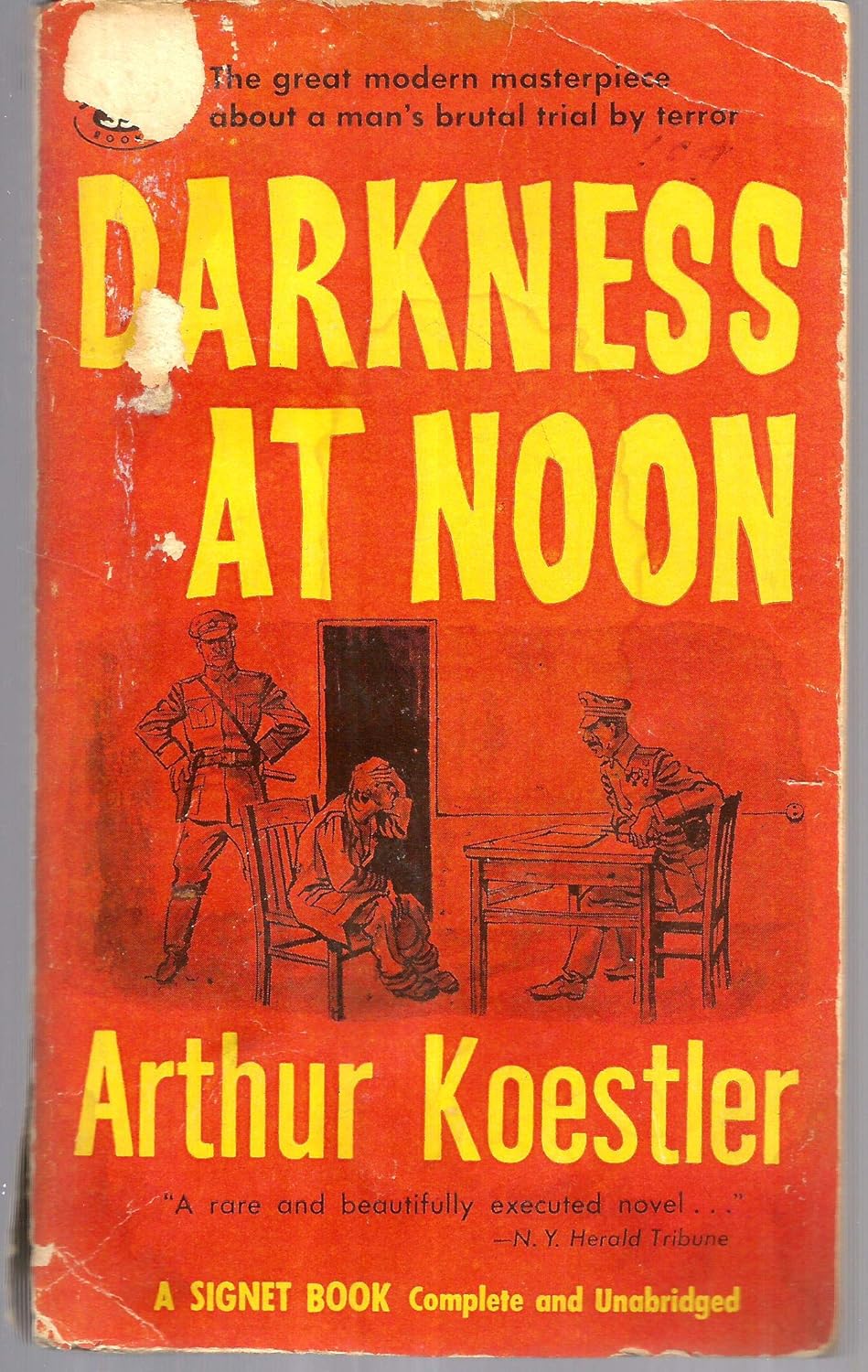
#1 — Darkness at Noon — trans. Daphne Hardy (1940)
- Readability: High — direct and urgent prose that captures the novel's airless logic.
- Accuracy: Good — based on an early draft rather than the final manuscript.
- Tone: Compressed and insider, reflecting the translator's closeness to Koestler.
- Accessibility: High — the version that shaped mid-century intellectual debate.
Which translation is right for you?
- Choose Hardy if you want the historically influential 1940 version read by Orwell, Camus, and the postwar anti-Stalinist generation.
- Choose Boehm if you want the most complete, accurate text restored from Koestler's final German manuscript.
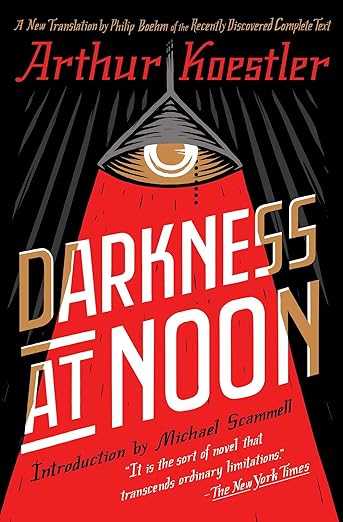
#2 — Darkness at Noon — trans. Philip Boehm (Scribner, 2019)
- Readability: Very high — lively contemporary English that still feels faithful.
- Accuracy: Excellent — the only translation made from the final German typescript.
- Tone: Nuanced and psychologically richer, especially in the interrogation scenes.
- Accessibility: Very high — the clearest entry point for new readers.
About the Translators
Philip Boehm (2019, Scribner): American translator and playwright; his translations from German and Polish include works by Christa Wolf, Franz Werfel, Hanna Krall, and Stefan Chwin. His 2019 translation of Darkness at Noon — made from the original German manuscript discovered in 2012 in a Zurich archive — is the first English translation to give readers what Koestler actually wrote. That manuscript (found by researcher Matthias Weßel) revealed that the Hardy version contained more than a thousand differences from the German, including substantial cuts, alterations of political emphasis, and passages added without Koestler's authorisation. Boehm's translation restores the novel to its original form.
Daphne Hardy (1917–2003, 1940, Bantam / Macmillan): British sculptor and painter who was Koestler's companion during the years of the novel's composition; she translated it from his German manuscript into English while Koestler was imprisoned in France, and the English version was published before the German original. Hardy was not a professional literary translator, and her version shows the signs of its circumstances: passages simplified, political nuances smoothed, and a prose rhythm that is her own as much as Koestler's. For the first generation of readers — and for Orwell, Camus, and the entire postwar anti-Stalinist literary culture — it was irreplaceable.
Themes
The logic of the totalitarian confession. The novel's central question is: how does an intelligent man, a man who knows that the charges against him are false, come to confess to crimes he did not commit? Koestler's answer — worked out through the three interrogation sequences — is that the old Bolshevik Rubashov has constructed, over his lifetime, a philosophical framework that leaves him no intellectual ground from which to resist. He cannot appeal to individual conscience, because he has spent forty years arguing that individual conscience is bourgeois sentimentality. He cannot appeal to truth, because he has spent forty years arguing that truth is what serves the movement. The interrogators simply use Rubashov's own logic against him.
Ends and means in revolutionary thought. The novel is a critique of a specific tradition in Marxist-Leninist thought: the argument that any individual atrocity is justified if it serves the historical goal of eventual liberation. Rubashov has committed such atrocities in the name of this principle. The novel forces him to confront whether a logic that justifies every individual betrayal in the name of future justice is compatible with justice itself.
The old guard and the new Soviet man. The contrast between Ivanov (the old Bolshevik who understands Rubashov and engages with him as an intellectual equal) and Gletkin (the new Soviet man who has no memory of the revolution, no irony, and no interest in ideas beyond their instrumental use) is the novel's most precise sociological observation. The old Bolsheviks are being replaced by a generation loyal to Stalin personally, trained in the techniques of confession, incapable of doubt — and this replacement is the historical event the show trials enacted.
Key Characters
Nicolas Salmanovitch Rubashov — the former commissar, now prisoner; a man of real intelligence and genuine revolutionary conviction who finds himself unable to resist the logic of the confession because that logic is his own. His internal monologues — his arguments with himself about history, conscience, and the rights of the individual — are the novel's intellectual substance and its emotional core.
Ivanov — the first interrogator; an old comrade of Rubashov's who conducts the early interrogations with the ease of a man talking to someone who shares his references and assumptions. He is removed from the case — and presumably shot — when his collegial methods prove insufficiently efficient.
Gletkin — the second interrogator; the new Soviet man; a figure without irony, without intellectual sympathy, and without the memory of pre-revolutionary idealism that makes Ivanov capable of understanding Rubashov's resistance. His technique — sleep deprivation, the blinding lamp, relentless logic — is more effective precisely because it operates without ambiguity.
No. 402 — the prisoner in the neighbouring cell who communicates with Rubashov by tapping in code on the wall; a tsarist officer by implication, and therefore politically opposite to Rubashov in every way. Their wall-tapping conversations are the novel's most unexpectedly human element: connection across ideology, in the face of the same end.
Recommended Sources
For further academic reading on Koestler and Darkness at Noon:
- Totalitarian Movements and Political Religions (Taylor & Francis) — the principal journal for scholarly work on totalitarianism; essential for Darkness at Noon in its political and historical context.
- Modern Fiction Studies (Johns Hopkins) — key venue for Darkness at Noon as a work of literary modernism alongside Orwell, Silone, and the anti-Stalinist left.
- Central European History (Cambridge) — essential for the novel's relationship to the actual history of the Moscow show trials and the Soviet purges of 1936–38.
Which translation is right for you?
Choose Boehm (Scribner, 2019) for a first reading — it is the first translation based on what Koestler actually wrote, restored from the original German manuscript, and it substantially changes our understanding of several important passages. Choose Hardy (Bantam/Macmillan, 1940) if you want the version through which Orwell, Camus, and the entire postwar anti-Stalinist literary culture read this novel, or if you are working with older criticism that refers to the Hardy text.
Frequently Asked Questions
What is Darkness at Noon about?
Darkness at Noon is about the imprisonment and interrogation of Rubashov, an old Bolshevik, during the Stalinist purges. It explores themes of totalitarianism, the conflict between individual conscience and political ideology, and the psychological manipulation involved in forced confessions.
Is Darkness at Noon hard to read?
Darkness at Noon can be challenging due to its philosophical depth and historical context. Boehm's translation is more accessible for modern readers, while Hardy's version may appeal to those interested in its historical significance.
Which Darkness at Noon translation is best?
For most readers, Philip Boehm's 2019 translation is the best choice because it is the first to be made from Koestler's recovered final German manuscript.
Boehm vs Hardy — which should I choose?
Choose Boehm for the most complete and accurate text based on the 2012 manuscript discovery. Choose Hardy if you want the historically influential 1940 version read by Orwell and Camus.
Which translation is easiest to read?
Boehm's translation is generally considered the most accessible and alive as contemporary English prose while remaining faithful to the original.
Which translation is most accurate?
Boehm's 2019 translation is the most accurate because it is the only one made directly from Koestler's final German typescript.
Why was a new Darkness at Noon translation needed after eighty years?
The original German manuscript was lost and presumed destroyed until its rediscovery in 2012, revealing over a thousand differences from the text Hardy had translated.
This guide is based on reading both translations and reviewing scholarly commentary. Last reviewed: June 2026.
As an Amazon Associate, I earn from qualifying purchases.
Looking for another classic? Browse all our translation guides →
For another suppressed Soviet masterpiece, see our guide to the best Life and Fate translation.
Readers interested in dystopian fiction should explore our We translation guide on Zamyatin's influential novel.
Arthur Koestler's themes of totalitarianism also appear in our Doctor Zhivago translation comparison.
If you're drawn to mid-century European novels under political pressure, try our If This Is a Man translation guide.