If This Is a Man: What It's About & Best Translation
Primo Levi's account of Auschwitz — and the translation he helped make
As an Amazon Associate, we earn from qualifying purchases.
If This Is a Man is Primo Levi's memoir of his time as a prisoner in Auschwitz. It explores the dehumanizing conditions of the camp and the struggle to maintain one's humanity in the face of systematic brutality.
Translation Comparison at a Glance
| Translation | Readability | Accuracy | Tone | Best For |
|---|---|---|---|---|
| Woolf (1959) | High | Excellent | Precise, clinical, humane | Definitive reading and study |
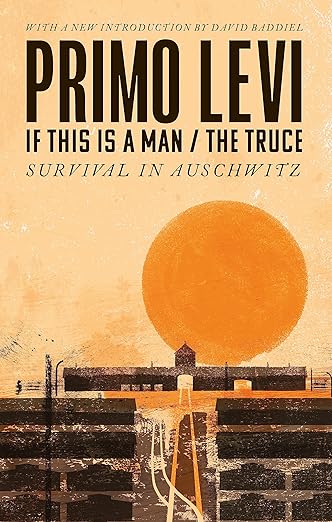
#1 — If This Is a Man / The Truce — trans. Stuart Woolf (Abacus, 50th Anniversary Edition)
- Readability: Clear, precise prose that carries weight without ostentation.
- Accuracy: Highest — reviewed and approved by Levi himself.
- Tone: Scientific exactness combined with human feeling.
- Accessibility: Suitable for all readers; the standard edition.
Which translation is right for you?
- Choose Woolf if you want the sole authorised English translation made with Levi's direct involvement and approval.
About the Translator
Stuart Woolf (b. 1936, late 1950s, Abacus/Touchstone): British historian; Professor Emeritus at the University of Venice and the University of Essex; a specialist in early modern and modern European history. He translated If This Is a Man and The Truce in close collaboration with Primo Levi in the late 1950s — Levi reviewed the English text and approved it, making it effectively a co-authorised translation in the way that Kundera's relationship with his translators would later become. Woolf is also the translator of Levi's The Truce (published with If This Is a Man in the standard Abacus edition) and has written extensively on the history of the Holocaust and of Italian Jewry.
Themes
The grey zone. Levi's most important conceptual contribution to the literature and ethics of the Holocaust is the idea of the "grey zone" — the moral space between victim and perpetrator in which most survivors of the Lager were necessarily located. The Sonderkommando, the Kapos, the prisoners who accepted small advantages at the cost of small collaborations — Levi insists that these people cannot be judged by ordinary moral categories, because the camp was designed to destroy the conditions under which ordinary moral judgement is possible. The grey zone is not an excuse but a demand: we must understand what conditions produce it before we can claim any moral clarity about it.
Chemistry as survival. Levi's professional formation as a chemist was directly responsible for his survival: his chemistry examination before SS Captain Pannwitz, and his subsequent assignment to the Buna rubber plant's laboratory, removed him from the lethal conditions of outdoor winter labour that killed most of his cohort. The examination scene — Levi sitting across from Pannwitz, who examines him without ever looking at him — is one of the book's most precise accounts of what it meant to be treated as less than human in a system that had abolished the category of the human for its Jewish prisoners.
The Lager as a human system. Levi writes about the camp as a structure, not as chaos: it has its own logic, its own hierarchy, its own economy of privilege and survival. His analytical habit of mind — the chemist's attention to what a system does and how it does it — produces an account of the Lager that is more disturbing in some respects than a purely emotional one, because it reveals how much of what happened was organised, rational, and the product of deliberate human choice rather than of simple hatred or passion.
Key Characters
Primo Levi — the narrator; a young chemist from Turin, arrested as a partisan and deported to Auschwitz in February 1944; one of a small number of Italian Jewish prisoners who survived the camp. His intelligence, his professional skills, and a series of contingent circumstances — including an act of kindness by an Italian civilian worker — allowed him to survive where almost all of his companions did not.
Lorenzo Perrone — an Italian civilian worker employed at the Buna plant who, for six months, brought Levi an extra ration of soup and once obtained a piece of bread for him. Levi wrote that he owed his life to Lorenzo, and that what Lorenzo did reminded him that there still existed a just world outside the camp. Lorenzo survived the war but died in poverty in 1952.
Alberto — Levi's closest friend in the camp; a young man from Fossoli whom Levi describes as endowed with an intelligence and moral clarity unusual under the conditions of the Lager. He was among those who died on the final forced march west as the Soviet army advanced in January 1945.
Jean Samuel (the Pikolo) — Levi's companion on the daily walk to collect the midday soup for the Chemical Kommando; the occasion for the book's most celebrated passage, in which Levi attempts to recite and explain the Canto of Ulysses from Dante's Inferno from memory, feeling acutely the importance of conveying the canto fully and sensing that what is at stake is something essential to human dignity.
Recommended Sources
For further academic reading on Primo Levi and If This Is a Man:
- Holocaust and Genocide Studies (Oxford University Press) — the leading journal for Holocaust scholarship; essential for Levi's place in the literature of Holocaust testimony.
- Italica (American Association of Teachers of Italian) — primary venue for Levi in the context of Italian literature and his relationship to Italian Jewish cultural identity.
- The Primo Levi International Center (Turin) — the authoritative institutional resource for Levi scholarship; its publications and online resources are the most comprehensive available in any language.
There is only one English translation of If This Is a Man. Stuart Woolf's text — made in close collaboration with Levi and carrying Levi's own approval — is the translation, and it has been continuously in print since its publication. In the United States the same translation is published under the title Survival in Auschwitz, a retitling Levi considered reductive; outside the US the Abacus/Penguin edition retaining Levi's own title is the version to seek.
Frequently Asked Questions
What is If This Is a Man about?
If This Is a Man is Primo Levi's memoir of his time as a prisoner in Auschwitz. It explores the dehumanizing conditions of the camp and the struggle to maintain one's humanity in the face of systematic brutality.
Is If This Is a Man hard to read?
While the subject matter is intense and harrowing, Stuart Woolf's translation is clear and precise, making it accessible to most readers.
Which If This Is a Man translation is best?
Stuart Woolf's translation is the only English edition and the definitive one, made in close collaboration with Primo Levi himself.
Woolf — which should I choose?
There is no choice to make: Woolf's is the sole authorised translation and remains the standard edition in print today.
Which translation is easiest to read?
Woolf's translation is clear and precise, capturing Levi's characteristic register of scientific exactness and human feeling without ostentation.
Which translation is most accurate?
Woolf's is the most accurate because it was reviewed and approved by Levi during the translation process.
Why is the US title Survival in Auschwitz considered reductive?
Levi himself felt the title narrowed the book's scope; the original title If This Is a Man better reflects its moral and philosophical inquiry into the Lager.
This guide is based on reading the translation and reviewing scholarly commentary. Last reviewed: June 2026.
As an Amazon Associate, I earn from qualifying purchases.
Looking for another classic? Browse all our translation guides →
Readers drawn to Primo Levi's moral clarity often turn next to our guide to The Reader translation.
For another essential account of survival under totalitarianism, see our Life and Fate translation guide.
If you are exploring mid-century European literature of witness, our Journey to the End of the Night translation guide is a natural companion.
Another landmark novel of the Second World War era is covered in our Tin Drum translation guide.