Life and Fate: What It's About & Best Translation
Grossman's suppressed Soviet masterpiece — and the indispensable Chandler translation
As an Amazon Associate, we earn from qualifying purchases.
Life and Fate is a sweeping epic set during the Battle of Stalingrad, exploring the lives of various characters amidst the chaos of war. It delves into themes of totalitarianism, human kindness, and the moral struggles faced by individuals.
Translation Comparison at a Glance
| Translation | Readability | Accuracy | Tone | Best For |
|---|---|---|---|---|
| Chandler (1985/2006) | Very high | Excellent | Faithful yet fully alive | Every reader; the definitive edition |
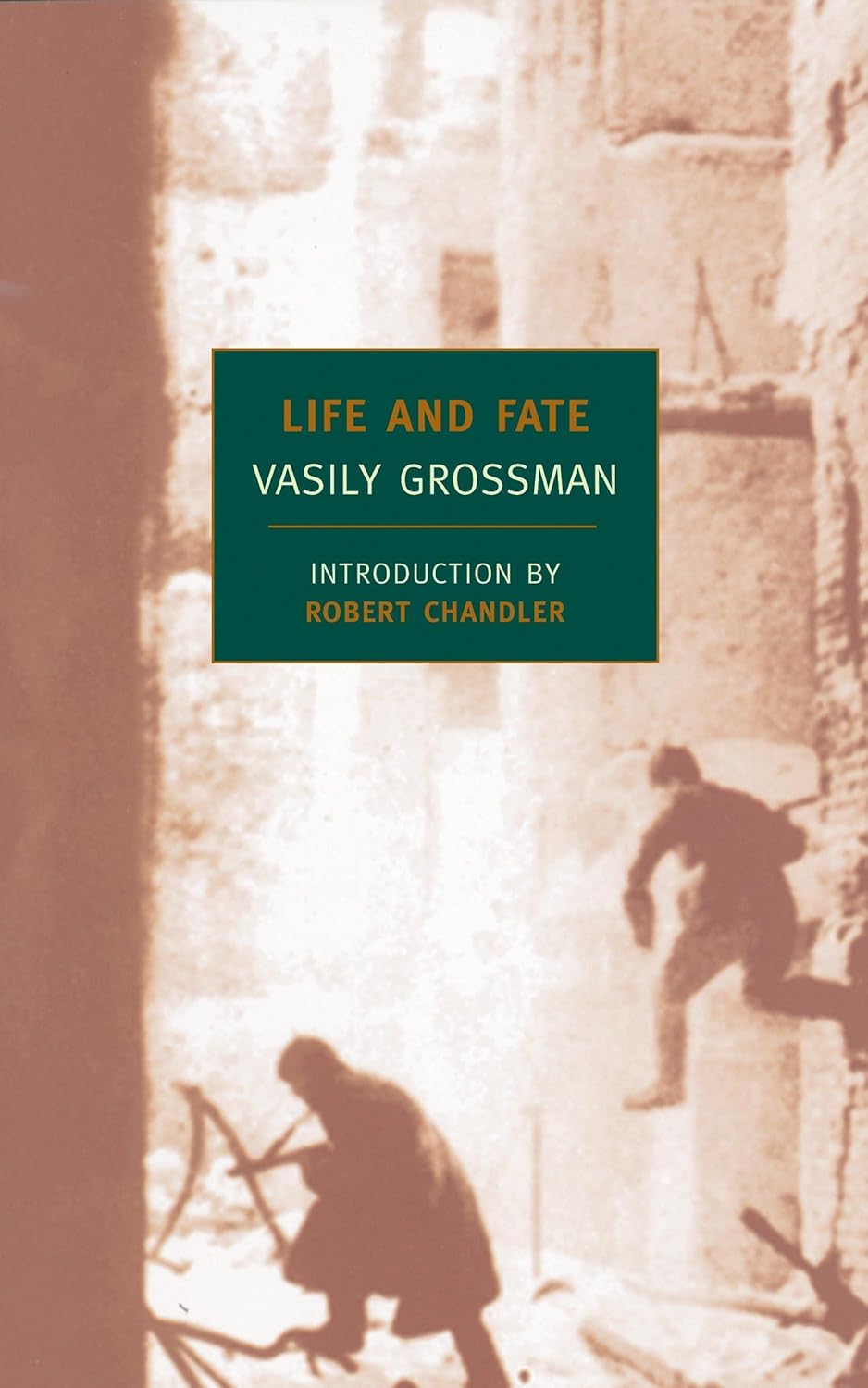
#1 — Life and Fate — trans. Robert Chandler (1985, revised 2006)
- Readability: Reads with exceptional fluency; never feels like a translation.
- Accuracy: Produced with direct access to Grossman's widow and Russian scholars.
- Tone: Faithful yet fully alive in English.
- Accessibility: The standard text continuously in print since 2006.
Which translation is right for you?
- Choose Chandler if you want the only complete, authoritative English translation of this suppressed Soviet masterpiece.
About the Translators
Robert Chandler (b. 1953, 1985/revised 2006, NYRB Classics): The pre-eminent British translator of Russian literature, with authoritative translations of Chekhov, Andrei Platonov, Teffi, and Grossman to his name. His Life and Fate is his most celebrated work; he worked closely with Grossman's widow and with Russian scholars to produce a text that is both faithful to the original and fully alive in English. The 2006 NYRB Classics revision — the standard text — incorporates corrections and refinements to the 1985 first edition.
Themes
The molecular form of goodness. Grossman's central argument — stated explicitly in one of the novel's most famous chapters, the letter from Ikonnikov — is that goodness does not belong to systems or ideologies but only to individuals, in specific moments, in concrete acts. The Holocaust and the Gulag demonstrate that both the Nazi and Soviet systems, however different their stated purposes, arrive at the same place: the annihilation of the person as such. What survives is not system but human kindness — what Grossman calls "yurodivy" kindness, the holy-fool kindness that is illogical, inefficient, and unkillable. This is the novel's deepest moral claim, and it is earned through the hundreds of lives the narrative follows rather than merely asserted.
The physics subplot as moral argument. Viktor Shtrum, the physicist, discovers a theory with genuine military value to the Soviet state. His moral compromises — the denunciations he signs, the colleagues he fails to defend — are purchased by the state's interest in his science. The subplot is not decorative; Grossman uses it to show how intellectual brilliance and moral cowardice coexist in the same person under totalitarianism, and how the state exploits exactly this combination. Shtrum is based partly on Grossman himself, and the self-portrait is not a flattering one.
House 6/1 as the novel's heart. The defence of a single ruined apartment building in Stalingrad by a small group of soldiers becomes the moral center of the narrative. In this fragment of contested space, something like democracy spontaneously emerges — different nationalities, different political views, coexisting under fire in conditions of radical equality. Grossman presents this not as propaganda but as evidence: the human capacity for decent communal life survives even the most extreme conditions, and cannot be entirely extinguished by the systems built to extinguish it.
Key Characters
Viktor Shtrum — a Jewish physicist working on nuclear theory; the character most closely based on Grossman himself. His intellectual brilliance, his fear, his moral failures, and his occasional unexpected acts of courage form the novel's central moral drama. He is not a hero, and Grossman does not pretend he is.
Lyudmila Shaposhnikova — Shtrum's wife, practical and devoted, moving through the war's losses with a grief that is personal and irreducible. Her journey to find her wounded son Tolya is one of the novel's most harrowing sequences.
Anna Semyonovna — Shtrum's mother, who is killed in the Nazi massacre of the Jewish community of a Soviet city. Her letter to her son, written the night before her death, is one of the most devastating passages in the novel — and in twentieth-century literature.
Vasily Grossman himself appears as a character — the correspondent who visits the front and Stalingrad. This is one of the novel's most unusual formal choices: the author inside his own fiction, witnessing what he also witnessed in life.
Colonel Novikov — a tank commander whose relationship to the front-line reality of war is Grossman's portrait of genuine military leadership: the man who delays an order by three minutes to save his soldiers' lives, and suffers the consequences.
Recommended Sources
For further academic reading on Grossman and Life and Fate:
- The Slavic and East European Journal (SEEJ) — the flagship journal of AATSEEL; covers Grossman's fiction and its place in Soviet and post-Soviet literary history.
- Slavic Review (Cambridge University Press) — essential historical context for the novel's suppression, the Battle of Stalingrad, and the Soviet treatment of the Holocaust.
- Russian Literature (Elsevier) — the main international journal for Grossman scholarship in English, including comparative studies with Tolstoy and other writers in the tradition Grossman is engaging.
Which translation is right for you?
There is one English translation. Choose Robert Chandler's NYRB Classics edition — it is the only complete translation, and it is exceptional. Chandler worked with Grossman's widow and with Russian scholars to produce a text that is both faithful and fully alive in English. The NYRB Classics edition includes his introduction, which is among the best available guides to the novel's composition, suppression, and historical significance.
Frequently Asked Questions
What is Life and Fate about?
Life and Fate is a sweeping epic set during the Battle of Stalingrad, exploring the lives of various characters amidst the chaos of war. It delves into themes of totalitarianism, human kindness, and the moral struggles faced by individuals.
Is Life and Fate hard to read?
Life and Fate can be challenging due to its complex themes and large cast of characters. However, Robert Chandler's translation is praised for its readability and fluency, making it accessible to many readers.
Which Life and Fate translation is best?
Robert Chandler's translation is the only complete English edition and is widely regarded as one of the finest translations from Russian in the English language.
Chandler vs other versions — which should I choose?
There is only one complete English translation. Chandler worked closely with Grossman's widow and Russian scholars to produce a text that is both faithful to the original and fully alive in English.
Which translation is easiest to read?
Chandler's revised 2006 NYRB Classics edition reads with exceptional fluency; readers report never feeling they are reading a translation.
Which translation is most accurate?
Chandler's version is the standard scholarly text, produced with direct access to Grossman's widow and Russian scholars.
Why was Life and Fate suppressed and how did it reach English readers?
The KGB confiscated the manuscript in 1960; a microfilm was smuggled to the West and the novel first appeared in Lausanne in 1980. Chandler's translation brought it to English readers in 1985.
This guide is based on reading the translation and reviewing scholarly commentary. Last reviewed: June 2026.
As an Amazon Associate, I earn from qualifying purchases.
Want more on this book? See our full plot synopsis, the real history behind the novel, a guide to how hard it is to read, its film, radio, and TV adaptations, and its most discussed passages.
Looking for another classic? Browse all our translation guides →
Readers drawn to Grossman's Tolstoyan scope should see our War and Peace translation guide.
For another landmark of suppressed Soviet fiction, explore our Doctor Zhivago translation guide.
Also essential in the Russian tradition is our Master and Margarita translation guide.
Another dystopian Russian classic worth comparing is our We translation guide.