The Collected Tales of Nikolai Gogol: What It's About & Best Translation
The trickiest prose in Russian literature to render in English
As an Amazon Associate, we earn from qualifying purchases.
The Collected Tales of Nikolai Gogol includes stories that range from the comic and folkloric Ukrainian tales to the dark, surreal Petersburg stories. These tales explore themes of identity, social status, and the absurdity of bureaucratic life.
Translation Comparison at a Glance
| Translation | Readability | Accuracy | Tone | Best For |
|---|---|---|---|---|
| Pevear & Volokhonsky (1998) | Moderate | Excellent | Preserves oddities and strangeness | First reading, comprehensive collection |
| Ronald Wilks (Penguin) | High | Good | More idiomatic and smooth | Shorter introduction, accessibility |
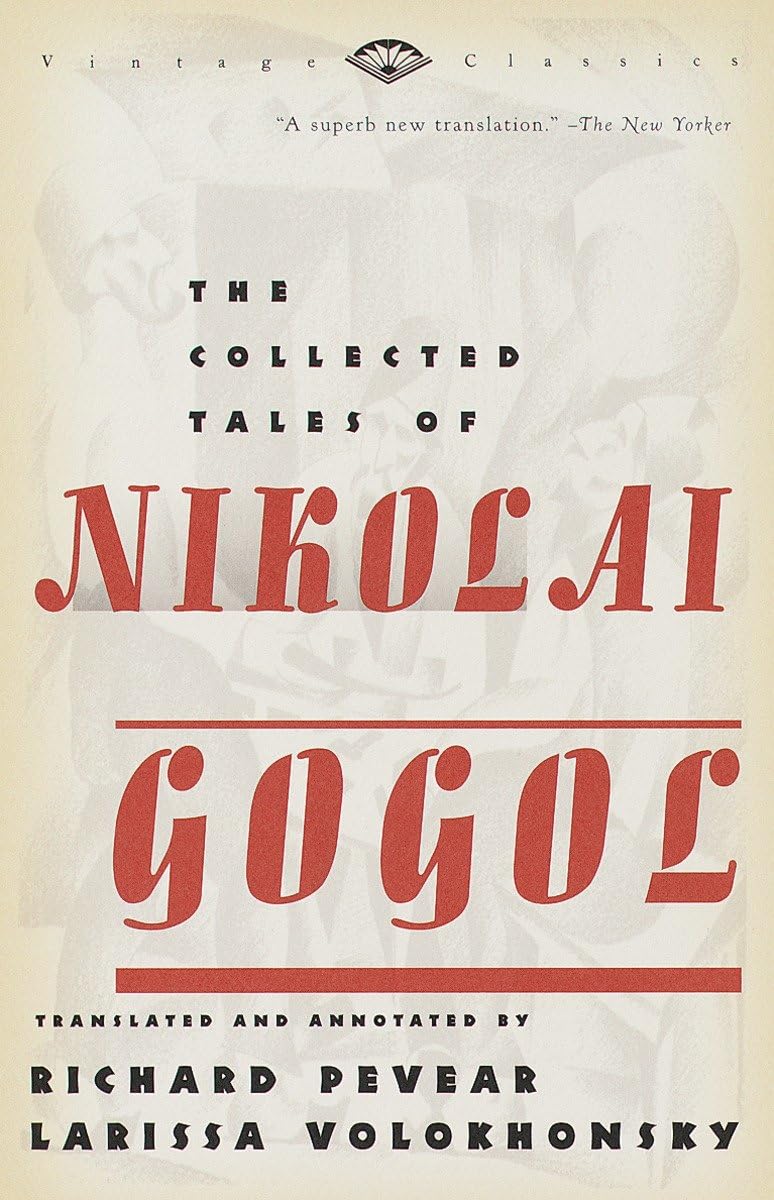
#1 — The Collected Tales of Nikolai Gogol — trans. Richard Pevear & Larissa Volokhonsky (1998)
- Readability: Moderate — preserves abruptness and strangeness rather than smoothing into conventional prose.
- Accuracy: Excellent — considered definitive for The Overcoat and The Nose.
- Tone: Faithful to Gogol's deadpan, lyrical eruptions, and bureaucratic jargon.
- Accessibility: Best starting point for first-time readers seeking the full collection.
Which translation is right for you?
- Choose Pevear & Volokhonsky if you want the most comprehensive collection and the most faithful rendering of Gogol's strangeness.
- Choose Ronald Wilks if you want a shorter, more idiomatic introduction to the Petersburg tales.
About the Translators
Richard Pevear & Larissa Volokhonsky (1998, Vintage Classics): Their Collected Tales is the most comprehensive and rigorous English collection of Gogol's shorter prose, spanning twelve stories from the early Ukrainian tales to the mature Petersburg stories. P&V bring to Gogol the same commitment they apply to Dostoevsky and Tolstoy: preserving the idiom, the syntactic peculiarities, and the tonal strangeness rather than rationalising them into conventional English literary prose.
Ronald Wilks (Penguin Classics): British translator whose Diary of a Madman and Other Stories collects the key Petersburg tales in a more idiomatic register than P&V. Wilks produces readable, accessible translations that suit readers who want a shorter introduction to Gogol's shorter work; his handling of the comic material is smooth and assured.
Themes
The Overcoat: annihilation by insignificance. Akaky Akakievich, a copying clerk, saves up for a new overcoat and is then robbed of it. The story is simultaneously social protest (the indifference of bureaucracy to human suffering), philosophical parable (the void left when the one thing a person loves is taken away), and something stranger — the final pages tip into the supernatural in a way that refuses to resolve into either realism or fantasy. Dostoevsky's claim — "We all came out from under Gogol's Overcoat" — names the story's foundational role in Russian literature. It invented the "little man," the person without resources or defenders, and passed that figure to every writer who came after.
The Nose: the bureaucratic surreal. A civil servant's nose detaches itself, dresses in a uniform of higher rank than its owner, and proceeds to live its own social life in St. Petersburg. The story is told in a tone of absolute deadpan solemnity, treating the impossible as merely inconvenient. This is the most completely Gogolian thing Gogol ever wrote: the horror and the comedy are inextricable, and the resolution — the nose returns, inexplicably — resolves nothing. The target is the social world of rank and status, in which identity is literally external to the person.
The Petersburg Tales as a group. The early Ukrainian stories (Evenings on a Farm Near Dikanka) are comic and folkloric; the Petersburg stories — The Overcoat, The Nose, Nevsky Prospect, Diary of a Madman, The Portrait — are dark, strange, and inhabited by clerks who are annihilated by their own insignificance or the city's indifference. The contrast marks the arc of Gogol's career and his growing preoccupation with what the city does to the self.
Key Characters
Akaky Akakievich Bashmachkin (The Overcoat) — the clerk whose name is itself a piece of comic humiliation. He is the original of the "little man" in Russian literature: a figure without resources, without defenders, without any claim on the world's attention, annihilated by the loss of the one thing he had. His afterlife as a ghost — haunting the city for the coat that was taken from him — is the story's one concession to justice.
Major Kovalev / The Nose (The Nose) — Kovalev discovers his nose is missing, locates it living independently at a higher social rank than he occupies, attempts to recover it through bureaucratic channels, and is told this is not how things work. The nose is eventually returned by the police. No explanation is offered. Kovalev's rage and indignation are treated with complete seriousness.
Poprishchin (Diary of a Madman) — the diarist, another copying clerk, who comes over the course of his journal entries to believe he is Ferdinand VIII, King of Spain. His delusion proceeds with an internal logic — it is the only explanation that makes his circumstances bearable — and the final entries, from inside the asylum, are among Gogol's most affecting writing.
Recommended Sources
For further academic reading on Gogol's shorter fiction:
- The Slavic and East European Journal (SEEJ) — the flagship journal of AATSEEL; extensive coverage of Gogol criticism and translation history.
- Slavic Review (Cambridge University Press) — essential historical and cultural context for Gogol's Petersburg world.
- Russian Literature (Elsevier) — the main international venue for Gogol scholarship, including comparative studies linking him to Kafka, Borges, and other writers shaped by his methods.
Which translation is right for you?
For a first reading and the most comprehensive collection, choose Pevear and Volokhonsky. The Penguin alternative — Ronald Wilks's translations in Diary of a Madman and Other Stories — is more idiomatic and more conventionally readable, and is a reasonable starting point if you want a shorter introduction to the Petersburg tales. For The Overcoat in particular, the P&V version is the most widely recommended English rendering.
Frequently Asked Questions
What is The Collected Tales of Nikolai Gogol about?
The Collected Tales of Nikolai Gogol includes stories that range from the comic and folkloric Ukrainian tales to the dark, surreal Petersburg stories. These tales explore themes of identity, social status, and the absurdity of bureaucratic life.
Is The Collected Tales of Nikolai Gogol hard to read?
The tales can be challenging due to Gogol's unique style and tone. Pevear & Volokhonsky's translation preserves these elements, while Ronald Wilks offers a more idiomatic version.
Which Gogol Stories translation is best?
Pevear and Volokhonsky's Vintage Classics collection remains the best available in English. It is comprehensive and Pevear and Volokhonsky approach Gogol with fidelity, preserving the oddities rather than smoothing them.
Pevear & Volokhonsky vs Ronald Wilks — which should I choose?
Pevear and Volokhonsky is the most comprehensive and rigorous. Wilks produces readable, accessible translations that suit readers who want a shorter introduction to Gogol's shorter work.
Which translation is easiest to read?
Ronald Wilks's Penguin translation is more idiomatic and more conventionally readable.
Which translation is most accurate?
Pevear and Volokhonsky's version is the most widely recommended English rendering, preserving the abruptness and tonal strangeness.
Why is Gogol considered the most difficult major Russian writer to translate?
Gogol's style is his content: the surreal deadpan, the bureaucratic jargon, the lyrical eruptions, the puns and verbal games that are inextricable from what the story is doing.
This guide is based on reading the translation(s) and reviewing scholarly commentary. Last reviewed: June 2026.
As an Amazon Associate, I earn from qualifying purchases.
Looking for another classic? Browse all our translation guides →
Gogol's only novel also deserves attention — see our guide to the best Dead Souls translation.
Readers who enjoy Pevear & Volokhonsky's Gogol will want their Brothers Karamazov translation guide as well.
For more Russian literature in the same vein, compare editions in our Crime and Punishment translation guide.
Another essential P&V rendering of a Russian masterpiece is covered in our War and Peace translation guide.