The Death of Ivan Ilyich: What It's About & Best Translation
The translation you choose shapes the novella you read
As an Amazon Associate, we earn from qualifying purchases.
The Death of Ivan Ilyich is about a high-court judge in 19th-century Russia who grapples with the existential dread of his impending death. The novella explores themes of the superficiality of social conventions and the search for genuine meaning in life.
Translation Comparison at a Glance
| Translation | Readability | Accuracy | Tone | Best For |
|---|---|---|---|---|
| Pevear & Volokhonsky (2009) | High | Excellent | Plain, accumulative, unsmoothed | First reading, university courses |
| Aylmer Maude (1902) | High | Very good | Austere, direct, conventional | Historical authority, Tolstoy-approved text |
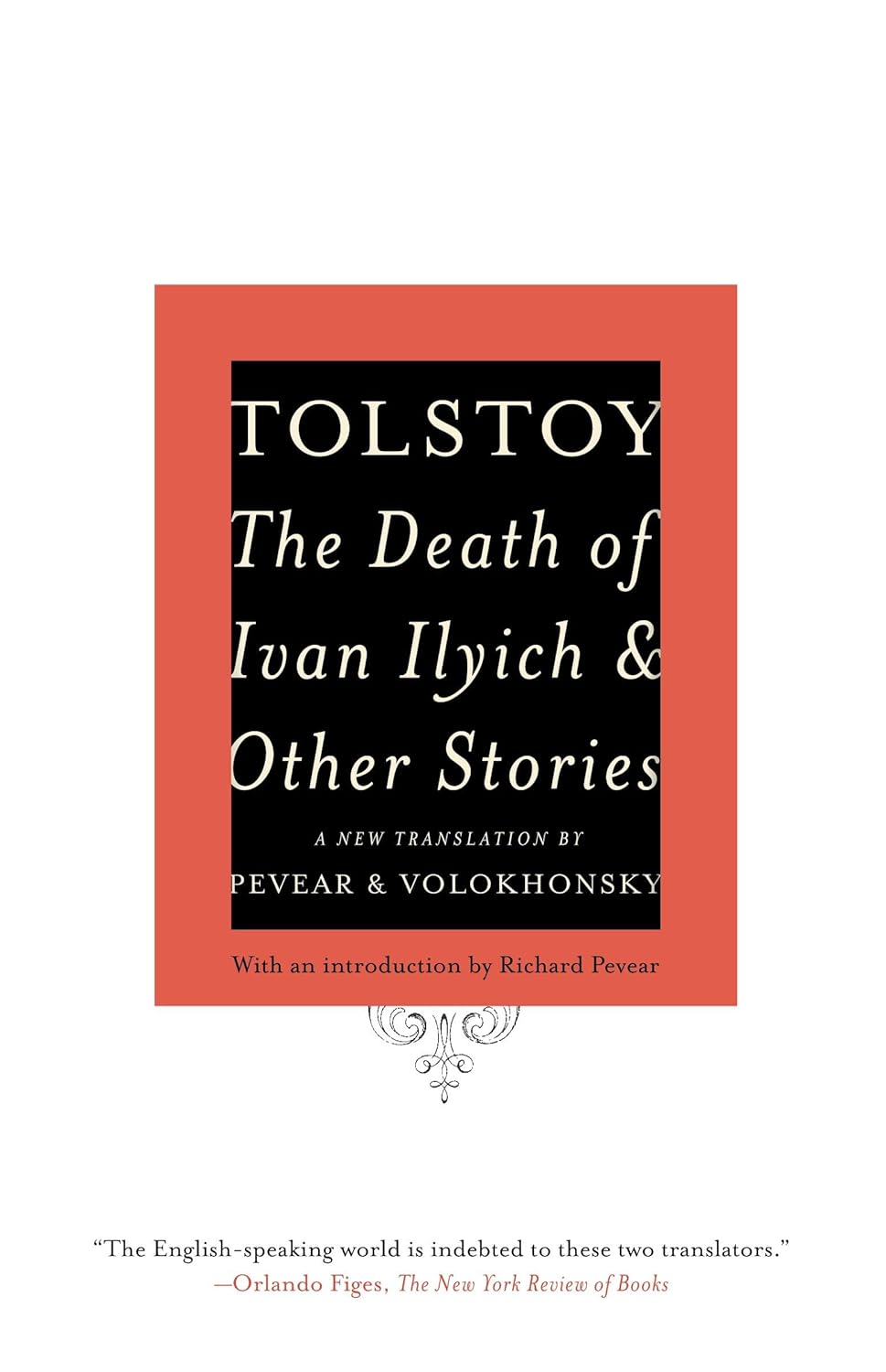
#1 — The Death of Ivan Ilyich and Other Stories — trans. Richard Pevear & Larissa Volokhonsky (2009)
- Readability: Clear modern sentences that preserve Tolstoy's relentless rhythm without softening.
- Accuracy: Maximum fidelity to the original Russian syntax and plain style.
- Tone: Clinical and morally direct, letting the terror arrive with full force.
- Accessibility: Ideal for first-time readers and classroom use.

Simon Vance's measured and poignant narration perfectly complements Pevear & Maude's acclaimed translation, capturing the existential depth and emotional nuance of Tolstoy's masterpiece.
Listen on Audible →Which translation is right for you?
- Choose Pevear & Volokhonsky if you want the current scholarly standard with maximum fidelity to Tolstoy's syntax and rhythm.
- Choose Aylmer Maude if you want the version Tolstoy personally approved, with a slightly more austere and conventional English.
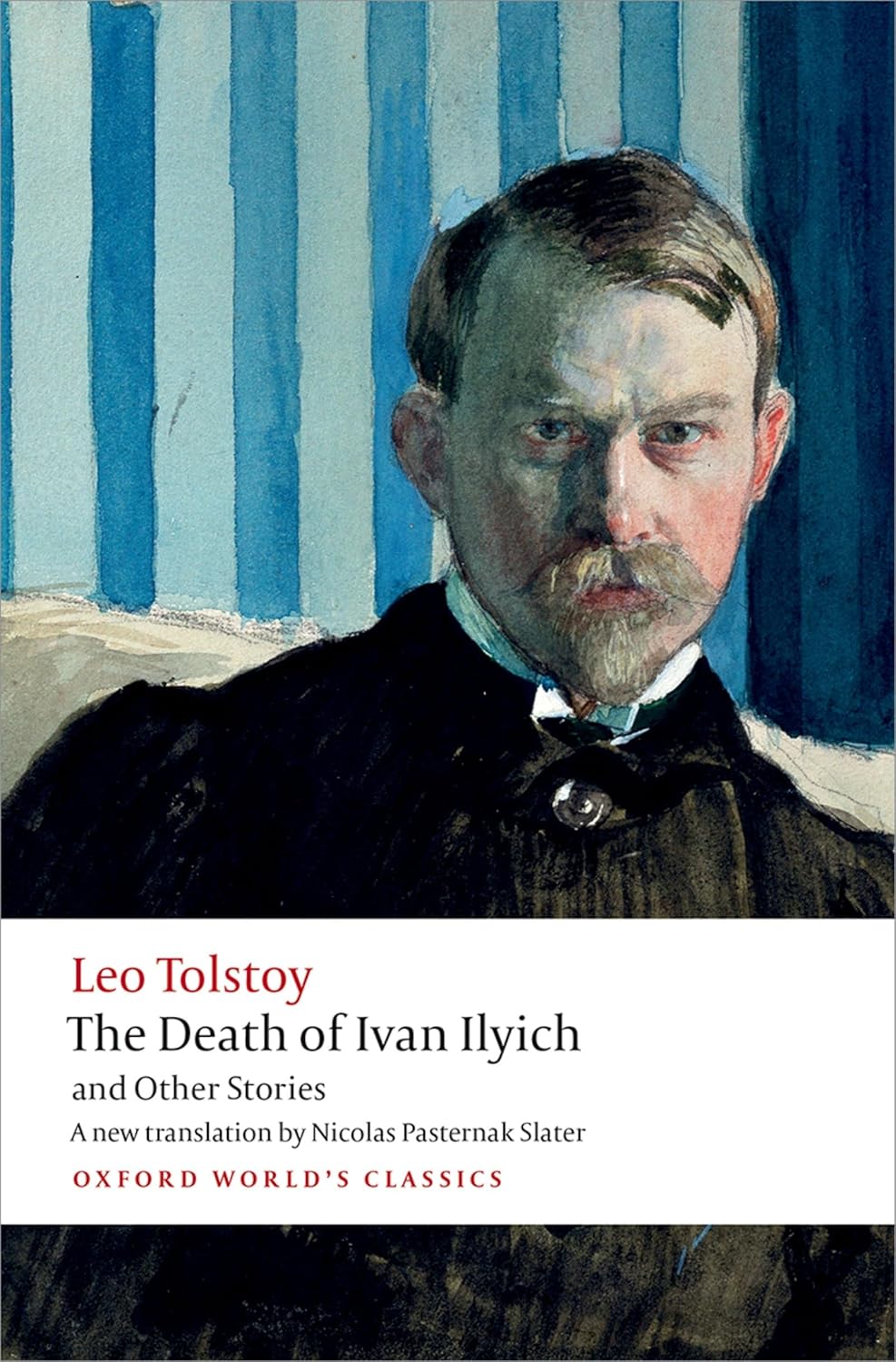
#2 — The Death of Ivan Ilyich and Other Stories — trans. Aylmer Maude (1902)
- Readability: Slightly more conventional English that many find devastatingly direct.
- Accuracy: Highly faithful with a less literal but still precise rendering.
- Tone: Austere and morally uncompromising, with no softening of edges.
- Accessibility: Excellent for readers seeking historical authority.
About the Translators
Richard Pevear & Larissa Volokhonsky published their Death of Ivan Ilyich in 2009 as part of a Vintage Classics volume of late Tolstoy stories that also includes Master and Man, Alyosha the Pot, and Hadji Murat. Their method — maximum fidelity to the rhythms and syntax of Tolstoy's Russian — suits Ivan Ilyich particularly well. The novella's late prose is plainer and more morally direct than War and Peace or Anna Karenina; it demands precision rather than elegance, and P&V supply it.
Aylmer Maude (1858–1938) was an English businessman who moved to Russia, became one of Tolstoy's closest friends, and devoted much of his later life to translating and promoting his work. He wrote the authorized two-volume biography of Tolstoy and worked with him directly on translations. Tolstoy read and approved Maude's versions — a distinction no other translator of his fiction holds. Maude's translation of Ivan Ilyich has been the version most widely cited in scholarly criticism for over a century.
Themes
The novella's central argument is about the falseness of Ivan's life — and Tolstoy makes it with surgical precision. Ivan's apartment is decorated correctly. His career progresses correctly. He marries correctly and lives correctly and associates with the correct people. The dying exposes all of it as hollow — not because Ivan made wrong choices by some external standard, but because he organized his existence around surfaces and approval and never encountered the question of whether any of it was real. The terror of his illness is partly physical and partly the terror of someone realizing, too late, that they have not lived.
Gerasim — the young peasant servant who carries the bedpan, holds Ivan's legs in the elevated position that relieves his pain, and does both without complaint, self-pity, or the false brightness everyone else brings to the sickroom — is Tolstoy's moral counterweight. He is not presented as saintly; he is simply uncorrupted. He has not yet learned to distance himself from death or to pretend that dying is not happening. Tolstoy believed the peasant class had preserved something in their relationship to death and the body that the educated classes had lost, and Gerasim is his demonstration of what that looks like.
The ending — Ivan's fall through the black bag into light, his three days of dying without fear — is the most debated passage in the novella. Is it genuine spiritual transformation? Wishful dying? The hallucination of a drugged mind? Tolstoy inserting his own theology into the story? The novella does not settle the question. Translators handle the passage differently, and the answer a reader reaches depends partly on the register and tone of the version they have been reading for a hundred pages.
Key Characters
Ivan Ilyich Golovin — A judge in the Russian bureaucracy: a brilliant legal mind who organized his entire existence around the pursuit of what was correct, proper, and approved by the right people. The novella reconstructs his life from the beginning — childhood, law school, career, marriage, home decoration — and the reconstruction is its own kind of indictment. His dying is the first truly real thing that happens to him.
Gerasim — The peasant servant. Young, fresh, strong, uncomplicated. He is the only person in the novella who does not pity Ivan with the self-serving pity that makes everyone else miserable, and the only one who does not distance himself from what is happening. His few scenes are the moral center of the book, and their simplicity is the point — Tolstoy is not offering a complicated alternative to Ivan's life, but an almost embarrassingly direct one.
Praskovya Fyodorovna — Ivan's wife. Tolstoy is careful not to make her a villain. She is practical, focused on the inconvenience his illness causes her and on what she will be owed as his widow, and entirely incapable of the simple directness Ivan needs. She is what Ivan was: a person who has organized herself around surfaces. Her presence at his sickbed is therefore the presence of everything his dying is supposed to have stripped away.
Pyotr Ivanovich — Ivan's colleague, who appears in the novella's opening chapter attending the funeral and calculating how the death will affect his own career. His discomfort, his awkward conversation with the widow, his relief at escaping back to his card game — these first pages compress everything the rest of the story will say at length about how the living deal with dying by not dealing with it at all.
Recommended Sources
Slavic and East European Journal — The flagship peer-reviewed publication of the American Association of Teachers of Slavic and East European Languages (AATSEEL). Regularly publishes translation criticism and Tolstoy scholarship. Available through JSTOR.
Tolstoy Studies Journal — Published annually by the North American Tolstoy Society, dedicated entirely to Tolstoy scholarship in all major languages. The most specialized peer-reviewed venue for close work on Tolstoy's texts, sources, and reception history.
Slavic Review — Published by Cambridge University Press on behalf of the Association for Slavic, East European, and Eurasian Studies. One of the two leading English-language journals in Russian literary and cultural studies, with extensive coverage of Tolstoy and translation reception.
Which translation is right for you?
Choose Pevear and Volokhonsky for a first reading — it is the current standard, rigorously faithful to Tolstoy's rhythm, and the Vintage Classics volume pairs the novella with Hadji Murat and other late Tolstoy that rewards reading alongside it. Choose Maude if you want the version closest to what Tolstoy's contemporaries read and the one he personally approved — its slightly more austere English suits the subject, and many readers find its restraint even more devastating than P&V's precision.
Frequently Asked Questions
What is The Death of Ivan Ilyich about?
The Death of Ivan Ilyich is about a high-court judge in 19th-century Russia who grapples with the existential dread of his impending death. The novella explores themes of the superficiality of social conventions and the search for genuine meaning in life.
Is The Death of Ivan Ilyich hard to read?
The Death of Ivan Ilyich can be challenging due to its existential themes, but Aylmer Maude's translation offers a more accessible English, while Pevear & Volokhonsky provide a faithful rendering of Tolstoy's original style.
Which The Death of Ivan Ilyich translation is best?
Pevear and Volokhonsky's Vintage Classics translation is this guide's primary recommendation for most readers. It is the current scholarly standard and the version most likely to be assigned in university courses.
Pevear & Volokhonsky vs Aylmer Maude — which should I choose?
Choose Pevear and Volokhonsky for rigorous fidelity to Tolstoy's rhythm and the current standard. Choose Maude if you want the version Tolstoy personally approved, with a slightly more austere English that many readers find devastating.
Which translation is easiest to read?
Aylmer Maude's version reads with a directness and conventional English that many readers find even more accessible and devastating than the modern rendering.
Which translation is most accurate?
Pevear and Volokhonsky bring maximum fidelity to the rhythms and syntax of Tolstoy's Russian, preserving the plain, accumulative sentences without softening or cushioning.
Why does Aylmer Maude's translation carry special authority?
Maude knew Tolstoy personally, wrote his authorized biography, and produced the only versions Tolstoy read and approved in his lifetime.
This guide is based on reading the two translations and reviewing scholarly commentary. Last reviewed: June 2026.
As an Amazon Associate, I earn from qualifying purchases.
Looking for another classic? Browse all our translation guides →
For more Tolstoy, see our guide to the best Anna Karenina translation.
Our War and Peace translation guide compares Pevear & Volokhonsky against Briggs and the Maudes.
Readers of Pevear & Volokhonsky should also check our Brothers Karamazov translation guide.
Explore another Russian classic with our Crime and Punishment translation comparison.