The Name of the Rose: What It's About & Best Translation
Umberto Eco's medieval murder mystery — erudition, poison, and the only book that can make semiotics a page-turner
As an Amazon Associate, we earn from qualifying purchases.
The Name of the Rose is a historical murder mystery set in a 14th-century Italian monastery. It follows Franciscan friar William of Baskerville and his novice Adso as they investigate a series of mysterious deaths, uncovering a labyrinth of secrets and forbidden knowledge.
Translation Comparison at a Glance
| Translation | Readability | Accuracy | Tone | Best For |
|---|---|---|---|---|
| Weaver (1983) | High | Excellent | Mock-medieval scholastic with wit and pace | First-time readers and scholars |
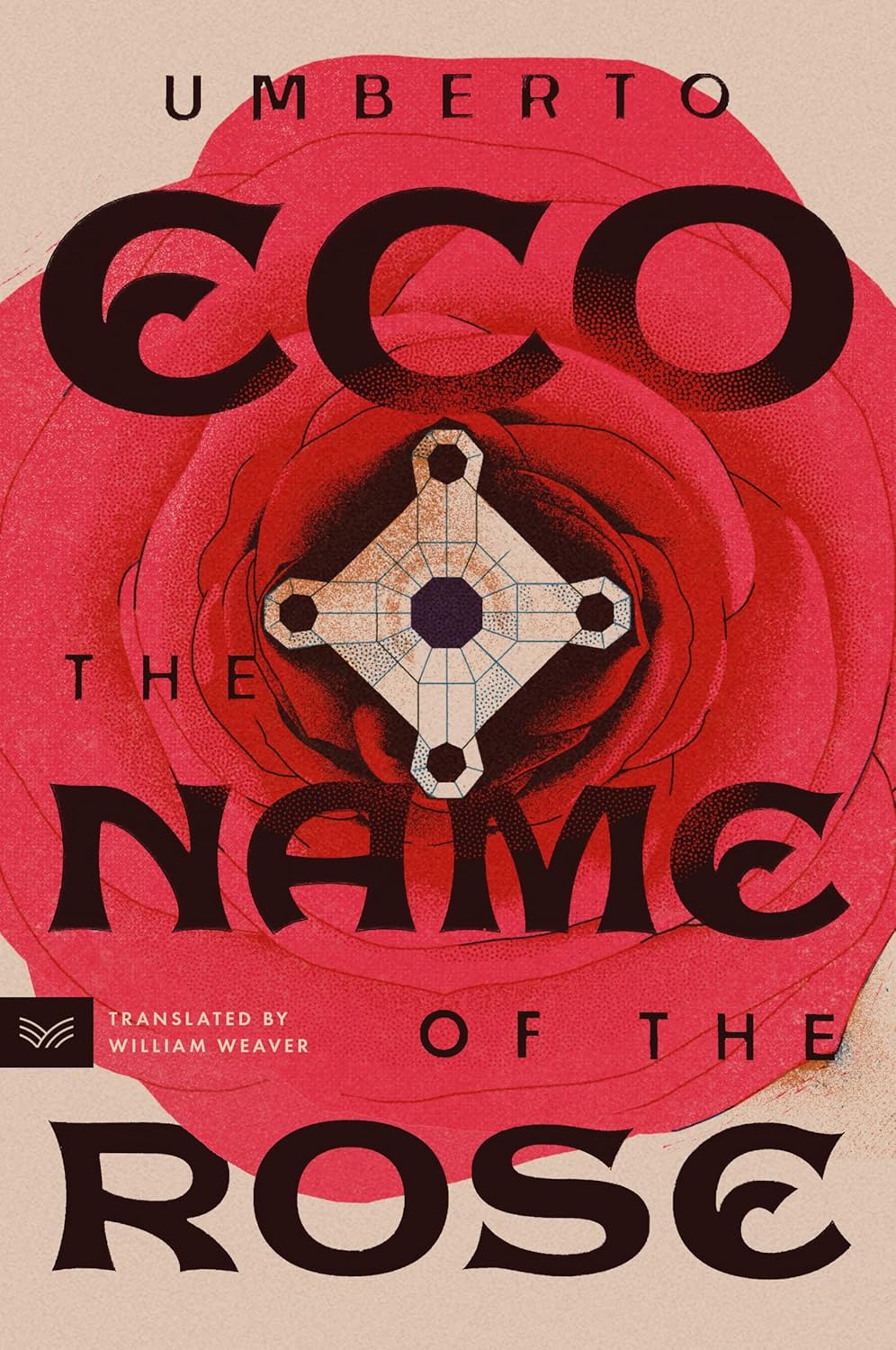
#1 — The Name of the Rose — trans. William Weaver (1983)
- Readability: High — balances archaic tone with clear, propulsive prose.
- Accuracy: Excellent — captures Eco's Latinate scholasticism and semiotic precision.
- Tone: Mock-medieval with dry wit and atmospheric weight.
- Accessibility: Suitable for both first-time readers and scholars.

Sean Barrett's masterful narration captures the medieval atmosphere and intellectual depth of Umberto Eco's novel, while William Weaver's acclaimed translation preserves its rich linguistic and philosophical nuances.
Listen on Audible →Which translation is right for you?
- Choose Weaver if you want the sole authoritative English rendering that preserves the novel's mock-medieval style, theological precision, and narrative momentum.
About the Translator
William Weaver (1923–2013, 1983, HarperCollins): American; the pre-eminent English-language translator of Italian literature of the twentieth century; his other translations include Calvino's Invisible Cities, If on a winter's night a traveler, and Cosmicomics; Moravia's novels; Ginzburg's Family Lexicon; and Sciascia's crime fiction. He received the PEN Medal for Translation and the National Book Award translation prize. He knew Eco personally and understood the semiotic and medieval scholarly dimensions of the novel from the inside — his translation is among his most technically demanding achievements, requiring him to simulate in English the effect of Italian prose mimicking medieval Latin scholasticism.
Themes
The labyrinth as figure for the limits of knowledge. The monastery's library is physically a labyrinth — a maze whose structure is itself a puzzle, whose books are organised according to a system only one person understands, and which contains a forbidden book that is killing people. But the labyrinth is also Eco's metaphor for interpretation itself: the attempt to read signs, to follow a thread through a maze of meaning, and to reach a truth that may not be there. William of Baskerville's brilliant deductions turn out to be right for mostly wrong reasons — which is Eco's most pointed comment on the pretensions of semiotics.
Laughter and the body of the Church. The plot turns on the existence of a second book of Aristotle's Poetics, which the murderer believes discusses comedy and which he is determined to prevent from entering circulation — because he believes that laughter, sanctioned by Aristotle's authority, would dissolve the fear of God on which ecclesiastical power rests. This is a real intellectual-historical debate (about whether comedy can be morally serious) dressed in the form of a murder mystery, and it is Eco's most direct engagement with the politics of knowledge and its suppression.
Signs, interpretation, and the question of meaning. Eco was a professor of semiotics, and the novel is in part a sustained meditation on how signs work and fail to work. William interprets everything — the snow, the horse's tracks, the monk's behavior — with detective-story brilliance, and his interpretations are often correct. But the novel's climax suggests that even correct interpretations can lead to catastrophic conclusions, and that the universe of signs is not organised to be read by human beings in any final or certain way.
Key Characters
William of Baskerville — the Franciscan friar and former inquisitor who investigates the murders; his name, his appearance, and his methods are all deliberate allusions to Sherlock Holmes. He is erudite, ironical, and equipped with Roger Bacon's new optic lenses and an empirical method that is — in the fourteenth century — almost scandalously modern. His relationship with Adso is the novel's emotional centre.
Adso of Melk — the German novice who accompanies William and narrates the novel in old age, from the distance of decades and in a prose that mimics medieval chronicle. His innocence and credulity are essential to the novel's comedy; his brief encounter with a village girl in the kitchen is a theological crisis from which he never entirely recovers.
Jorge of Burgos — the ancient blind monk who functions as the novel's antagonist; a figure whose hatred of laughter and whose willingness to kill to suppress a book makes him the novel's most alarming portrait of how knowledge can be weaponised against itself. His name is a deliberate homage to Jorge Luis Borges.
Bernard Gui — the historical Inquisitor who arrives at the monastery to conduct his own investigation and whose methods are entirely unlike William's: where William observes and deduces, Gui accuses and coerces. His presence allows Eco to dramatise the difference between empirical inquiry and the use of legal power to confirm predetermined conclusions.
Recommended Sources
For further academic reading on Eco and The Name of the Rose:
- Semiotica (De Gruyter Mouton) — the leading international journal for semiotics; Eco published in it throughout his career, and it is the primary venue for reading the novel in relation to his theoretical work.
- Italica (American Association of Teachers of Italian) — the primary English-language journal for Italian literary studies; essential for Eco in the context of Italian literary history and the postmodern tradition.
- Speculum (Medieval Academy of America) — the leading journal for medieval studies; essential for the novel's historical backdrop — Franciscan poverty debates, inquisitorial procedure, fourteenth-century monastic culture.
There is only one English translation of The Name of the Rose. William Weaver's text — described by Eco himself as the version he most trusted — is the translation through which the novel reached its global audience, and it remains the only English rendering of this technically demanding work. The current HarperCollins edition, with Eco's own sketches and the translator's name displayed prominently, is the version to buy.
Frequently Asked Questions
What is The Name of the Rose about?
The Name of the Rose is a historical murder mystery set in a 14th-century Italian monastery. It follows Franciscan friar William of Baskerville and his novice Adso as they investigate a series of mysterious deaths, uncovering a labyrinth of secrets and forbidden knowledge.
Is The Name of the Rose hard to read?
The novel's complex themes and medieval setting can be challenging, but William Weaver's translation balances the archaic tone with readability, making it accessible for most readers.
Which The Name of the Rose translation is best?
William Weaver's 1983 translation is the only English edition and a monument of twentieth-century literary translation.
William Weaver vs any other — which should I choose?
There is no other English translation; Weaver's version remains definitive because of its fidelity to Eco's style and the author's own endorsement.
Which translation is easiest to read?
Weaver's rendering balances the novel's elaborate mock-medieval sentences with clarity and narrative drive, making it highly readable despite its scholarly depth.
Which translation is most accurate?
Weaver's is the sole and authoritative English text, praised by Eco for preserving the novel's semiotic and theological precision.
Why has The Name of the Rose never received another English translation?
Weaver's technically demanding achievement and Eco's personal trust in it have made subsequent translations unnecessary.
This guide is based on reading the translation and reviewing scholarly commentary. Last reviewed: June 2026.
As an Amazon Associate, I earn from qualifying purchases.
Looking for another classic? Browse all our translation guides →
William Weaver also translated Italo Calvino — see our guide to the best Invisible Cities translation.
The Name of the Rose pays homage to Jorge Luis Borges; explore our comparison of the best Borges collections in English.
For another major Italian novel, our Leopard translation guide compares Colquhoun and Nisbet.
Readers of postwar Italian literature may also want our guide to If This Is a Man translations.