Invisible Cities: What It's About & Best Translation
Calvino's meditation on memory and imagination — and the indispensable Weaver translation
As an Amazon Associate, we earn from qualifying purchases.
Invisible Cities is a series of conversations between the explorer Marco Polo and the emperor Kublai Khan. Polo describes 55 fantastical cities, each embodying different philosophical ideas and human experiences.
Translation Comparison at a Glance
| Translation | Readability | Accuracy | Tone | Best For |
|---|---|---|---|---|
| Weaver (1974) | High | Excellent | Precise and lyrical | Architects, poets, urban theorists |
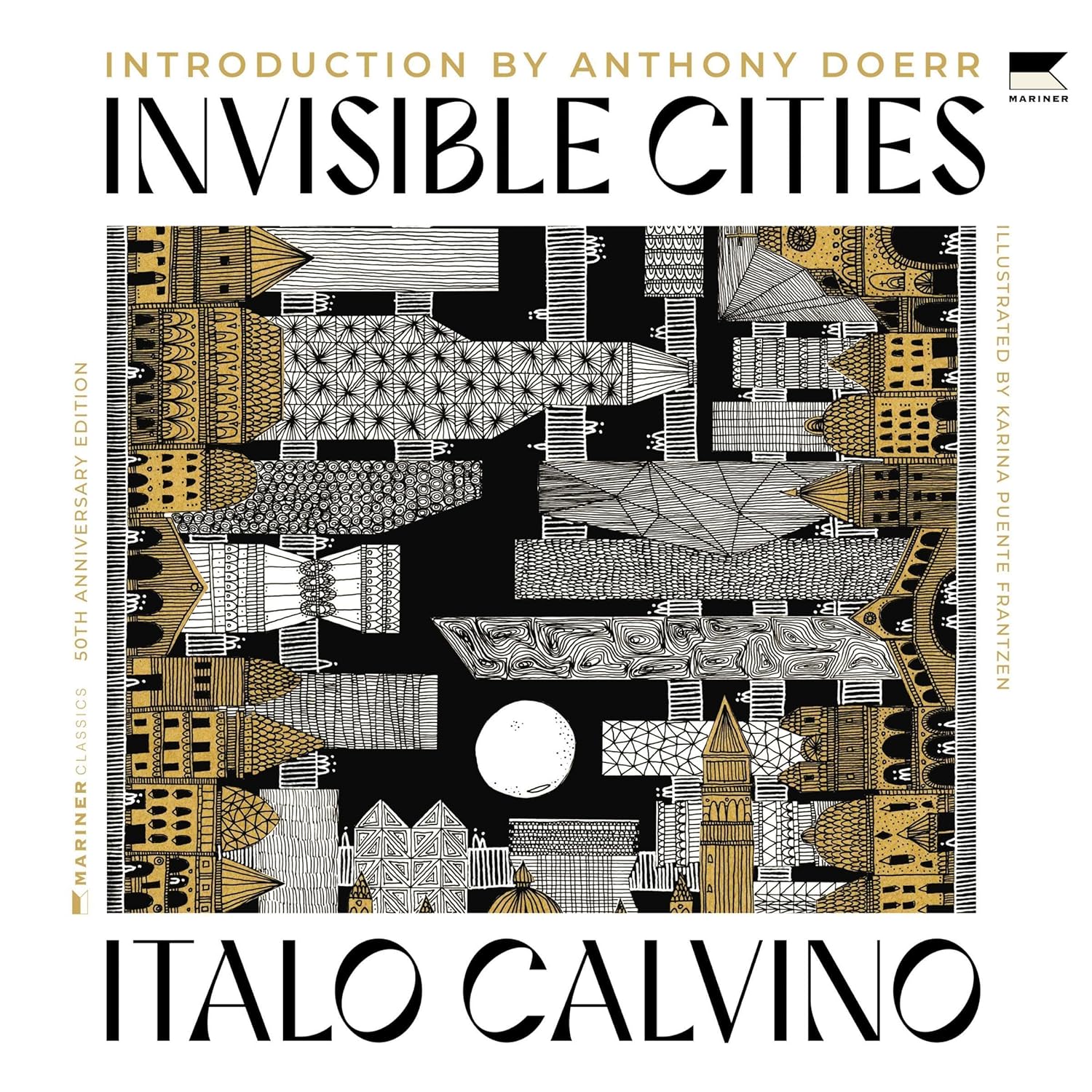
#1 — Invisible Cities — trans. William Weaver (1974)
- Readability: Alive and unlaboured on every page.
- Accuracy: Captures precise lyricism with remarkable fidelity.
- Tone: Distinct rhythm for each of the fifty-five cities.
- Accessibility: Philosophical yet immediate for any reader.

Ballerini's nuanced and evocative narration perfectly captures the dreamlike, poetic quality of Calvino's prose, while Weaver's translation is widely regarded as the most faithful and elegant English version.
Listen on Audible →Which translation is right for you?
- Choose Weaver if you want the definitive, only English translation that preserves Calvino's lyricism and structural precision.
About the Translator
William Weaver (1923–2013, 1974, Mariner Books): American; the pre-eminent English-language translator of Italian literature of the twentieth century; recipient of the PEN Medal for Translation and the National Book Award translation prize. He knew Calvino personally and translated his major works across several decades — Invisible Cities, If on a winter's night a traveler, The Baron in the Trees, Cosmicomics, and The Castle of Crossed Destinies — constituting one of the great translator-author partnerships in literary history. His Invisible Cities is considered the finest of his Calvino translations: a version that captures the precise lyricism and structural rigour of the original without making it feel laboured.
Themes
Memory and the cities we carry inside us. Calvino organises his fifty-five cities into eleven categories, one of which is "cities and memory." But the memory theme pervades the entire book: the cities Marco describes are assembled from desires, from losses, from things seen and things imagined, and the act of describing them is inseparable from the act of remembering. Every traveller, Calvino suggests, carries a city inside them — an ur-city against which all other cities are measured. For Marco, this city is Venice, which he never names.
The impossible empire. Kublai Khan's melancholy is the book's political frame: he rules an empire so vast it cannot be known directly, and the symbols and reports by which he attempts to comprehend it are always already abstractions, translations, approximations of a reality that recedes as he approaches it. This is a figure for any attempt to govern or comprehend a complex totality — a nation, a market, a language — and it resonates with the political context of the early 1970s in which Calvino was writing.
All cities as one city — and all cities as Venice. The dialogue that frames the city descriptions gradually reveals that Marco may be describing the same city over and over again — or that all cities partake of a single ideal City, or that the city Marco is really describing, under fifty-five names, is Venice. This recursive quality is the book's deepest formal joke and its deepest philosophical point: the imagination cannot escape its origins, and all attempts to describe the world are attempts to describe where one comes from.
Key Characters
Marco Polo — the narrator of the city descriptions; he and Kublai converse in a language neither shares, through gestures and objects and silences, and only gradually develop the ability to speak to each other in words. Whether Marco's cities are real, remembered, imagined, or symbolic is never resolved; the book is uninterested in that distinction.
Kublai Khan — the emperor who listens to Marco's descriptions and draws from them a model of his empire he cannot otherwise possess; a figure of immense power and profound helplessness, who begins the book dreaming of conquest and ends it dreaming of an inferno that may or may not be escapable.
The fifty-five cities — each named after a woman, each devoted to a different aspect of human experience. Among the most celebrated: Isidora (the city of desires), Zora (the city of memory, which is also the city that exhausts memory), Thekla (under perpetual construction to prevent its completion), and Octavia (the spider-web city, suspended over an abyss).
Recommended Sources
For further academic reading on Calvino and Invisible Cities:
- Italica (American Association of Teachers of Italian) — the primary English-language journal for Italian literary studies; essential for Calvino in the context of Italian postwar fiction and his relationship to Oulipo.
- Comparative Literature (Duke University Press) — key for Calvino's place in the international postmodern tradition and his relationship to Borges, whose influence on Invisible Cities is profound.
- Utopian Studies (Penn State University Press) — the primary venue for academic work on the utopian imagination; Invisible Cities is extensively discussed as a utopian and anti-utopian text.
There is only one English translation of Invisible Cities. William Weaver's Mariner Books text — made with Calvino's knowledge and approval — has been in continuous print since 1974 and is the version read by every English-language architect, poet, urban theorist, and novelist who has loved this book. There is no alternative English translation, and given the closeness of Weaver's relationship to Calvino and the quality of his rendering, none is needed.
Frequently Asked Questions
What is Invisible Cities about?
Invisible Cities is a series of conversations between the explorer Marco Polo and the emperor Kublai Khan. Polo describes 55 fantastical cities, each embodying different philosophical ideas and human experiences.
Is Invisible Cities hard to read?
Invisible Cities is not hard to read, especially in Weaver's translation, which captures Calvino's lyrical style and philosophical depth without being cumbersome.
Which Invisible Cities translation is best?
William Weaver's 1974 translation is the only English edition and is considered definitive.
Weaver vs any other translator — which should I choose?
There is no other English translation; Weaver's version, made with Calvino's knowledge, remains the sole and authoritative choice.
Which translation is easiest to read?
Weaver's rendering captures Calvino's precise lyricism without feeling laboured, making the fifty-five city descriptions accessible and alive.
Which translation is most accurate?
Weaver's translation is the most accurate because he worked directly with Calvino and preserved the original's structural rigour and philosophical depth.
Is a new English translation of Invisible Cities needed?
No new translation is needed; Weaver's Mariner Books edition has been in continuous print since 1974 and captures the book's Oulipian precision and epiphanic quality perfectly.
This guide is based on reading the translation and reviewing scholarly commentary. Last reviewed: June 2026.
As an Amazon Associate, I earn from qualifying purchases.
Looking for another classic? Browse all our translation guides →
Calvino was deeply influenced by Borges — see our guide to the best Borges translations in English.
William Weaver also translated Umberto Eco; read our guide to the best Name of the Rose translation.
For more Italian fiction, explore our comparison of the best Leopard translations.
Another cornerstone of Italian literature is covered in our Decameron translation guide.
Readers of Calvino often enjoy Primo Levi — see our guide to the best If This Is a Man translation.