Oedipus Rex: What It's About & Best Translation
The play Aristotle called the perfect tragedy — and it still is
As an Amazon Associate, we earn from qualifying purchases.
Oedipus Rex is a tragedy by Sophocles that tells the story of Oedipus, a king who seeks to rid Thebes of a plague by uncovering the truth about his own origins. His investigation reveals that he has unwittingly fulfilled a prophecy by killing his father and marrying his mother, leading to his tragic downfall.
Our companion site, Reading Sophocles, has the full text of R. C. Jebb's translation of Oedipus the King, scene by scene with his notes, reference pages on the myths, characters and theater behind the play, and the edition as a free PDF.
Translation Comparison at a Glance
| Translation | Readability | Accuracy | Tone | Best For |
|---|---|---|---|---|
| Fagles (1982) | High | Very good | Dramatic, theatrical | First reading, performance |
| Griffith / Chicago (2013) | Moderate | Excellent | Scholarly, precise | Academic study, close reading |
| Roche (1958) | Very high | Good | Clear, accessible | Beginners, inexpensive entry |
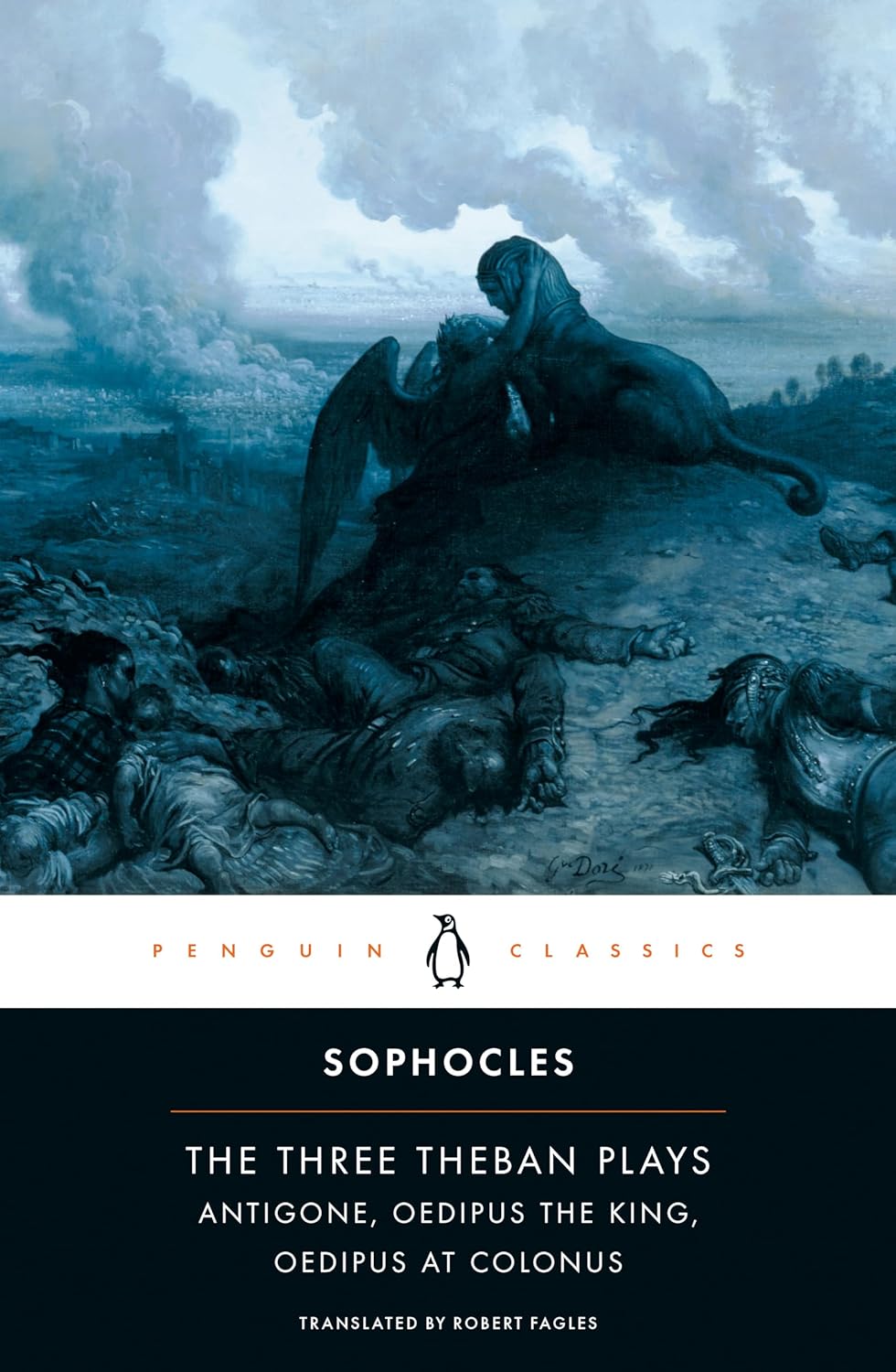
#1 — The Three Theban Plays — trans. Robert Fagles (1982)
- Readability: High — dramatic rhythm and theatrical momentum
- Accuracy: Very good — faithful while vivid
- Tone: Urgent and performative
- Accessibility: Excellent for first-time readers

Michael Sheen's powerful and dramatic narration captures the tragic intensity of Sophocles' play, while Fagles' translation is widely praised for its poetic clarity and accessibility.
Listen on Audible →Which translation is right for you?
- Choose Fagles if you want dramatic momentum and the best short introduction to Sophocles for a first reading.
- Choose Griffith (Chicago) if you want scholarly accuracy, textual precision, and extensive notes for close or academic study.
- Choose Roche if you want an inexpensive, accessible complete collection for a first encounter with Greek tragedy.
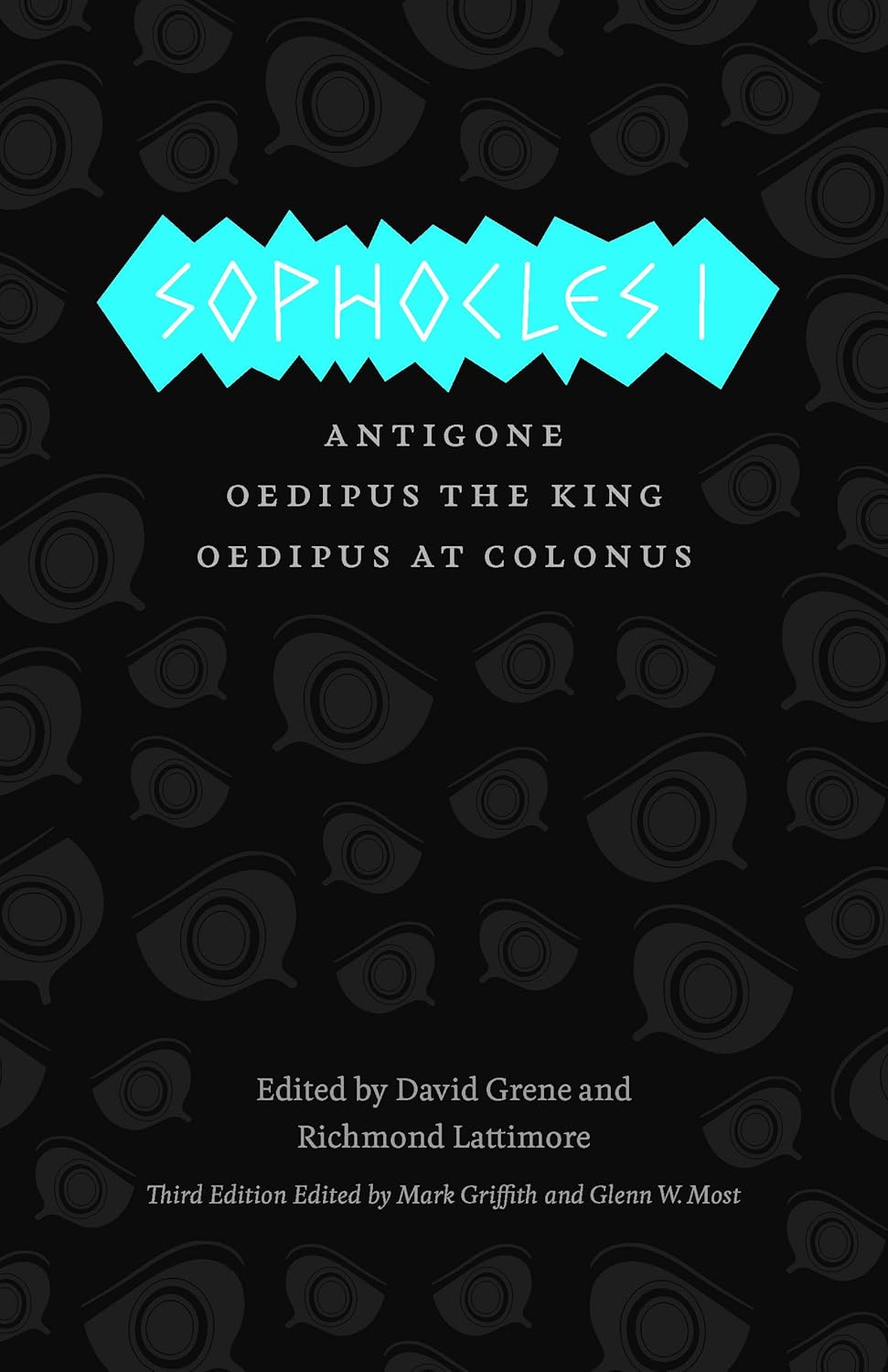
#2 — Sophocles I: The Theban Plays — trans. Mark Griffith (2013, Chicago Complete Greek Tragedies)
- Readability: Moderate — prioritises precision
- Accuracy: Excellent — textual fidelity first
- Tone: Scholarly and measured
- Accessibility: Best for students and researchers
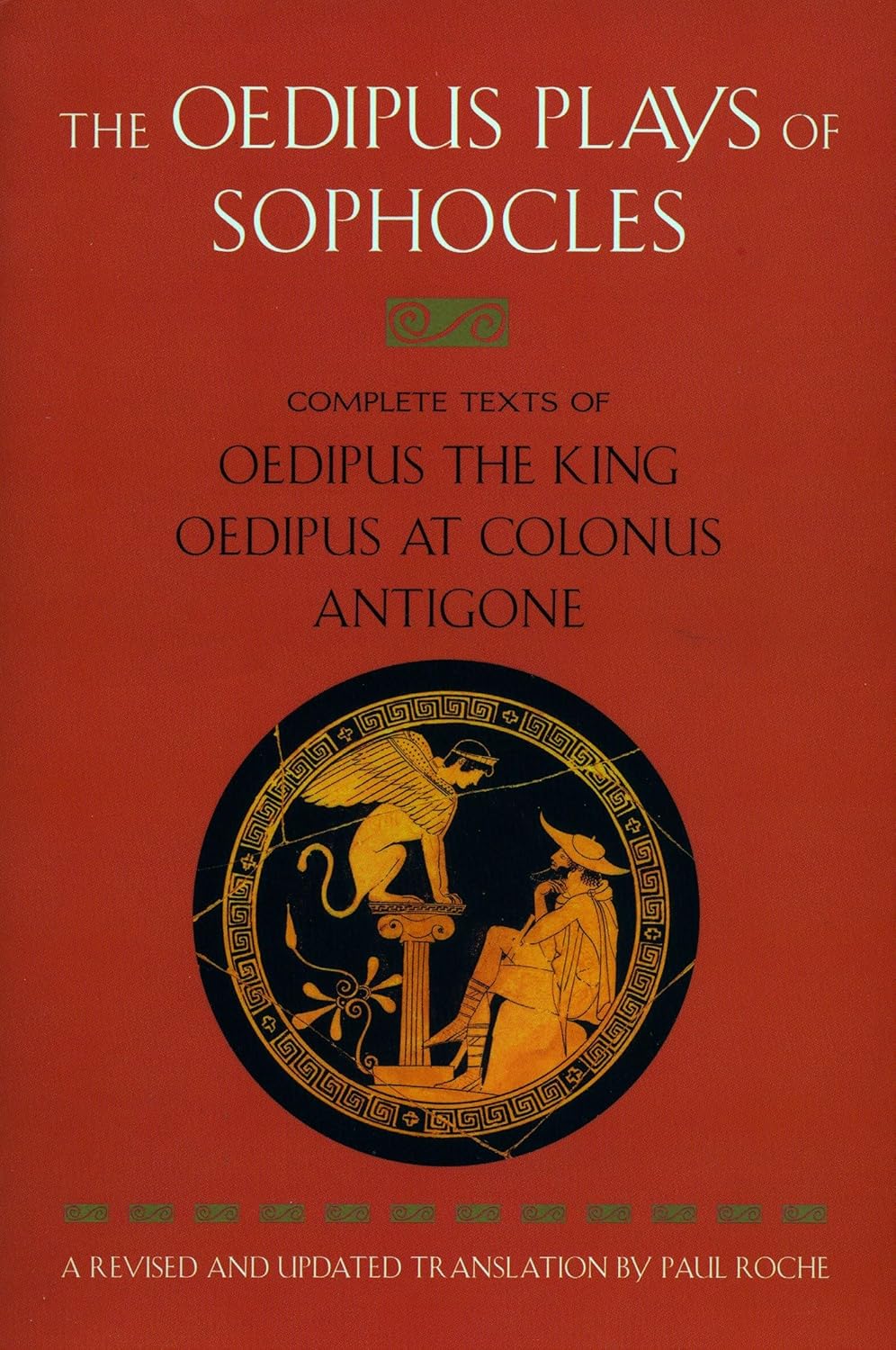
#3 — The Oedipus Plays of Sophocles — trans. Paul Roche (1958)
- Readability: Very high — clear and straightforward
- Accuracy: Good — accessible rather than literal
- Tone: Plainspoken and approachable
- Accessibility: Ideal inexpensive entry point
About the Translators
Robert Fagles (1933–2008, 1982, Penguin Classics): Professor of Comparative Literature at Princeton; winner of the PEN/Ralph Manheim Medal for Translation; his other translations include Homer's Iliad and Odyssey and Aeschylus's Oresteia — a body of work that established him as the pre-eminent translator of ancient epic and drama into contemporary English. His introductions and notes by the classical scholar Bernard Knox (1914–2010) are among the best short guides to ancient Greek literature available in English; Knox's hundred-page introduction to the Theban plays alone justifies the purchase of the Penguin Classics edition.
Mark Griffith (2013, University of Chicago Press): Professor of Classics at the University of California, Berkeley; author of major studies of Greek tragedy and Hesiod; his Chicago translation updated and replaced the earlier Sophocles I translations by David Grene that had defined the series for decades. The University of Chicago Complete Greek Tragedies series, edited originally by David Grene and Richmond Lattimore and now in its third edition, remains the standard scholarly edition of all the ancient Greek dramatists in English.
Paul Roche (1916–2007, 1958, Plume): British poet and classicist; his other translations include Aristophanes's complete plays and Aeschylus's Oresteia for Mentor/Plume; known for accessible verse translations aimed at readers without classical training. His single Plume paperback collecting all three Oedipus plays has been a widely used classroom introduction to Greek tragedy for decades.
Themes
The detective who is the criminal. Oedipus Rex is constructed as a detective story in which the detective's investigation of the crime gradually reveals that he himself is the criminal. The dramatic irony — the audience knows what Oedipus does not — gives the play its particular quality of mounting dread. Sophocles does not present the audience with a mystery; he presents them with the experience of watching a brilliant, determined man pursue the truth with increasing intensity until he can no longer avoid it. The formal perfection Aristotle noted in the Poetics is inseparable from this structure: every scene tightens the trap that Oedipus has set for himself.
Sight and blindness. The play is organised around a sustained metaphor of sight and blindness that operates on multiple levels simultaneously. Teiresias, the blind prophet who sees the truth, refuses to reveal it. Oedipus, who has physical sight, is blind to the truth about himself. Jocasta, who sees enough to be horrified, tries to prevent Oedipus from looking further. When Oedipus finally knows, he blinds himself — exchanging physical sight for the terrible inner knowledge he has acquired. The metaphor carries the play's central claim: that seeing and knowing are not the same thing, and that the truth can be hidden in plain sight for decades.
Human knowledge and divine foreknowledge. The oracle that governs the play was pronounced before Oedipus's birth: he will kill his father and marry his mother. Every action taken to prevent this — his birth parents abandoning him, his adoptive parents sending him away, Oedipus's own flight from Corinth — contributes to its fulfilment. Sophocles does not offer a moral about fate or free will; he presents the collision between human intelligence and divine foreknowledge and shows what happens when human beings, operating in good faith with the information they have, still cannot avoid what is coming. The play's most enduring question is whether Oedipus is guilty, and the play refuses to answer.
Key Characters
Oedipus — king of Thebes; a man of exceptional intelligence and integrity who solved the Sphinx's riddle and saved the city; now investigating the plague that is destroying it, with the same relentless energy and certainty of his own capacities that served him before. His determination to know the truth, even when every witness begs him to stop, is simultaneously his greatest virtue and the cause of his destruction.
Jocasta — Oedipus's wife and mother; a woman of courage and pragmatic intelligence who arrives at the truth before Oedipus does and makes her exit as soon as she has understood what is coming. Her final moments — when she runs from the stage — are among the most terrible in Greek drama: she knows, and cannot say what she knows, and her only option is silence.
Teiresias — the blind prophet; he knows the truth and refuses to speak it. His scene with Oedipus — in which Oedipus's growing rage at Teiresias's silence gradually extracts the accusation that Oedipus himself is the murderer — is one of the great confrontation scenes in drama, and its irony (the blind man sees; the seeing man is blind) is the play's central image compressed into a single exchange.
Creon — Jocasta's brother; a figure of bureaucratic good sense who becomes, in this play, a target for Oedipus's paranoid suspicion (that Creon and Teiresias have conspired to frame him) and then, in Oedipus at Colonus and Antigone, a figure of power unchecked by self-knowledge.
Recommended Sources
For further academic reading on Sophocles and Oedipus Rex:
- Classical Quarterly (Cambridge University Press) — the leading journal for Greek and Latin literature; essential for Sophocles scholarship and textual study of the Theban plays.
- American Journal of Philology (Johns Hopkins) — the principal American journal for classical philology; key for the play's language, formal structure, and its relationship to Aristotle's account of tragedy in the Poetics.
- Arion: A Journal of Humanities and the Classics (Boston University) — important for more expansive literary and cultural readings of Greek tragedy and its modern reception.
Which translation is right for you?
Choose Fagles (Penguin Classics) for a first reading — his translations have the dramatic momentum that makes the plays feel urgent, Bernard Knox's introduction is the best short guide to Sophocles available in English, and the Penguin Classics Deluxe Edition is the most attractive format. Choose Griffith / Chicago for scholarly or close reading — the Chicago series is the standard academic edition, its notes are the most extensive, and its translations prioritise accuracy over theatrical effect. Choose Roche (Plume) if you want an inexpensive complete collection in an accessible format — his version is the easiest entry point for readers approaching Greek tragedy for the first time.
Frequently Asked Questions
What is Oedipus Rex about?
Oedipus Rex is a tragedy by Sophocles that tells the story of Oedipus, a king who seeks to rid Thebes of a plague by uncovering the truth about his own origins. His investigation reveals that he has unwittingly fulfilled a prophecy by killing his father and marrying his mother, leading to his tragic downfall.
Is Oedipus Rex hard to read?
Oedipus Rex can be challenging due to its complex themes and ancient context. The Fagles translation is praised for its dramatic clarity, while Roche offers a more accessible entry point for beginners. Griffith's version is best for those seeking scholarly precision.
Which Oedipus Rex translation is best?
The Robert Fagles translation is the most dramatically alive English version and the one most likely to make the plays feel urgent in performance or on the page.
Fagles vs Griffith — which should I choose?
Choose Fagles for a first reading with dramatic momentum and Bernard Knox's excellent introduction. Choose Griffith / Chicago for scholarly or close reading where accuracy and textual precision are prioritized.
Which translation is easiest to read?
Paul Roche's translation is the most accessible and easiest entry point for readers approaching Greek tragedy for the first time.
Which translation is most accurate?
The Chicago Complete Greek Tragedies edition translated by Mark Griffith prioritises accuracy and textual precision and is the standard scholarly edition.
Should I read all three Theban plays together?
Yes. Most editions collect all three, which is the right way to read them: together they form one of the great arcs in literature.
This guide is based on reading all three translations and reviewing scholarly commentary. Last reviewed: June 2026.
As an Amazon Associate, I earn from qualifying purchases.
For the full text, a scene-by-scene synopsis, and a free PDF edition, visit Reading Sophocles.
Looking for another classic? Browse all our translation guides →
Our Theban Plays translation guide covers the full Sophocles cycle including Oedipus at Colonus and Antigone.
Robert Fagles also translated the best Oresteia translations — see how his Aeschylus compares to his Sophocles.
For more Greek epic in Fagles’s voice, explore our Iliad translation guide.
Readers of classical drama may also want our Aeneid translation guide comparing Ruden, Ferry, and Ahl.