The Theban Plays: What It's About & Best Translation
Sophocles's three plays about Oedipus and Antigone — Fagles's Penguin versus the Chicago Complete Greek Tragedies
As an Amazon Associate, we earn from qualifying purchases.
The Theban Plays by Sophocles consist of three tragedies that explore the fate of Oedipus and his family. The plays delve into themes of fate, free will, and the consequences of human actions, focusing on Oedipus's tragic discovery of his own identity and Antigone's defiance of state laws to honor her brother.
For Oedipus the King, our companion site Reading Sophocles has the full text of R. C. Jebb's translation, scene by scene with his notes, reference pages on the myths, characters and theater behind the play, and the edition as a free PDF.
Translation Comparison at a Glance
| Translation | Readability | Accuracy | Tone | Best For |
|---|---|---|---|---|
| Fagles (1982) | High | Good | Theatrical, rhythmic | First reading, performance |
| Grene & Lattimore (Chicago, 3rd ed.) | Moderate | Excellent | Literal, scholarly | Academic study, close reading |
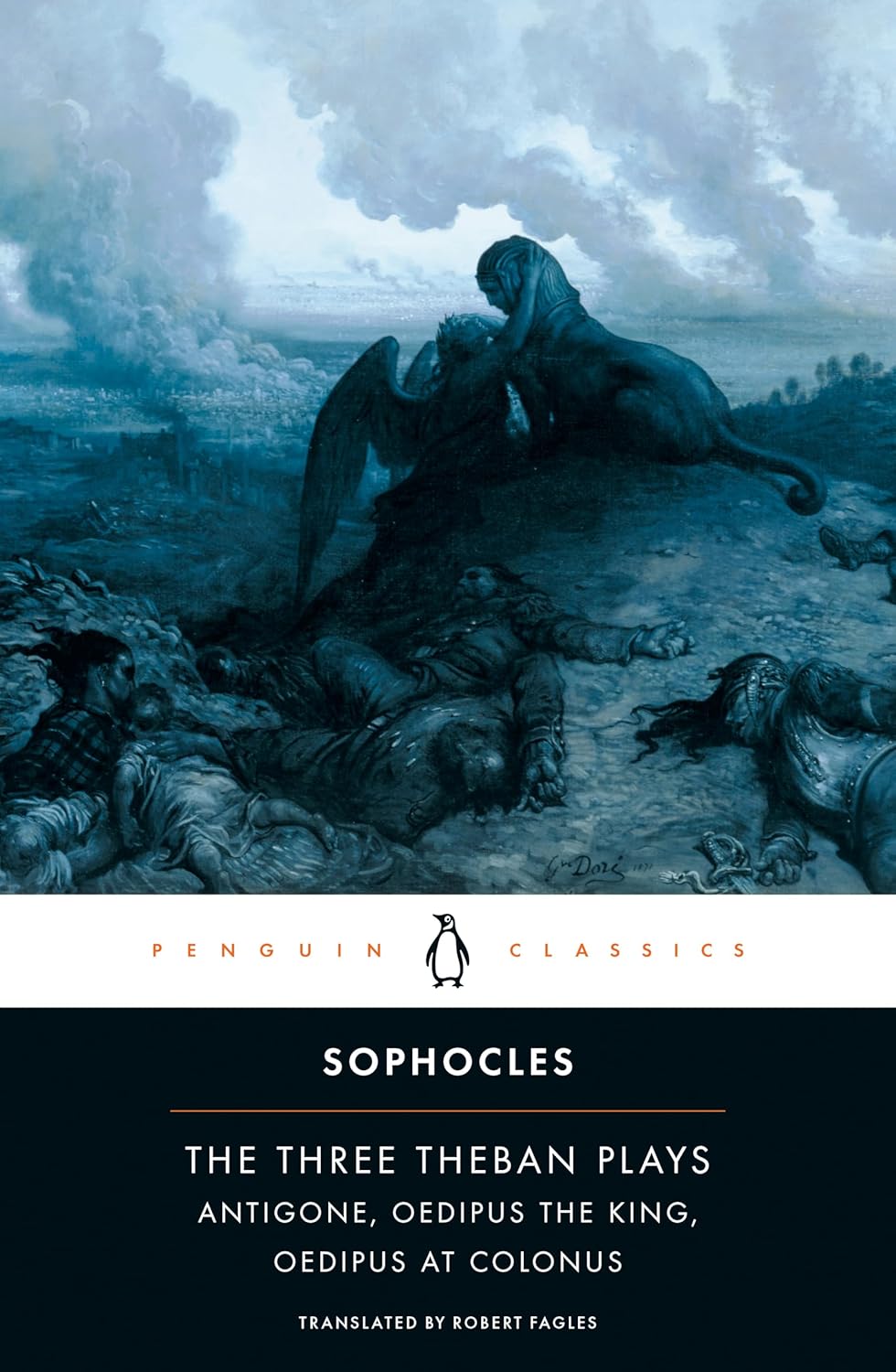
#1 — The Three Theban Plays — trans. Robert Fagles (1982)
- Readability: High — written for the voice with rhythmic force and dramatic momentum.
- Accuracy: Good — prioritises spoken effect while remaining faithful.
- Tone: Theatrical and contemporary without being anachronistic.
- Accessibility: Excellent for first-time readers and theatrical production.
Which translation is right for you?
- Choose Fagles if you want a first reading that is written for the voice and the stage, with rhythmic force and dramatic momentum.
- Choose Grene & Lattimore (Chicago) if you want the scholarly standard for academic study, with translations that prioritise accuracy and interpretive neutrality.
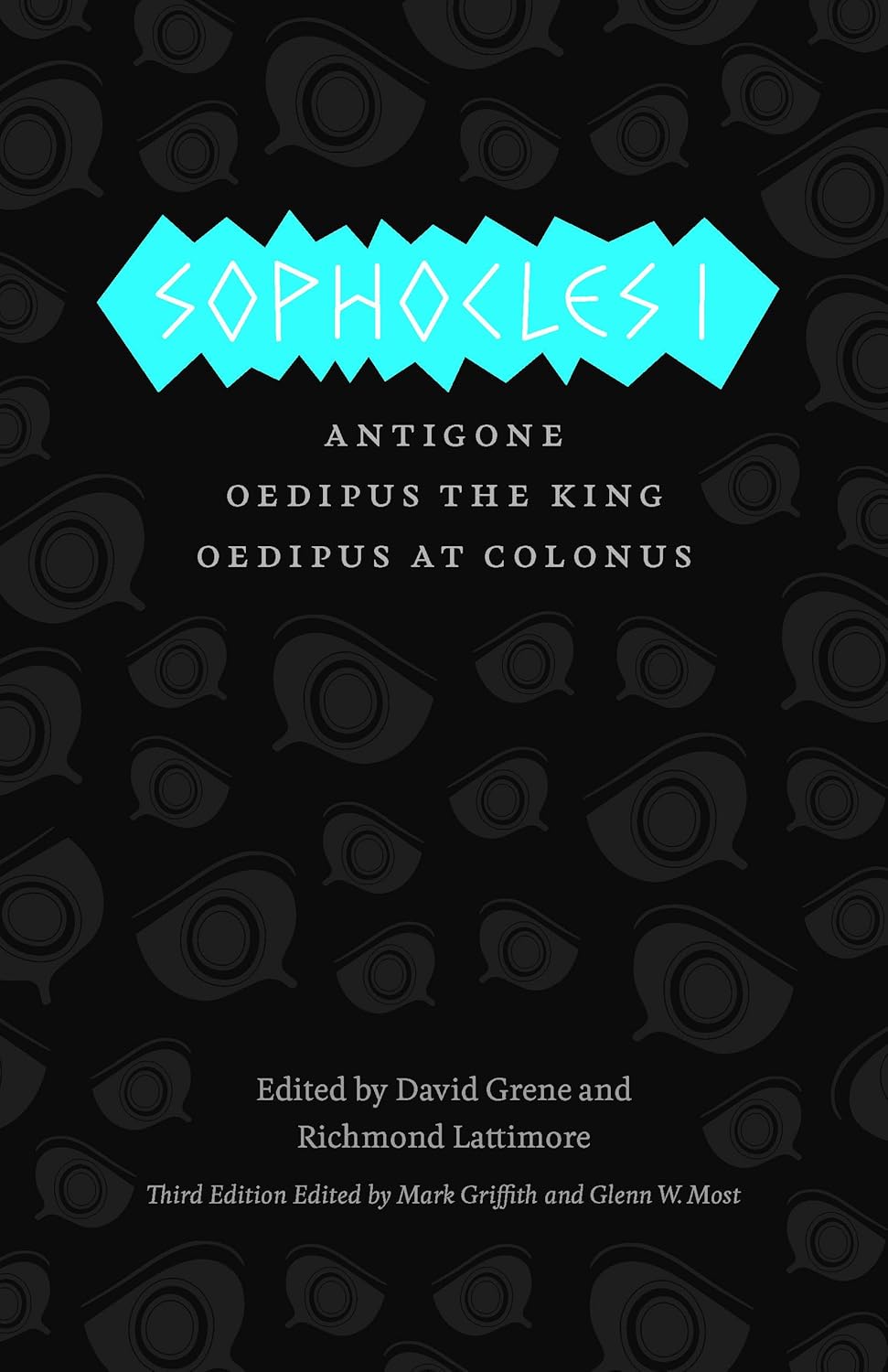
#2 — Sophocles I: The Theban Plays — ed. David Grene & Richmond Lattimore, 3rd ed. Mark Griffith & Glenn W. Most
- Readability: Moderate — more literal and less theatrical.
- Accuracy: Excellent — prioritises fidelity to the Greek.
- Tone: Neutral and scholarly, preserving strangeness.
- Accessibility: Best for students working alongside the Greek text.
About the Translators
Robert Fagles (1933–2008, 1982, Penguin Classics): Professor of Comparative Literature at Princeton; his other translations include Homer's Iliad and Odyssey and Virgil's Aeneid, which together established him as the most widely read translator of ancient epic and drama in English. His Sophocles is the version most commonly used in theatrical production and in university humanities courses. The Penguin edition's introduction and notes by Bernard Knox — one hundred pages of classical scholarship — are themselves a major reference.
David Grene (1913–2002) and Richmond Lattimore (1906–1984) founded the University of Chicago's Complete Greek Tragedies series in the 1940s and 1950s; the project has become the standard scholarly series for Greek drama in English. The third edition, revised by Mark Griffith (University of California, Berkeley) and Glenn W. Most (Scuola Normale Superiore, Pisa), updated the translations throughout and reflects current scholarly understanding of the Greek text. The Chicago Sophocles I is the version most commonly used in academic study of the plays as Greek literature.
Themes
Fate and the impossibility of ignorance. Oedipus the King is structured as a detective story in which the detective discovers that he is the murderer he is hunting: Oedipus pursues the truth about Laius's killer with relentless energy, dismissing every warning, ignoring every hint, until the knowledge arrives and destroys him. Aristotle used the play as his paradigm of tragedy because it demonstrates that the protagonist's downfall follows necessarily from who he is — his intelligence, his determination, his refusal to be deterred — rather than from a moral failing separable from his character.
The law of the dead versus the law of the state. Antigone stages the foundational political conflict of Western political philosophy: the claim of divine and natural law (Antigone's obligation to bury her brother) against the claim of positive law and political authority (Creon's edict forbidding burial of traitors). Neither character is simply right or wrong; both are destroyed by their absolute commitment to a principle. The play has been read as a tragedy of Antigone, a tragedy of Creon, and a tragedy of the incommensurability of the obligations each represents.
Blindness and insight. Tiresias, the blind prophet, is the only character in the Theban Plays who consistently sees clearly. The irony that structures both Oedipus plays — that the man who can see is blind to what matters, while the blind man sees what no one else can — is Sophocles's deepest formal device, and it extends to the audience's relationship to the plays: we know from the myth what the characters do not yet know, and we watch them approach the knowledge that will destroy them.
Key Characters
Oedipus — king of Thebes; the man who solved the Sphinx's riddle and married the queen; the investigator who discovers he is the criminal; the paradigmatic tragic hero in Western literary tradition. His intelligence and energy are inseparable from his blindness to his own nature.
Antigone — Oedipus's daughter; the woman who buries her brother Polynices in defiance of Creon's edict and accepts death as the consequence. She is one of the great figures of political resistance in all literature, and her particular brand of resistance — rooted in familial obligation rather than abstract principle — has generated debate across twenty-five centuries.
Creon — King of Thebes; the tragic figure of Antigone; a man who believes he is defending the state's authority and discovers too late that he has destroyed everything he loves in its name. His function shifts between the plays: in Oedipus the King he is a secondary figure; in Antigone he is the protagonist.
Tiresias — the blind prophet who appears in all three plays and delivers the warnings no one heeds until it is too late. His blindness is the emblem of a knowledge unavailable to ordinary human sight.
Jocasta — Oedipus's mother and wife; the woman who attempts to stop Oedipus's investigation and dies before its conclusion. Her pragmatic scepticism about oracles is both reasonable and fatally wrong.
Recommended Sources
For further academic reading on Sophocles and the Theban Plays:
- Classical Quarterly (Oxford University Press) — the leading British journal for Greek and Latin literary studies; decades of essential Sophocles scholarship.
- American Journal of Philology (Johns Hopkins) — the primary American journal for classical studies; key venue for interpretive and textual work on Sophocles.
- Arion (Boston University) — a journal for literature and the humanities with a strong record of publishing important essays on Sophocles and Greek tragedy for a non-specialist audience.
Which translation is right for you?
Choose Fagles (Penguin Classics) for a first reading — his translations are written for the voice and the stage, with rhythmic force and dramatic momentum that make the plays come alive on the page; Bernard Knox's introduction is one of the best available guides to reading Sophocles. Choose the Chicago Complete Greek Tragedies (University of Chicago Press) for academic study — the translations prioritise accuracy and neutrality over theatrical effect, the apparatus tracks the Greek text carefully, and the series is designed for readers who want to think through the plays as ancient literature.
Frequently Asked Questions
What is The Theban Plays about?
The Theban Plays by Sophocles consist of three tragedies that explore the fate of Oedipus and his family. The plays delve into themes of fate, free will, and the consequences of human actions, focusing on Oedipus's tragic discovery of his own identity and Antigone's defiance of state laws to honor her brother.
Is The Theban Plays hard to read?
The Theban Plays can be challenging due to their ancient context and themes. Fagles's translation is more accessible for modern readers, emphasizing readability and dramatic effect, while Grene & Lattimore's version is more literal and suited for academic study.
Which Theban Plays translation is best?
Start with Robert Fagles's Penguin Classics edition for a first reading. It is written for the voice and the stage, with rhythmic force and dramatic momentum.
Fagles vs Chicago — which should I choose?
Choose Fagles for theatrical reading and university humanities courses; choose the Chicago Complete Greek Tragedies for academic study and close reading of the Greek text.
Which translation is easiest to read?
Fagles's translation is the easiest to read. It prioritises spoken rhythm and dramatic momentum over literal fidelity.
Which translation is most accurate?
The Chicago Complete Greek Tragedies edition is the most accurate. Its translations are more literal and preserve the strangeness of the Greek.
Why are the three Theban Plays published together when they were not written as a trilogy?
They share characters, mythology, and recurring questions about fate, law, and knowledge, so modern readers and publishers treat them as a unified examination of the Theban cycle.
This guide is based on reading both translations and reviewing scholarly commentary. Last reviewed: June 2026.
As an Amazon Associate, I earn from qualifying purchases.
For the full text of Oedipus the King, a scene-by-scene synopsis, and a free PDF edition, visit Reading Sophocles.
Looking for another classic? Browse all our translation guides →
Reading more Sophocles? See our guide to the best Oedipus Rex translation.
For Aeschylus, our Oresteia translation guide compares Fagles against Lattimore and Carson.
Exploring Greek epic? Check our Iliad translation guide covering Fagles, Wilson, and Lattimore.
Also reading classical drama? Our Aeneid translation guide compares Ruden, Ferry, and Ahl.