Oresteia: What It's About & Best Translation
Three plays, one argument: who gets to decide what justice means
As an Amazon Associate, we earn from qualifying purchases.
The Oresteia is a trilogy of Greek tragedies by Aeschylus that follows the story of the House of Atreus, focusing on themes of justice, vengeance, and the transition from personal retribution to a system of organized litigation.
Translation Comparison at a Glance
| Translation | Readability | Accuracy | Tone | Best For |
|---|---|---|---|---|
| Fagles (1977) | High | Very good | Theatrical, urgent | First-time readers |
| Lattimore (1953) | Moderate | Excellent | Dense, scholarly | Academic study |
| Carson (2009) | High | Very good | Inventive, strange | Comparative reading |
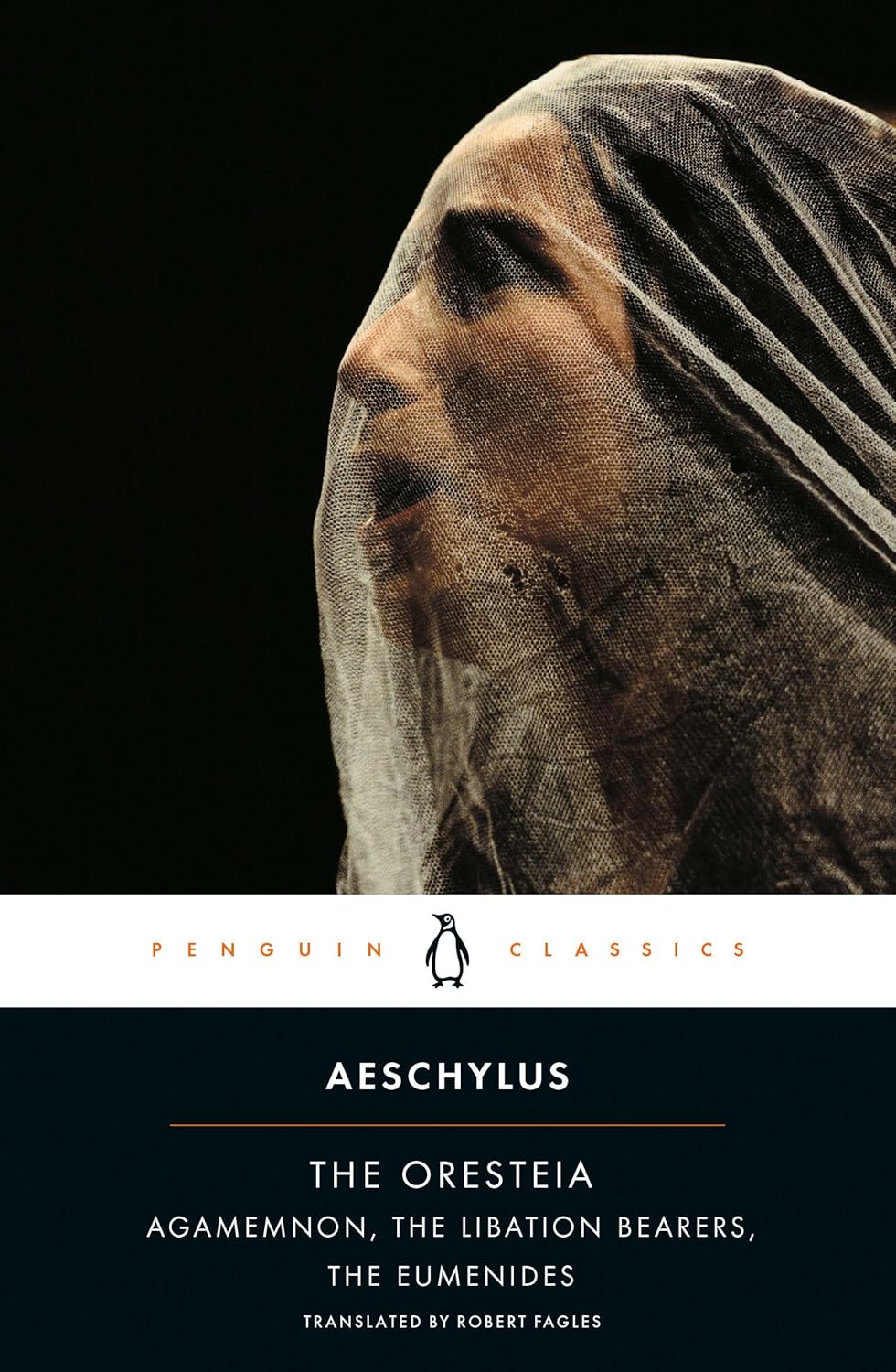
#1 — The Oresteia — trans. Robert Fagles (1977)
- Readability: High — free verse that carries dramatic force.
- Accuracy: Very good — balanced with theatrical energy.
- Tone: Urgent and stage-ready.
- Accessibility: Excellent for first-time readers.
Which translation is right for you?
- Choose Fagles if you want the most dramatically alive version for a first reading or performance.
- Choose Lattimore if you are studying the plays academically and want maximum fidelity to the Greek.
- Choose Carson if you already know the trilogy and want a radically inventive comparative approach.
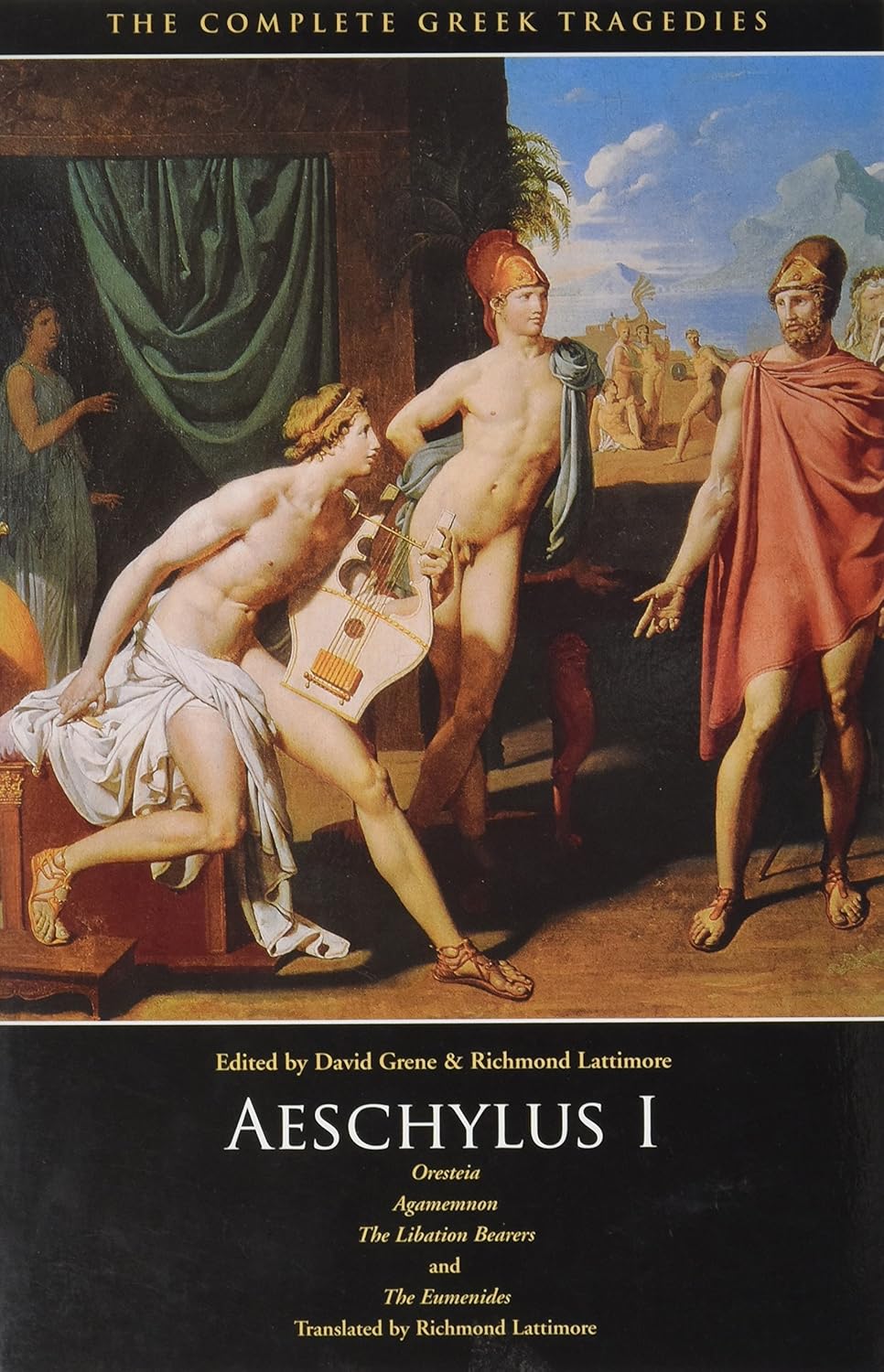
#2 — The Oresteia — trans. Richmond Lattimore (1953)
- Readability: Moderate — rewards slow reading.
- Accuracy: Excellent — line-by-line fidelity.
- Tone: Dense and archaic.
- Accessibility: Best for scholars and re-readers.
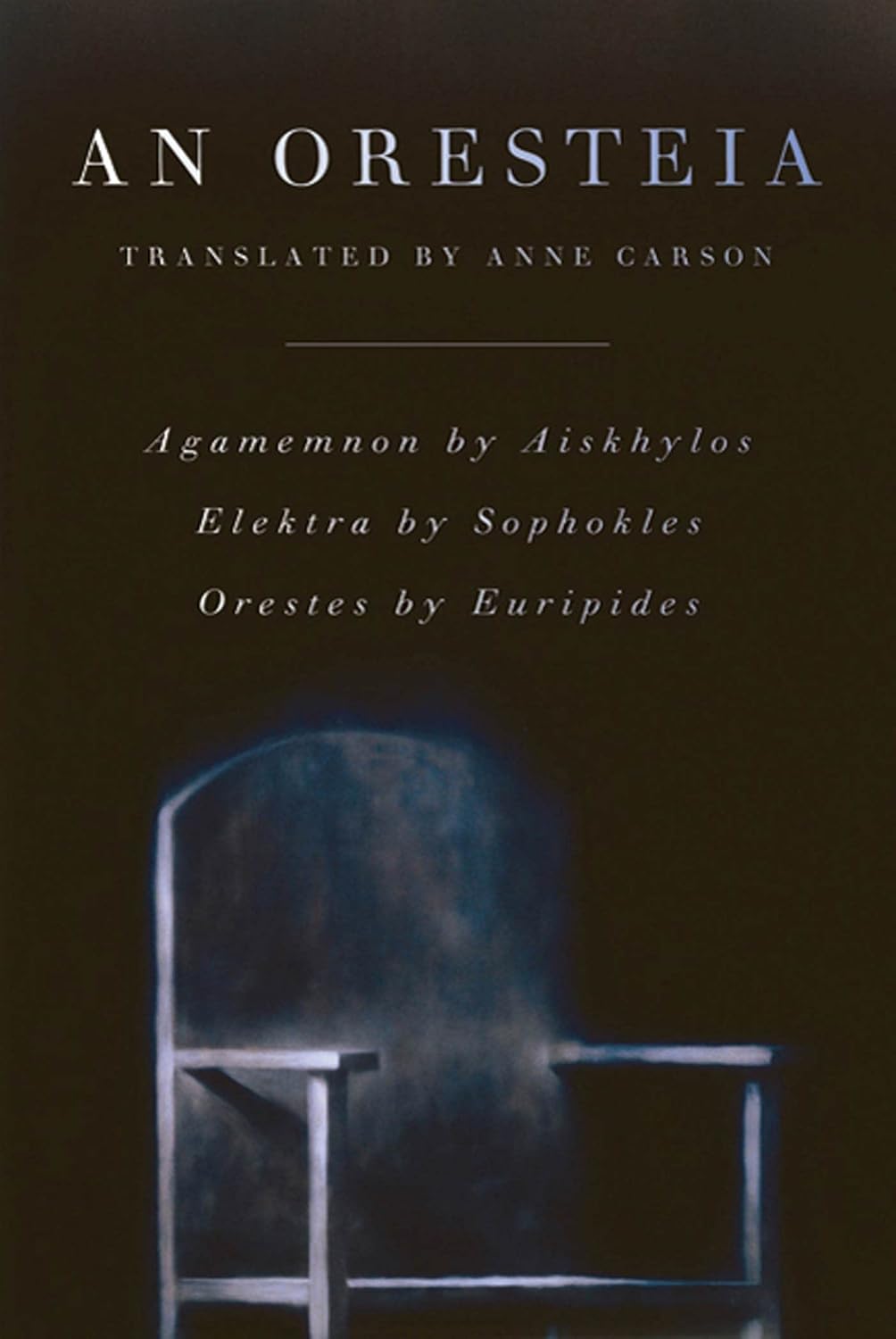
#3 — An Oresteia — trans. Anne Carson (2009)
- Readability: High — inventive and surprising.
- Accuracy: Very good — amplifies strangeness.
- Tone: Austere, ironic, modern.
- Accessibility: Best as a second or third encounter.
About the Translators
Robert Fagles (1933–2008): Professor of Comparative Literature at Princeton; his translations of the Iliad, Odyssey, and Aeneid are the standard Penguin Classics editions and have sold millions of copies. The Oresteia (1977) was his first major translation project; he received a National Humanities Medal in 1996.
Richmond Lattimore (1906–1984): Professor of Greek at Bryn Mawr; his translations of the Iliad, Odyssey, and the complete Greek tragedies (for the University of Chicago series, co-edited with David Grene) set the standard for scholarly English translation of ancient Greek in the mid-twentieth century.
Anne Carson (b. 1950): Canadian poet, classicist, and MacArthur Fellow; professor at New York University. Her books include Autobiography of Red, The Beauty of the Husband, and Nox. She has translated Sappho (If Not, Winter), Sophocles (Antigonick), and Euripides (Bakkhai), and is widely considered the most significant poet-classicist writing in English today.
Themes
The cycle of vengeance. The trilogy's first question is not "who killed Agamemnon?" but "when does a killing become murder, and who is entitled to avenge it?" Clytemnestra killed Agamemnon because he sacrificed their daughter Iphigenia at Aulis. The Furies pursue Orestes because he killed his mother. Every killing is both crime and justified response. The trilogy's argument is that this cycle cannot be broken from inside — it requires the institution of a new kind of authority, which is what Athena's court in the Eumenides provides.
The invention of justice. The Eumenides ends with a trial: Orestes is judged by a jury of Athenian citizens, with Apollo arguing his defense and the Furies arguing prosecution, and Athena casting the deciding vote. Aeschylus is making a claim about Athens — that the city's institutions represent a genuine advance over the old law of blood vengeance, that deliberation can break cycles that violence cannot. Whether this ending is ironic or sincere about that claim is one of the central debates in Oresteia scholarship.
Gender and the logic of power. The Oresteia repeatedly frames its conflicts in terms of gendered authority. Clytemnestra rules Argos while Agamemnon is at war; her power is consistently described by the chorus as unnatural and threatening. The trial in the Eumenides produces a troubling gender argument: Apollo argues that the mother is not a true parent (only the father is), so matricide is less serious than parricide. Athena votes for acquittal on these grounds. The play embeds its founding of justice within a patriarchal logic it does not examine.
Key Characters
Agamemnon — the king who sacrificed his daughter Iphigenia to gain favorable winds for the fleet at Aulis, and who returns from Troy with the captive prophetess Cassandra. He is not heroic — he is vain, brutal, and heedless — and his murder at Clytemnestra's hands, described offstage and narrated through screams, is the trilogy's originating act.
Clytemnestra — the most formidable character in Greek tragedy. She has waited ten years for Agamemnon's return, plotting his murder; she kills him in the bath. She is not a villain but an avenger — her speech explaining why she killed him is entirely coherent — and the Oresteia never fully refutes her case.
Orestes — Agamemnon's son, commanded by Apollo to avenge his father by killing his mother. He obeys and is immediately pursued by the Furies. His trial in Athens is the trilogy's resolution, though its terms remain troubling.
Cassandra — the Trojan prophetess brought back as Agamemnon's war-prize. She knows she will die; she sees it clearly; she cannot prevent it. Her long lament in Agamemnon, in which she describes her curse and narrates the house of Atreus's history of slaughter, is one of the greatest passages in all drama.
The Furies (Erinyes/Eumenides) — ancient goddesses of blood vengeance who pursue Orestes after the matricide. They are the old law made manifest — older than the Olympian gods, older than the institutions Athena founds. Their transformation at the end from Erinyes to Eumenides (from Furies to Kindly Ones) is the trilogy's moment of resolution.
Recommended Sources
For further academic reading on Aeschylus and the Oresteia:
- Greek, Roman and Byzantine Studies (Duke University Press) — one of the leading journals for Aeschylean scholarship; essential for textual criticism and interpretation.
- Classical Quarterly (Oxford University Press) — the primary British journal for Greek and Latin literary studies; decades of Oresteia scholarship across every interpretive approach.
- Transactions of the American Philological Association — major venue for American classical scholarship; key for comparative and theoretical readings of the trilogy.
Which translation is right for you?
Choose Fagles (Penguin) for a first reading — his version is the most dramatically alive in English, the one that makes the plays feel like theater rather than literature, and Bernard Knox's introduction is essential orientation. Choose Lattimore (Chicago) for academic study — his version is the most faithful to Aeschylus's density and the standard reference for classics departments. Choose Carson (Faber) as a second or third encounter — her Agamemnon is considered one of the great performances of that play in English, and her decision to include Sophocles and Euripides alongside makes it a genuinely different kind of book.
Frequently Asked Questions
What is Oresteia about?
The Oresteia is a trilogy of Greek tragedies by Aeschylus that follows the story of the House of Atreus, focusing on themes of justice, vengeance, and the transition from personal retribution to a system of organized litigation.
Is Oresteia hard to read?
Oresteia can be challenging due to its complex themes and archaic language, but the Fagles translation is noted for its readability, while Lattimore offers a more scholarly approach.
Which Oresteia translation is best?
The Robert Fagles translation is the best starting point for most readers because it is the most dramatically alive version in English.
Fagles vs Lattimore — which should I choose?
Choose Fagles for a first reading and theatrical energy; choose Lattimore for academic study and maximum fidelity to Aeschylus's dense Greek.
Which translation is easiest to read?
Fagles is the easiest to read and the most dramatically immediate.
Which translation is most accurate?
Lattimore is the most accurate and faithful to the original Greek text and meter.
Is Anne Carson's An Oresteia a complete translation of Aeschylus?
No. Carson translates Aeschylus's Agamemnon but pairs it with Sophocles' Elektra and Euripides' Orestes for a comparative trilogy.
This guide is based on reading all three translations and reviewing scholarly commentary. Last reviewed: June 2026.
As an Amazon Associate, I earn from qualifying purchases.
Looking for another classic? Browse all our translation guides →
Robert Fagles also translated the best Iliad translation — his version remains the standard starting point for new readers.
For more Greek tragedy, see our guide to the best Oedipus Rex translations including Fagles and the Chicago edition.
Explore the rest of Sophocles with our Theban Plays translation guide comparing Fagles against the Chicago Complete Greek Tragedies.
Anne Carson's inventive approach also appears in our best Metamorphoses translation recommendations.