The Red and the Black: What It's About & Best Translation
Stendhal's great novel of ambition — Slater's Oxford versus Adams's Norton Critical
As an Amazon Associate, we earn from qualifying purchases.
The Red and the Black follows Julien Sorel, a young man of humble origins who seeks to rise in society through a combination of ambition, intelligence, and manipulation. Set against the backdrop of post-Napoleonic France, the novel explores themes of social class, hypocrisy, and the tension between genuine ambition and moral compromise.
Translation Comparison at a Glance
| Translation | Readability | Accuracy | Tone | Best For |
|---|---|---|---|---|
| Slater (2009) | High | Very good | Fluent, contemporary | First reading, general readers |
| Adams (2008) | Moderate | Excellent | Formal, scholarly | Classroom use, close study |
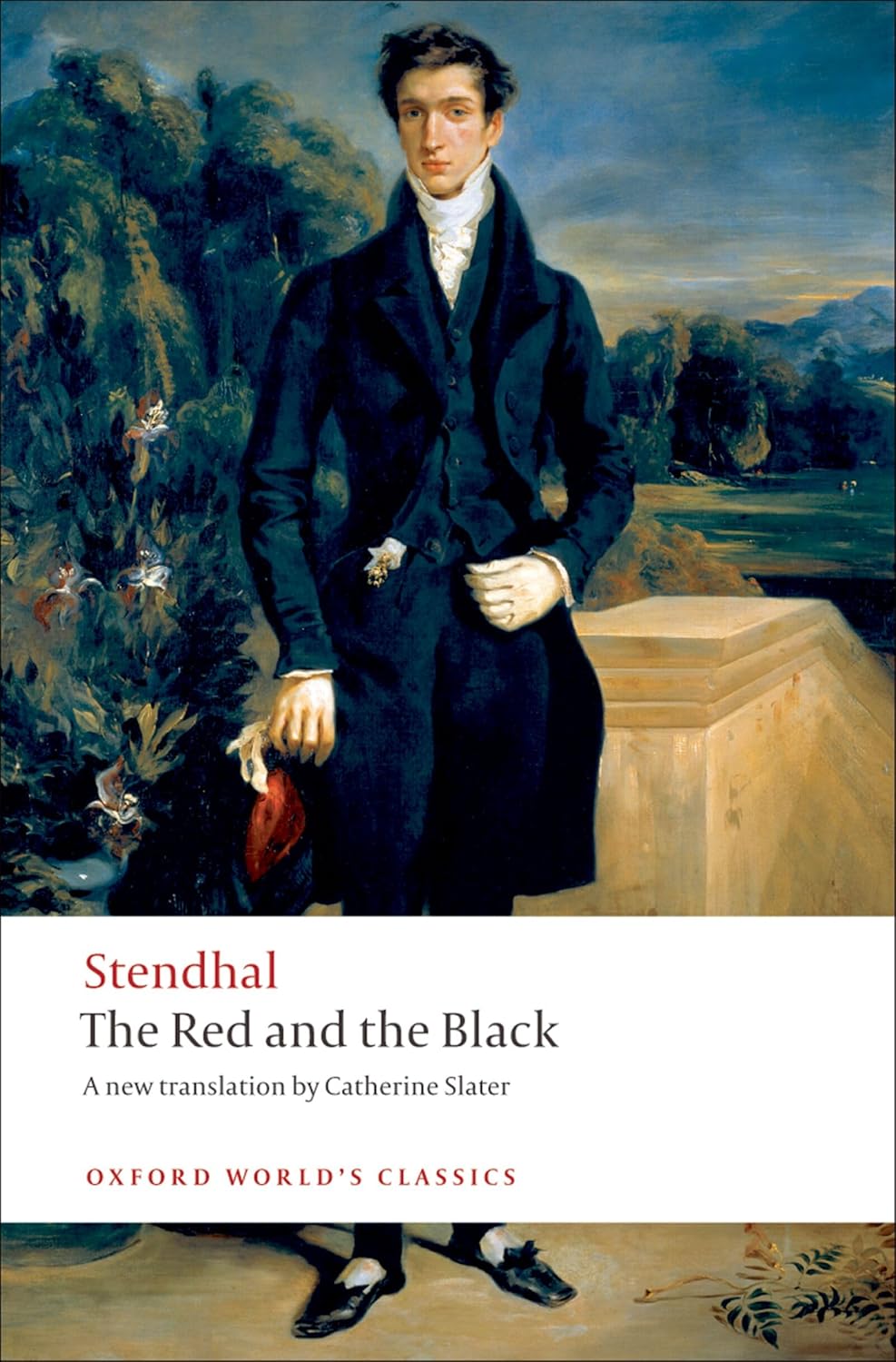
#1 — The Red and the Black — trans. Catherine Slater (2009)
- Readability: Fluent and contemporary without sacrificing period texture.
- Accuracy: Very good; preserves distinctions of rank and ironic psychology.
- Tone: Controlled irony with modern accessibility.
- Accessibility: Excellent for first-time readers.

Bill Homewood's dynamic narration captures Stendhal's psychological depth and irony, while Slater's translation preserves the novel's sharp social critique and vivid prose.
Listen on Audible →Which translation is right for you?
- Choose Slater if you want the most fluent, contemporary first-reading experience with an excellent scholarly introduction.
- Choose Adams if you need the full Norton Critical apparatus of journals, reviews, and essays for classroom or close study.
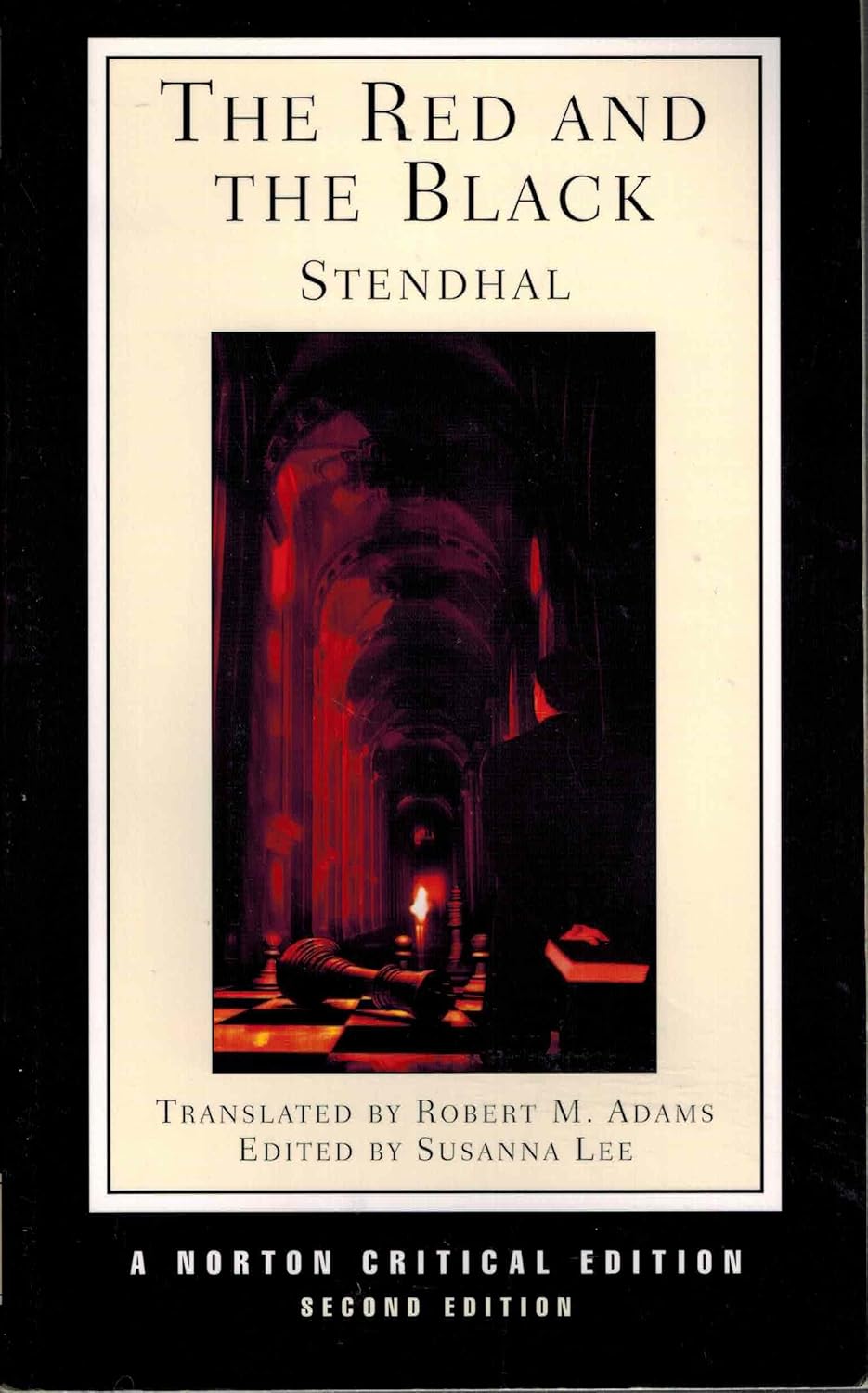
#2 — The Red and the Black — trans. Robert M. Adams, ed. Susanna Lee (2008)
- Readability: Slightly more formal than Slater.
- Accuracy: Excellent, with embedded notes for reference.
- Tone: Scholarly and precise.
- Accessibility: Best for classroom or close reading.
About the Translators
Catherine Slater (2009, Oxford World's Classics): British scholar and translator of nineteenth-century French literature; her Oxford translation includes a substantial introduction by Roger Pearson (Professor of French at Oxford and author of major studies of Stendhal and Voltaire), making it the version that best combines literary quality with scholarly orientation. Slater's English prioritises fluency and contemporary accessibility while preserving Stendhal's ironic narrative voice.
Robert M. Adams (1917–2004, 1969, Norton Critical Edition): Distinguished Professor of English and Comparative Literature at Cornell; also translated Machiavelli's The Prince, More's Utopia, and works of Montaigne for Norton. His Norton Critical translation of The Red and the Black is paired with a substantial anthology of contextual material — extracts from Stendhal's journals, contemporary reviews, and critical essays — making it the edition most used in classroom settings where the novel is read as both literature and historical document.
Themes
Ambition as the novel's engine. Julien Sorel is one of literature's great studies in ambition — specifically, the ambition of a provincial outsider who is too intelligent and too proud to accept the station he was born into, in a society structured to keep him there. Napoleon's defeat has closed the military career that would have been his natural outlet; the Church offers the only remaining avenue, and Julien's pursuit of it is simultaneously sincere (he genuinely admires what he believes a great man must be) and deeply hypocritical (he despises the craven accommodation to the powerful that clerical advancement requires). The tension between what he admires and what he must do produces the novel's central irony.
Hypocrisy as the social medium of the Restoration. Stendhal's subtitle — "A Chronicle of 1830" — signals his diagnostic intent: the novel is a portrait of a specific society at a specific moment, the France of Charles X in its final year. That society is organised around a fundamental hypocrisy — the aristocracy and the Church claim moral and social authority while acting from entirely self-interested motives — and Julien's tragedy is that he understands this perfectly and yet cannot bring himself to play the game without reservation. He is too sincere in his ambition to be comfortable with the dissimulation his ambition requires.
Love as crystallisation and its reversal. Stendhal's theory of love as "crystallisation" — from his earlier essay De l'amour — structures both of Julien's major love affairs. He projects an idealised image onto both Madame de Rênal and Mathilde de la Mole, and what he loves is largely his own creation. Yet both relationships move, under pressure, toward something more genuine: Madame de Rênal's love for Julien is the novel's most fully achieved feeling; Julien's recognition of this, at the end, too late, is its most painful moment.
Key Characters
Julien Sorel — the carpenter's son from Verrières who is brilliant, beautiful, burning with ambition, and constitutionally incapable of the consistent hypocrisy that social success requires. He is both the novel's hero — Stendhal's version of the Napoleonic type, the man of merit in a society that rewards birth — and its most rigorous object of irony.
Madame de Rênal — Julien's first employer's wife; a woman of genuine goodness who falls in love with her children's tutor with a simplicity and depth that is entirely unlike Julien's calculated emotion. Her love for him survives everything, including the letter she writes to the Marquis de la Mole that destroys him, which she writes under the direction of her confessor. She is the novel's moral centre.
Mathilde de la Mole — the Marquis's daughter; Julien's second love; a young woman of formidable intelligence who is bored by the society around her and falls in love with Julien because he is the only person she has encountered who does not bore her. Her love is theatrical and self-conscious — she models herself on her ancestor Boniface de la Mole — and the psychological game she and Julien play before and after their affair is the novel's most technically brilliant section.
The Marquis de la Mole — Julien's Paris employer; a figure of the Restoration aristocracy at its most sympathetic: genuinely cultivated, fair-minded within his class prejudices, and ultimately unable to accept Julien's marriage to his daughter. His decision to have Julien ennobled rather than disinherited is the novel's most generous aristocratic gesture, made moot by Madame de Rênal's letter.
Recommended Sources
For further academic reading on Stendhal and The Red and the Black:
- Nineteenth-Century French Studies (University of Nebraska Press) — the primary English-language journal for Stendhal scholarship and the Restoration-era French novel.
- French Studies (Oxford University Press) — key for The Red and the Black in its literary-historical context; essential for the novel's relationship to the political situation of 1830 France.
- Romanic Review (Columbia University) — the oldest American journal for Romance languages; essential for comparative readings of Stendhal alongside Balzac, Flaubert, and the French realist tradition.
Which translation is right for you?
Choose Slater (Oxford World's Classics) for a first reading — her version is the most fluent and contemporary, Roger Pearson's introduction provides an excellent orientation, and the trade paperback is the edition most readily available. Choose Adams (Norton Critical) for classroom or scholarly use — the critical apparatus, including Stendhal's own commentary and a selection of critical essays, makes it the most complete single-volume resource for the novel in English.
Frequently Asked Questions
What is The Red and the Black about?
The Red and the Black follows Julien Sorel, a young man of humble origins who seeks to rise in society through a combination of ambition, intelligence, and manipulation. Set against the backdrop of post-Napoleonic France, the novel explores themes of social class, hypocrisy, and the tension between genuine ambition and moral compromise.
Is The Red and the Black hard to read?
The Red and the Black can be challenging due to its historical context and complex themes. Slater's translation is more accessible for modern readers, while Adams offers a more scholarly approach with extensive notes.
Which The Red and the Black translation is best?
Catherine Slater's Oxford World's Classics edition is the best for most readers: fluent, contemporary, and paired with Roger Pearson's excellent introduction.
Slater vs Adams — which should I choose?
Choose Slater for a first reading and Adams (Norton Critical) when you want the full scholarly apparatus of essays, journals, and contemporary reviews alongside the text.
Which translation is easiest to read?
Slater's version is the most fluent and contemporary while still preserving the period texture of Stendhal's world.
Which translation is most accurate?
Both are reliable; Adams is slightly more formal and embeds notes directly in the text, suiting close scholarly reading.
Should I buy the Norton Critical Edition or the Oxford World's Classics edition?
Buy Norton if you need background materials and critical essays for class or deep study; buy Oxford for the cleanest first-reading experience.
This guide is based on reading the two translations and reviewing scholarly commentary. Last reviewed: June 2026.
As an Amazon Associate, I earn from qualifying purchases.
Looking for another classic? Browse all our translation guides →
Stendhal's contemporary Balzac offers a similar study of ambition in Restoration France — see our Lost Illusions translation guide.
For another landmark of French realism, compare the best Madame Bovary translations including Lydia Davis and Geoffrey Wall.
Explore Victor Hugo's epic of justice and redemption in our Les Misérables translation guide.
Another great 19th-century French novel of social climbing is Dumas's The Three Musketeers translation guide.