The Three Musketeers: What It's About & Best Translation
Dumas's swashbuckling masterpiece — and which English translation to read
As an Amazon Associate, we earn from qualifying purchases.
The Three Musketeers follows the adventures of d'Artagnan, a young nobleman, as he joins forces with three musketeers, Athos, Porthos, and Aramis, to protect the honor of the Queen of France against the schemes of Cardinal Richelieu and the villainous Milady de Winter.
Translation Comparison at a Glance
| Translation | Readability | Accuracy | Tone | Best For |
|---|---|---|---|---|
| Sudley (Penguin) | High | Good | Formal, brisk, period-appropriate | First-time readers, pure adventure |
| Le Clercq (Modern Library) | Moderate | Good | Literary, fluent | Readers wanting Furst's political intro |
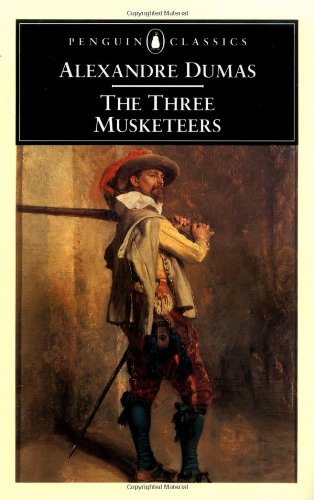
#1 — The Three Musketeers — trans. Lord Sudley (Penguin Classics)
- Readability: Brisk and consistently entertaining with a slightly formal mid-century register.
- Accuracy: Good overall; some sharpness and irony softened.
- Tone: Period-appropriate and serviceable for adventure.
- Accessibility: Easiest to find and ideal for first-time readers.

Bill Homewood's dynamic narration captures the swashbuckling energy and wit of Dumas' classic, while Peacock's translation preserves the original's vivid prose and historical flavor.
Listen on Audible →Which translation is right for you?
- Choose Sudley if you want the most widely available, brisk, and entertaining first-reading experience.
- Choose Le Clercq if you value Alan Furst's introduction framing the novel's political dimensions.
- Choose Ellsworth if you seek the most faithful modern translation of Dumas's ironic and comic French.
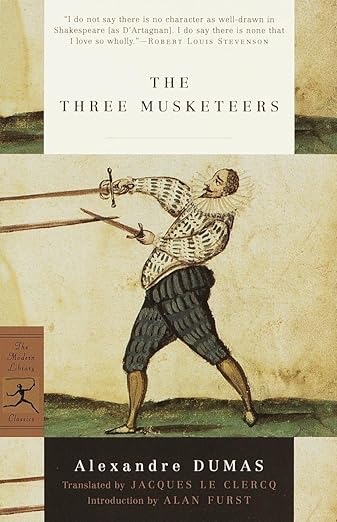
#2 — The Three Musketeers — trans. Jacques Le Clercq (Modern Library Classics)
- Readability: Pleasantly fluent with a slightly more literary character.
- Accuracy: Good; Ellsworth's later version surpasses it in fidelity.
- Tone: Literary mid-century rendering.
- Accessibility: Enhanced by Furst's political framing.
A note for those who want the most acclaimed modern translation: Lawrence Ellsworth's complete retranslation for Pegasus Books (2018), part of his comprehensive Musketeers Cycle, is widely considered the finest contemporary version of the novel — the most faithful to Dumas's ironic, comic, psychologically precise French. If you can locate it, it is the translation serious Dumas readers recommend. Bottom line: Worth owning for Furst's introduction; Ellsworth remains the top modern choice for accuracy.
About the Translators
Lord Sudley (William George Clark Wriothesley, 1920–1983, Penguin Classics): British aristocrat and translator; his mid-twentieth-century rendering has been the standard Penguin Classics edition for decades and is the version most widely encountered in English-language reading. He is primarily known through this translation.
Jacques Le Clercq (1891–1971, Modern Library): American poet, translator, and teacher at Bard College; his translations from French include major works by Rabelais, Montaigne, and Pascal for the Modern Library. His Three Musketeers has an introduction by Alan Furst, the novelist of European espionage, which frames the novel's political dimensions with particular authority.
Themes
Friendship as the novel's emotional center. "All for one, one for all" is not just a motto but the novel's structural principle: the friendship between d'Artagnan, Athos, Porthos, and Aramis is the one stable element in a world of political conspiracy, shifting alliances, and personal danger. Dumas depicts male friendship with a warmth and precision unusual in nineteenth-century fiction, and the novel's most affecting passages are those in which the four risk themselves for each other without calculation or hesitation.
History as adventure. The novel is set in 1625, during the ministry of Cardinal Richelieu. Dumas conducted genuine historical research with his collaborator Auguste Maquet, and the historical figures — Richelieu, Louis XIII, the Duke of Buckingham, Anne of Austria — behave with plausibility even in a story about diamond studs and secret assignations. The novel argues implicitly that history is made by individuals acting from love, ambition, jealousy, and loyalty rather than by impersonal forces.
Milady de Winter as the novel's darkest invention. The antagonist of the novel's second half is not Richelieu but Milady — multiple identities, branded thief, escaped nun, poisoner, and secret agent. She is one of the great villains in French fiction: intelligent, beautiful, utterly ruthless, and with a backstory that complicates the reader's moral relationship to her eventual execution at the hands of the Musketeers.
Key Characters
d'Artagnan — the young Gascon who arrives in Paris with nothing but his sword, his courage, and his impetuous temper. He is brave, resourceful, loyal to his friends and his king, and possessed of a gift for improvisation that allows him to survive every catastrophe. He is one of the most appealing protagonists in all popular fiction.
Athos — the noblest of the Musketeers; an aristocrat of immense dignity with a terrible secret (he was the one who branded Milady and condemned her to death; their marriage destroyed him). He drinks heavily and speaks rarely, but his courage and his judgment are the group's moral ballast.
Porthos — the cheerful, vain braggart who is the most purely entertaining character in the novel. His illusions about his own wealth, appearance, and consequence are entirely harmless; his loyalty is absolute; his physical courage is real. He is impossible not to like.
Aramis — the hypocrite-priest, divided between his clerical ambitions and his genuine appetite for the world. He is the most intelligent of the Musketeers and the most opaque. His later career in the sequels — ending as a Jesuit general plotting against the Sun King — is already latent in his first appearances.
Milady de Winter — Athos's first wife; Richelieu's most capable agent; the villain of the novel's second half. Her ability to manipulate men, escape captivity, and survive every reversal makes her the novel's most formidable character — and the one whose death is most morally uncomfortable.
Recommended Sources
For further academic reading on Dumas and The Three Musketeers:
- Nineteenth-Century French Studies (University of Nebraska Press) — the primary English-language journal for Dumas scholarship and the tradition of the French popular novel (roman-feuilleton).
- French Cultural Studies (SAGE) — essential for Dumas in the broader context of nineteenth-century French cultural history.
- Comparative Literature Studies — key venue for comparative readings of Dumas in relation to Scott, Dickens, and the European popular fiction tradition.
Which translation is right for you?
Choose Sudley (Penguin Classics) for the most widely available English version — his translation is the standard edition and delivers the novel's adventure and comedy with consistent readability. Choose Le Clercq (Modern Library) for Alan Furst's introduction, which frames the novel's political dimensions (Richelieu as intelligencer, the weakness of the King as structural condition) with the authority of a novelist who has spent his career in similar territory. For the finest modern translation available, seek out Lawrence Ellsworth's Pegasus Books version (2018) — scholarly consensus considers it the most faithful and literarily accomplished English Three Musketeers.
Frequently Asked Questions
What is The Three Musketeers about?
The Three Musketeers follows the adventures of d'Artagnan, a young nobleman, as he joins forces with three musketeers, Athos, Porthos, and Aramis, to protect the honor of the Queen of France against the schemes of Cardinal Richelieu and the villainous Milady de Winter.
Is The Three Musketeers hard to read?
The Three Musketeers is generally accessible, especially in the Sudley translation, which is known for its readability. The Ellsworth translation offers a more faithful rendition of Dumas's style, which some may find slightly more challenging.
Which The Three Musketeers translation is best?
Start with Lord Sudley for the most widely available and consistently entertaining version. For the finest modern translation, seek out Lawrence Ellsworth's 2018 Pegasus Books retranslation.
Sudley vs Le Clercq — which should I choose?
Choose Sudley (Penguin Classics) for pure story pleasure and easy availability. Choose Le Clercq (Modern Library) if you want Alan Furst's introduction framing the novel's political intrigue.
Which translation is easiest to read?
Lord Sudley's Penguin Classics edition is brisk, readable, and the standard choice for first-time readers seeking straightforward adventure.
Which translation is most accurate?
Lawrence Ellsworth's 2018 Pegasus Books version is widely considered the most faithful to Dumas's ironic, comic, psychologically precise French.
Is there a better modern translation than the Penguin or Modern Library editions?
Yes — Lawrence Ellsworth's complete retranslation for Pegasus Books (2018) is the version serious Dumas readers recommend for its fidelity and literary quality.
This guide is based on reading the translations and reviewing scholarly commentary. Last reviewed: June 2026.
As an Amazon Associate, I earn from qualifying purchases.
Looking for another classic? Browse all our translation guides →
Dumas also wrote the ultimate revenge tale — see our guide to the best Count of Monte Cristo translation.
For more 19th-century French adventure, our Les Misérables translation guide compares Fahnestock, Denny, and Rose.
Another French classic: compare the best Lost Illusions translations by Balzac.
Or explore Stendhal with our Red and the Black translation guide.