Satantango: What It's About & Best Translation
Krasznahorkai's debut novel — and the George Szirtes translation that brought it to English readers
As an Amazon Associate, we earn from qualifying purchases.
Satantango is about a decaying Hungarian village where the return of a charismatic figure, Irimias, promises hope but leads to manipulation and despair. The novel explores themes of repetition, false hope, and the collapse of meaning in post-communist Hungary.
Translation Comparison at a Glance
| Translation | Readability | Accuracy | Tone | Best For |
|---|---|---|---|---|
| Szirtes (2012) | High | Excellent | Accumulative, spiralling | Readers seeking the definitive English edition |
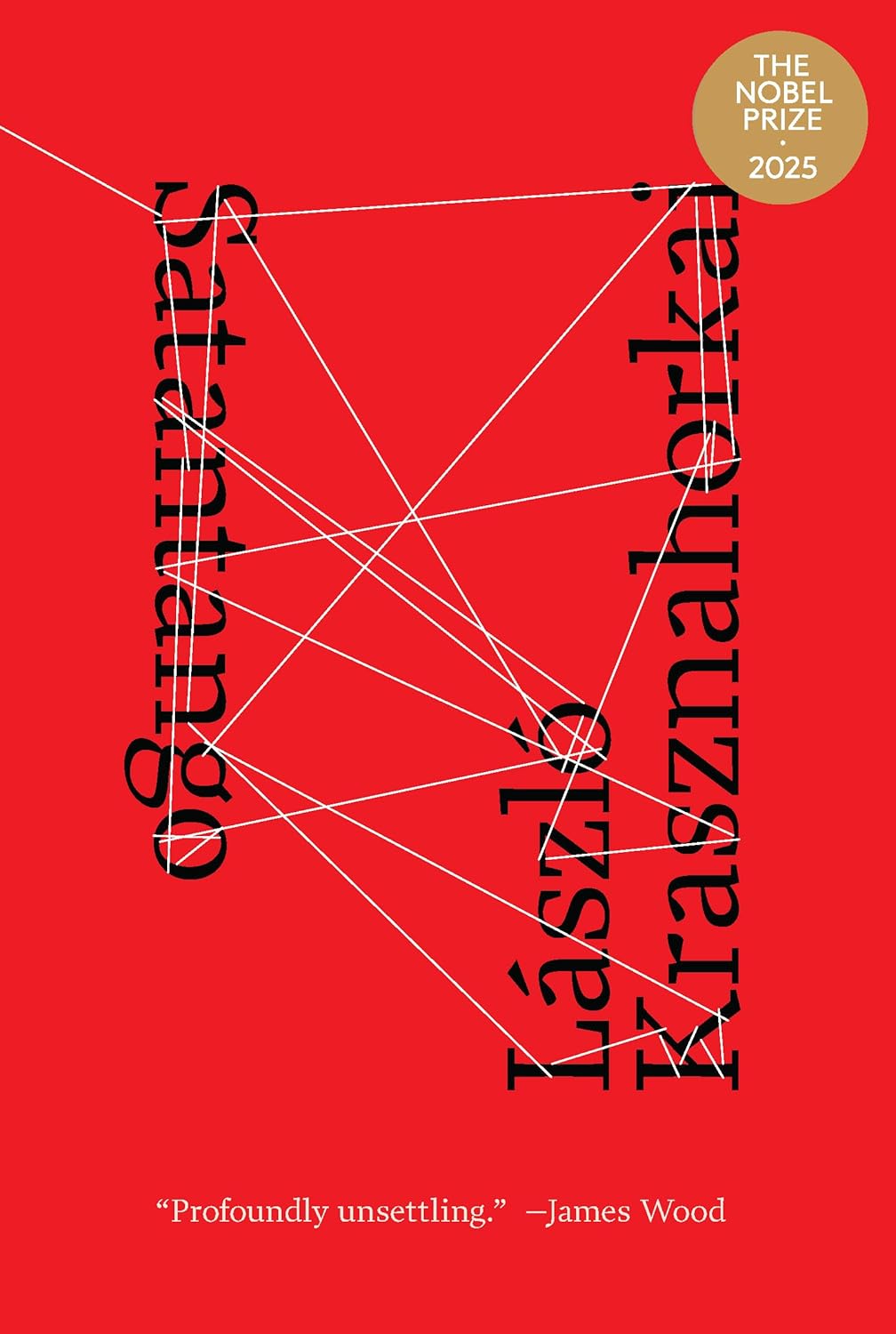
#1 — Satantango — trans. George Szirtes (New Directions, 2012)
- Readability: Preserves enormous sentences while making them navigable in English.
- Accuracy: Distinguished rendering of Krasznahorkai's demanding prose style.
- Tone: Accumulative, spiralling, faithful to the original rhythms.
- Accessibility: The sole English edition; ideal starting point for all readers.
Which translation is right for you?
- Choose Szirtes if you want the only English translation, a distinguished rendering that preserves the novel's spiralling sentences and won the Best Translated Book Award.
About the Translator
George Szirtes (New Directions, 2012): A British poet of Hungarian parentage who has translated all of Krasznahorkai's major works into English — including The Melancholy of Resistance, War and War, Seiobo There Below, and Baron Wenckheim's Homecoming — as well as major translations of Ágnes Nemes Nagy, Imre Kertész, and other Hungarian writers. Szirtes grew up bilingual before English became his primary literary language, and this inside relationship with Hungarian gives him an understanding of the rhythms and idioms of Krasznahorkai's prose that purely scholarly translation cannot replicate. His translation of Satantango won the Best Translated Book Award in 2013. In interviews, Szirtes has described translating Krasznahorkai's enormous sentences — the longest in the novel running for more than forty pages without a full stop — as a feat of sustained concentration requiring that he hold the entire arc of the sentence in mind while navigating each subordinate clause and qualification.
Themes
The return of the false messiah. Irimias's return is awaited with the fervour of a second coming by a community that has no other hope, and the novel's most disturbing question is whether he is a manipulator, an informer for the state, or simply a man who has discovered that other people's desperation can be turned to use. He may be all three simultaneously. The novel refuses to adjudicate.
History as repetition, time as mud. The tango structure — six chapters forward, six chapters back, overlapping and spiralling around the same events from different perspectives — enacts the novel's central experience of time in post-communist Hungary: not linear progress but recursive failure, the same mistakes repeating, the same rain falling, the same mud making the same movements impossible.
The collective farm as closed world. The unnamed collective farm is a community that cannot leave and cannot imagine a future — not because of physical barriers but because the collapse of the communist system has removed every structure of meaning and left nothing to replace it. The inhabitants know they have no future here; they also have nowhere else to go.
The weight of observation. The Doctor's project — his endless, obsessive chronicle of what he sees from his window — is the novel's darkest joke: a man who knows everything that is happening in this community and whose knowledge changes nothing. Intelligence without the capacity for action is the novel's definition of the intellectual's situation.
Key Characters
Irimias — the charismatic figure whose return structures the entire novel; his motives remain genuinely ambiguous throughout; the community's investment in him as a saviour reveals everything about their desperation and nothing reliable about him.
Futaki — the man who first hears news of Irimias's coming; the novel's most alert consciousness among the ordinary inhabitants; his wariness about Irimias is vindicated in ways that do not help him.
The Doctor — who watches everything from his window, compiling his endless chronicle of the community's life while drinking himself into stupor; a figure of paralysed intelligence; he knows that what he is recording is a dissolution and cannot stop it.
Estike — a child; the novel's most affecting and most disturbing figure; her fate — which is the direct result of Irimias's manipulation of the community — is the event that reveals the true stakes of the novel's world and the true nature of what Irimias represents.
Recommended Sources
For further reading on Krasznahorkai and Satantango:
- George Szirtes's own essays on translating Krasznahorkai — available in literary magazines and interviews; among the best accounts of what it means to translate a prose style this demanding.
- Senses of Cinema and Cinema Scope — the best English-language sources on Béla Tarr's 1994 film adaptation, which has given the novel a second life and remains one of the most celebrated works in the history of cinema.
- Hungarian Literature Online (hlo.hu) — the primary English-language source for current Hungarian literary culture, including translations, reviews, and scholarship on Krasznahorkai and his contemporaries.
Szirtes's New Directions translation is the only English version of Satantango, and it is a distinguished one — a translation that genuinely solves the central problem of rendering Krasznahorkai's sentences in English without either losing their accumulative, spiralling quality or making them unreadable. The New Directions paperback is in print. For readers coming to the novel through Béla Tarr's film, the experience of reading is very different from the experience of watching — slower, stranger, closer — and both are essential.
Frequently Asked Questions
What is Satantango about?
Satantango is about a decaying Hungarian village where the return of a charismatic figure, Irimias, promises hope but leads to manipulation and despair. The novel explores themes of repetition, false hope, and the collapse of meaning in post-communist Hungary.
Is Satantango hard to read?
Satantango can be challenging due to its complex structure and long sentences. However, George Szirtes's translation makes it more accessible while preserving the original's spiralling prose style.
Which Satantango translation is best?
George Szirtes's 2012 translation is the only English edition and the clear choice; it won the Best Translated Book Award and renders Krasznahorkai's enormous sentences with sustained attention and literary craft.
Szirtes translation — why is it the definitive Satantango?
Szirtes is a British poet of Hungarian parentage who has translated all of Krasznahorkai's major works; his bilingual childhood gives him an inside understanding of Hungarian rhythms that scholarly translation cannot replicate.
Which translation is easiest to read?
Szirtes's version preserves the accumulative, spiralling quality of Krasznahorkai's sentences while making them navigable in English.
Which translation is most accurate?
Szirtes's translation is the only English edition and is widely regarded as distinguished for its fidelity to the original's demanding prose style.
How does the tango structure affect reading Satantango?
The twelve chapters move six steps forward and six steps back, creating overlapping chronologies that enact the novel's experience of time as recursive failure and endless repetition.
This guide is based on reading the translation and reviewing scholarly commentary. Last reviewed: June 2026.
As an Amazon Associate, I earn from qualifying purchases.
Looking for another classic? Browse all our translation guides →
Readers drawn to Krasznahorkai's spiralling sentences may also want our guide to the best Life and Fate translation.
For another landmark of Central European literature, see our Radetzky March translation guide.
If you enjoyed Szirtes's work on Hungarian prose, our Tin Drum translation guide compares Breon Mitchell against the earlier Manheim version.
Another Eastern European classic rendered in a single definitive English edition is covered in our We translation guide.