Shahnameh: What It's About & Best Translation
Ferdowsi's Persian epic — and the Dick Davis translation that made it accessible in English
As an Amazon Associate, we earn from qualifying purchases.
The Shahnameh is an epic poem that chronicles the mythical and historical past of Persia, from the creation of the world to the Arab conquest of Iran. It features legendary heroes, tragic battles, and the struggle of good versus evil.
Translation Comparison at a Glance
| Translation | Readability | Accuracy | Tone | Best For |
|---|---|---|---|---|
| Davis (2006) | High | Excellent | Clear prose with lyrical verse passages | First-time readers and scholars |
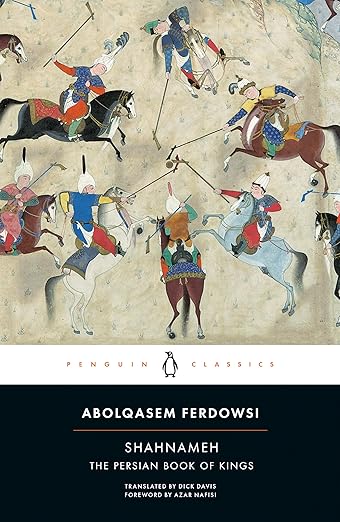
#1 — Shahnameh: The Persian Book of Kings — trans. Dick Davis (Penguin Classics, 2006)
- Readability: Hybrid prose-and-verse approach keeps the long narrative flowing.
- Accuracy: Combines deep Persian scholarship with poetic craft.
- Tone: Dignified yet accessible, preserving formal texture at key moments.
- Accessibility: Includes helpful foreword and notes for general readers.

Dick Davis's translation is widely regarded as the most poetic and accessible English version of the Shahnameh, and his narration brings the epic's grandeur to life with authenticity and passion.
Listen on Audible →Which translation is right for you?
- Choose Davis if you want the only complete, scholarly, and poetically sensitive English version that balances readability with fidelity to Ferdowsi's form.
About the Translator
Dick Davis (Penguin Classics, 2006): A poet and professor emeritus of Persian literature at Ohio State University, Davis is the leading Western scholar-translator of classical Persian poetry and the only translator who has combined deep knowledge of classical Persian with the craft as an English poet necessary to handle the Shahnameh's formal demands. His other Persian translations include Attar's Conference of the Birds (Penguin Classics), Rumi's Faces of Love, and Hafez's poetry — establishing a body of work that has done more than any other to make classical Persian literature accessible to English readers. His solution to the translation challenge — rendering the narrative in prose while keeping the most lyrical passages as verse — is both practically elegant and artistically justified: it gives general readers a Ferdowsi they can actually read while preserving the poem's formal texture at its most significant moments. Azar Nafisi, whose foreword frames the translation, is the author of Reading Lolita in Tehran and one of the most prominent voices on Persian literary culture in English.
Themes
Persian identity and the power of language. Ferdowsi composed the Shahnameh in Persian at a time when Arabic was the prestige language of scholarship and religion across the Islamic world. His choice was a cultural act of the first importance: a demonstration that Persian was capable of carrying an epic of this scope and ambition, and a preservation of Iranian cultural memory against the pressure to Arabise. The poem is still recited from memory by Iranians who have never studied it formally.
The tragic hero and the weight of fate. In the Shahnameh, heroes know their fate and cannot escape it — the tragic structure is not one of ignorance but of knowledge, which makes it darker. Rustam's killing of Sohrab, his own son, is the archetype: both father and son understand what has happened; neither can undo it; the grief is absolute and without consolation.
The three ages of Iranian history. The poem's movement from mythological to legendary to historical encompasses the entire arc of Iranian civilisation — from the creation of fire to the Arab conquest — and frames this arc as a tragedy of inevitable loss. The heroic age ends; what replaces it is never as great.
The Simorgh and divine wisdom. The mythological bird who raises Rustam's father Zal and who intervenes at moments of crisis is one of the most beautiful figures in world literature — a creature of divine grace and impersonal wisdom, available to those who call on her but not to be commanded. Her appearances punctuate the heroic age like a recurring visitation of something larger than human affairs.
Key Characters
Rustam — the champion of champions; the greatest warrior in the world; his career spans four generations of kings and his relationship with the throne is one of the poem's great recurring dramas. He is both the poem's hero and its embodiment of tragic limitation — powerful enough to shape events, not powerful enough to escape fate.
Sohrab — Rustam's son; killed by his father in single combat in the poem's most famous episode; the archetype of tragic irony in world literature; the son who sought his father, the father who killed his son, neither recognising the other until it was too late.
Zal — Rustam's father; born albino, abandoned by his father, raised by the Simorgh on her mountain; he returns to the human world with her feathers as a talisman and with a nature marked by his unusual upbringing. One of the great figures of the legendary age.
Kay Khosrow — the greatest king of the legendary age; who disappears into the mountains at the moment of his greatest power, refusing the decline that awaits all kings; a figure of achieved transcendence and voluntary withdrawal that the poem presents as the highest human possibility.
The Simorgh — the mythical bird who raised Zal and who intervenes when called to save Rustam's life; a figure of divine wisdom and impersonal grace; one of the most beautiful creations in world literature and one of the least known outside the Persian tradition.
Recommended Sources
For further reading on Ferdowsi and the Shahnameh:
- Iranian Studies (Taylor and Francis) — the primary English-language journal for Iranian literature and culture; the essential venue for current Shahnameh scholarship.
- Olga Davidson, Poet and Hero in the Persian Book of Kings (Cornell, 1994) — the most important English-language scholarly study of the Shahnameh's oral traditions and its relationship to the heroic poetry of the ancient world.
- Dick Davis's own introductions and notes in the Penguin edition — the most accessible scholarly overview of the poem's structure, characters, and cultural significance available to English readers.
Davis's Penguin Classics translation is the edition that finally made Ferdowsi's epic accessible to English readers, and it remains the definitive version — universally recommended by scholars, Persian speakers, and readers approaching the text for the first time. There is no competing complete English translation of comparable quality. The Penguin Classics paperback is in print and readily available.
Frequently Asked Questions
What is Shahnameh about?
The Shahnameh is an epic poem that chronicles the mythical and historical past of Persia, from the creation of the world to the Arab conquest of Iran. It features legendary heroes, tragic battles, and the struggle of good versus evil.
Is Shahnameh hard to read?
The Shahnameh can be challenging due to its length and poetic form, but Dick Davis's translation offers a readable prose-and-verse hybrid that balances accessibility with fidelity to the original text.
Which Shahnameh translation is best?
Dick Davis's 2006 Penguin Classics edition is the definitive English translation, universally recommended by scholars and Persian speakers.
Dick Davis vs earlier attempts — which should I choose?
Davis is the only translator who has combined deep knowledge of classical Persian with the craft of an English poet, rendering the narrative in clear prose while preserving key passages in verse.
Which translation is easiest to read?
Davis's hybrid prose-and-verse approach makes the epic accessible without sacrificing its formal texture.
Which translation is most accurate?
Davis's version is praised for both scholarly rigor and literary sensitivity, making it the standard reference.
Why does the Shahnameh matter for understanding Persian culture?
Composed in Persian when Arabic was the prestige language, the epic preserved Iranian identity, vocabulary, and heroic narratives for over a thousand years.
This guide is based on reading the translation and reviewing scholarly commentary. Last reviewed: June 2026.
As an Amazon Associate, I earn from qualifying purchases.
Looking for another classic? Browse all our translation guides →
Readers drawn to Persian literary traditions should also explore our guide to the best Arabian Nights translation.
For another foundational epic poem, see our comparison of the best Iliad translations.
If you're interested in long narrative verse from the ancient world, our Gilgamesh translation guide is essential reading.
Those who enjoy Davis's approach to classical poetry may also appreciate our recommendations for the best Divine Comedy translation.