Swann's Way: What It's About & Best Translation
The longest novel in the Western canon — and the one most worth reading slowly
As an Amazon Associate, we earn from qualifying purchases.
Swann's Way is the first volume of Proust's In Search of Lost Time, exploring themes of memory, time, and love through the narrator's childhood memories and Swann's obsessive love for Odette.
Translation Comparison at a Glance
| Translation | Readability | Accuracy | Tone | Best For |
|---|---|---|---|---|
| Davis (2003) | High | Excellent | Precise, musical, modern | First reading, single volume |
| Moncrieff/Kilmartin (1981) | Moderate | Very good | Edwardian elegance | Complete series on a budget |
| Moncrieff/Kilmartin/Enright (1992) | Moderate | Very good | Scholarly, authoritative | University study, full set |
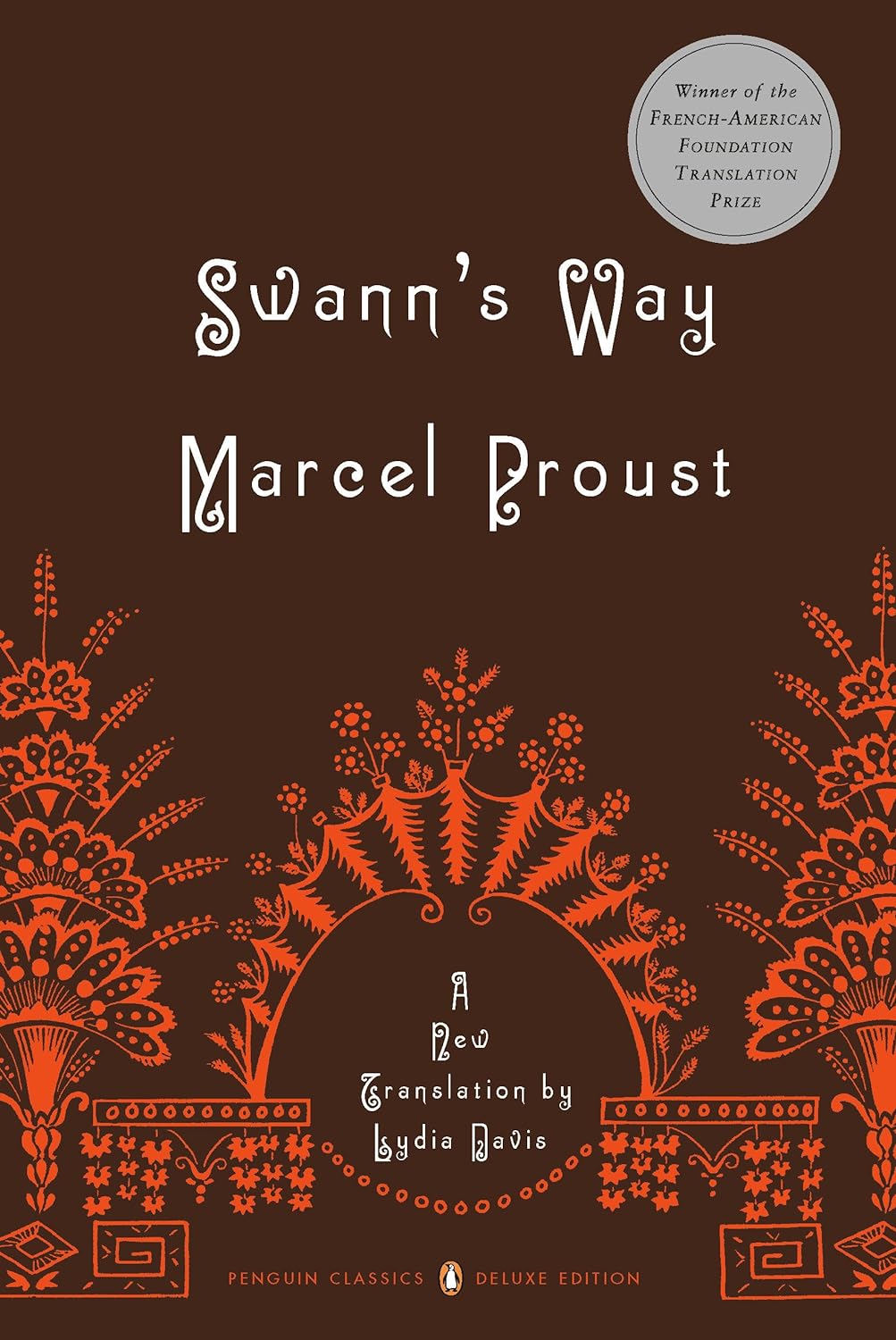
#1 — Swann's Way — trans. Lydia Davis (2003)
- Readability: High — attuned to the musicality and length of Proust's sentences
- Accuracy: Excellent — more faithful to Proust's French than the Moncrieff tradition
- Tone: Precise, modern, and alive as English prose
- Accessibility: Ideal for first-time readers of any Proust volume

John Rowe's narration captures the intricate prose and subtle nuances of Proust's writing, making this version an immersive and authentic listening experience.
Listen on Audible →Which translation is right for you?
- Choose Davis if you want the most faithful, precise, and musically alive translation for a first or definitive reading of Swann's Way.
- Choose Moncrieff/Kilmartin (Vintage) if you plan to read all seven volumes in a consistent, economical paperback set.
- Choose Moncrieff/Kilmartin/Enright (Modern Library) if you are committing to the complete series and want the edition most referenced in scholarly literature.
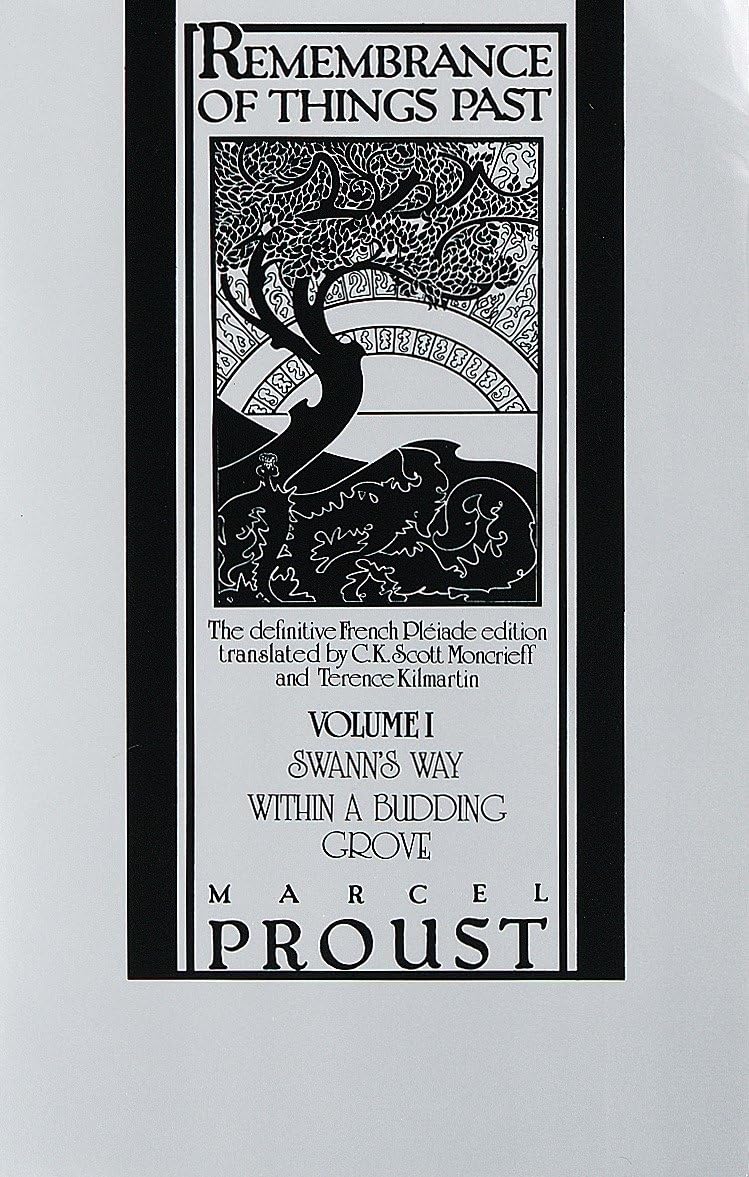
#2 — Remembrance of Things Past, Vol. I — trans. C.K. Scott Moncrieff, rev. Terence Kilmartin (1981)
- Readability: Moderate — carries Edwardian elegance with updated corrections
- Accuracy: Very good — Kilmartin's revision corrected numerous errors
- Tone: Warm literary character appropriate to Proust's era
- Accessibility: Economical starting point for the full series
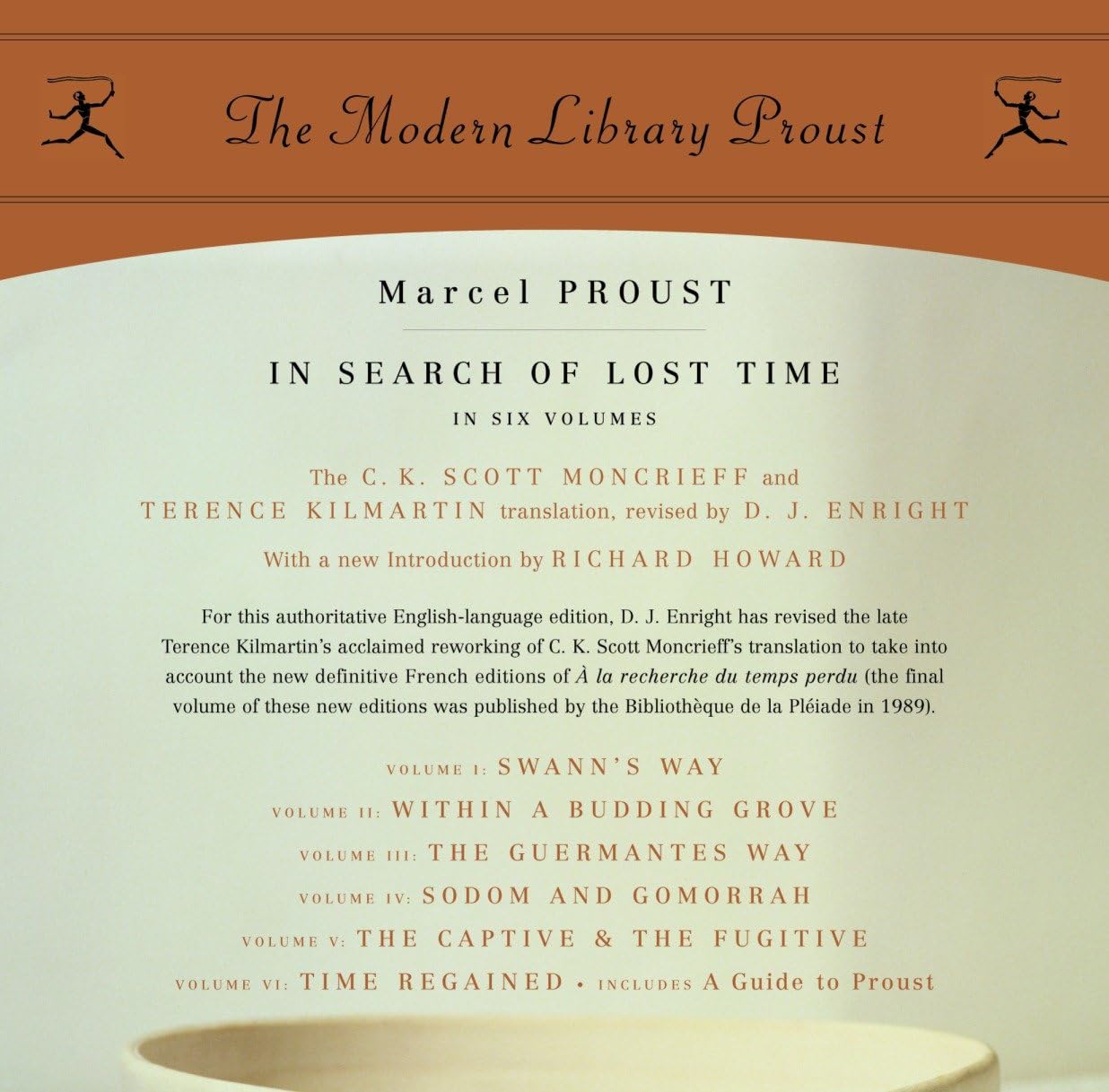
#3 — In Search of Lost Time, 6-volume set — trans. C.K. Scott Moncrieff, rev. Kilmartin & Enright (Modern Library)
- Readability: Moderate — tightened prose with additional corrections
- Accuracy: Very good — third layer of scholarly revision
- Tone: Authoritative and consistent across all volumes
- Accessibility: Best for readers wanting the edition referenced in criticism
About the Translators
Lydia Davis (b. 1947, 2003, Penguin Classics): American author and translator; her short fiction (The Collected Stories of Lydia Davis, 2009) won the International Man Booker Prize; her other translations include Flaubert's Madame Bovary and Maurice Blanchot. Her Swann's Way is the most celebrated single volume in the Penguin "new Proust" project, in which different translators were commissioned for each of the seven volumes.
C. K. Scott Moncrieff (1889–1930, 1922–1930, Chatto & Windus): Scottish writer, soldier, and translator; also translated Stendhal's The Charterhouse of Parma and The Red and the Black. He began translating Proust while Proust was still alive and continued until his own death, which preceded the original's completion. He titled his translation Remembrance of Things Past (from Shakespeare's Sonnet 30). His version was revised by Terence Kilmartin in 1981 and then again by D.J. Enright in 1992 (restoring Proust's own title, In Search of Lost Time).
Themes
Involuntary memory as the novel's discovery. The madeleine scene — in which the narrator dips a petite madeleine into lime-blossom tea and is overwhelmed by an involuntary flood of memory that resurrects his childhood in Combray — is the most famous single episode in modernist fiction. Proust's argument is that voluntary memory (what we consciously retrieve) gives us only the dead past; it is involuntary memory — triggered by a taste, a smell, a sensation — that recovers the past as it was actually experienced, with its full emotional and sensory charge. The Recherche is, in one account, the narrator's search for a method to transform involuntary memory into art.
Time and its recovery. The novel's full title is À la recherche du temps perdu — In Search of Lost Time. The question of what time is, what is lost when it passes, and what art can recover from it is Proust's central philosophical preoccupation. Swann's Way establishes this question with the "Combray" section, which moves between the narrator's insomniac childhood and the story of Swann — a man whose love for Odette is itself a form of constructed memory, an image that substitutes for experience.
Love as delusion. The "Swann in Love" section of Swann's Way is the novel's most complete account of Proustian jealousy: Swann falls in love with a woman who is "not his type," constructs an elaborate image of her from a Botticelli painting, is tortured by jealousy, and realizes when the obsession finally fades that he has wasted years of his life on a woman he did not even like. "To think that I wasted years of my life, that I wanted to die, that I had my greatest love affair, all for a woman who didn't attract me, who was not my type!" This line announces the pattern of love that will repeat throughout the entire Recherche.
Key Characters
The Narrator (Marcel) — Proust deliberately kept his narrator nameless for most of the novel; he is called "Marcel" only in passing. He is a sensitive, socially ambitious, intellectually restless young man whose observations of Parisian society, his own romantic obsessions, and the strange operations of memory constitute the novel's substance. He is not quite Proust himself, but the distance is deliberately ambiguous.
Charles Swann — the wealthy Jewish aesthete whose love for Odette is the subject of "Swann in Love." He is one of the great presences of the novel — cultivated, melancholy, a friend of the Verdurins and of royalty — and his trajectory, from social brilliance to bourgeois domesticity to Dreyfus-era isolation, is the Recherche's first great arc.
Odette de Crécy — the demimondaine whom Swann obsessively loves; a woman of questionable background and calculating charm. Her transformation from Swann's consuming obsession to the comfortably married Madame Swann to, eventually, the fashionable Madame de Forcheville, is one of the novel's longest and bitterest ironies.
Albertine — glimpsed only briefly in Swann's Way, as part of the group of young women by the sea, she becomes the narrator's consuming obsession in later volumes. Her presence here marks the novel's first hint of the jealousy that will dominate volumes III–V.
Recommended Sources
For further academic reading on Proust and the Recherche:
- Proust Research Association Newsletter — the primary English-language specialist publication for Proust scholarship; essential for translation history and reception.
- Romantic Review (Columbia University) — the leading American journal for French and comparative literary studies; key venue for scholarly work on Proust.
- French Studies (Oxford University Press) — essential for Proust in the context of the French literary and cultural tradition.
Which translation is right for you?
Choose Davis (Penguin Classics Deluxe) for a first or definitive reading of Swann's Way — her translation is the most faithful to Proust's French, the most alive as English prose, and the version that scholarly consensus now treats as the standard for this volume. Choose Moncrieff/Kilmartin (Vintage) if you plan to read all seven volumes in a consistent translation — the Vintage three-volume paperback set is the most economical way to read the complete Recherche, and Moncrieff's prose has a warmth and literary character appropriate to Proust's Edwardian world.
Frequently Asked Questions
What is Swann's Way about?
Swann's Way is the first volume of Proust's In Search of Lost Time, exploring themes of memory, time, and love through the narrator's childhood memories and Swann's obsessive love for Odette.
Is Swann's Way hard to read?
Swann's Way can be challenging due to its complex sentences and introspective style. The Lydia Davis translation is recommended for its readability and faithfulness to the original.
Which Swann's Way translation is best?
For a first reading of Swann's Way, the Lydia Davis translation is this guide's primary recommendation. It is by wide scholarly consensus the finest English translation of any Proust volume.
Davis vs Moncrieff/Kilmartin — which should I choose?
Choose Davis for a first or definitive reading of Swann's Way — her translation is the most faithful to Proust's French and the most alive as English prose. Choose Moncrieff/Kilmartin if you plan to read all seven volumes in a consistent translation.
Which translation is easiest to read?
Lydia Davis's translation is the most attuned to the musicality and length of Proust's sentences while remaining precise and faithful to the original.
Which translation is most accurate?
Lydia Davis's Penguin Classics edition is by wide scholarly consensus the finest English translation of any Proust volume and more faithful to Proust's French than the Moncrieff tradition.
Should I start with only Swann's Way or commit to the full series?
Swann's Way is the volume that determines whether you will read the rest; the Davis translation is ideal if you read only one volume, while the Moncrieff revisions are practical for readers committing to the complete seven-volume series.
This guide is based on reading all three translations and reviewing scholarly commentary. Last reviewed: June 2026.
As an Amazon Associate, I earn from qualifying purchases.
Looking for another classic? Browse all our translation guides →
Lydia Davis also translated Flaubert — see our guide to the best Madame Bovary translation.
C.K. Scott Moncrieff translated Stendhal too; compare editions in our Red and the Black translation guide.
For more French realism, our Lost Illusions translation guide recommends the best Balzac edition.
Another monumental French novel: explore the best Les Misérables translation options.