The Three-Body Problem: What It's About & Best Translation
The novel that opened Chinese science fiction to the world — and the translator who made it possible
As an Amazon Associate, we earn from qualifying purchases.
The Three-Body Problem explores humanity's first contact with an alien civilization, set against the backdrop of China's Cultural Revolution. It delves into themes of scientific discovery, political intrigue, and existential risk.
Translation Comparison at a Glance
| Translation | Readability | Accuracy | Tone | Best For |
|---|---|---|---|---|
| Ken Liu (2014) | High | Excellent | Clear, explanatory, historically grounded | First-time readers and Hugo fans |
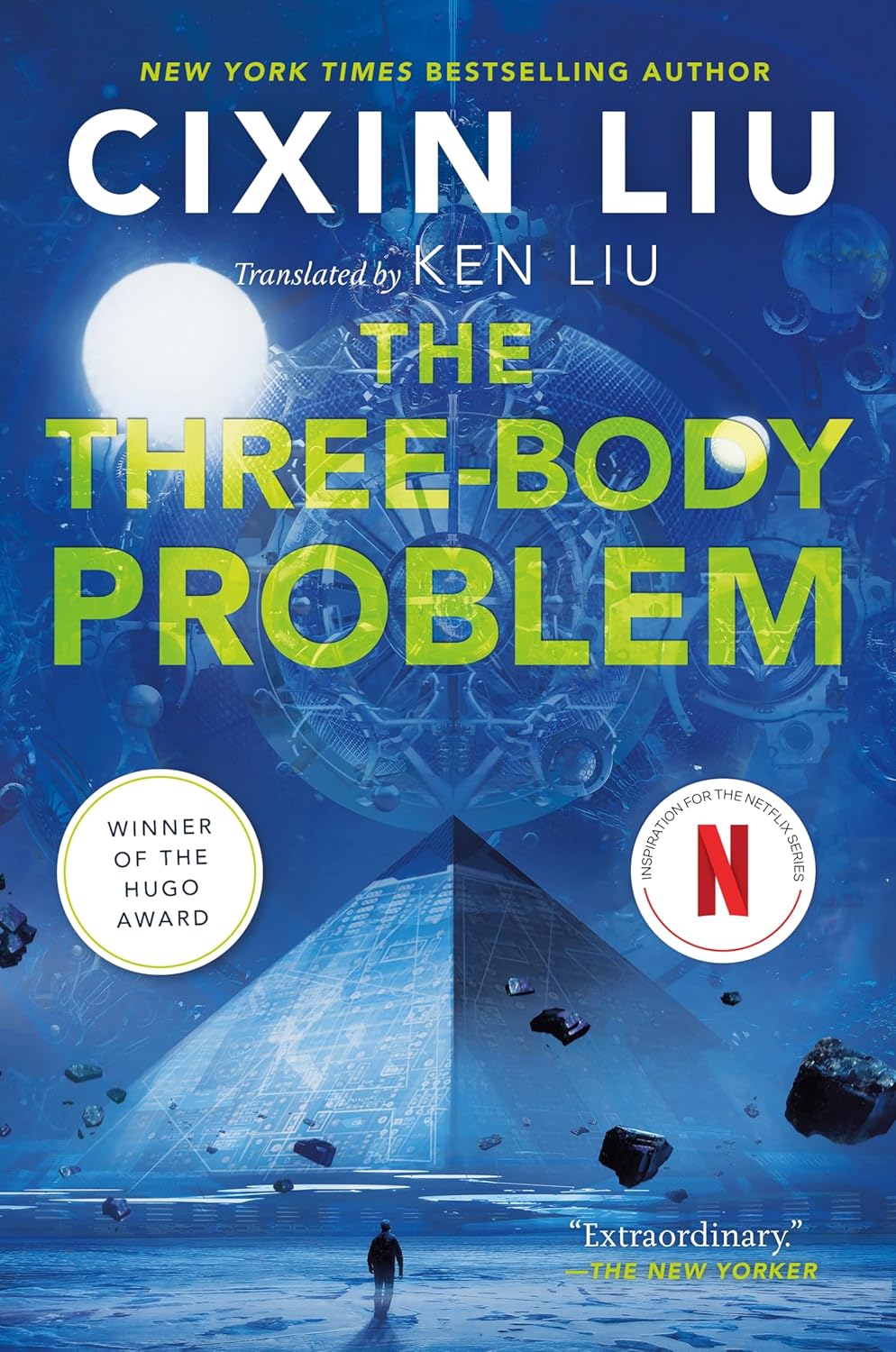
#1 — The Three-Body Problem — trans. Ken Liu (2014)
- Readability: Highly accessible while retaining scientific and historical nuance.
- Accuracy: Restored the original prologue and added helpful cultural footnotes.
- Tone: Clear, explanatory, and dramatically effective.
- Accessibility: Ideal entry point for new readers of Chinese SF.
Which translation is right for you?
- Choose Ken Liu if you want the definitive, award-winning English edition that restored the original Cultural Revolution prologue and introduced the trilogy to global readers.
About the Translator
Ken Liu (b. 1976, 2014, Tor Books): American science fiction author and translator; winner of the Hugo, Nebula, and World Fantasy Awards for his story "The Paper Menagerie" — the first work of short fiction to win all three major awards. His story collection The Paper Menagerie and Other Stories (2016) introduced his fiction to a wider audience. He translated volumes one and three of the Remembrance of Earth's Past trilogy (volume two, The Dark Forest, was translated by Joel Martinsen). His translation of The Three-Body Problem won the Hugo Award for Best Novel in 2015 — the first time in the award's history that a translated work had won. He is also the editor and primary translator of Invisible Planets (2016) and Broken Stars (2019), the two principal anthologies of contemporary Chinese science fiction in English.
Themes
The Fermi paradox and the silence of the universe. The novel's central enigma — why, in a universe of billions of potential civilisations, have we heard nothing? — is one of science fiction's oldest and most disturbing questions. Liu Cixin's answer, developed fully in the trilogy's second volume, is the Dark Forest theory: the universe is silent because every civilisation that reveals its location is destroyed, since contact between civilisations leads inevitably to competition for finite resources, and the only rational response to the existence of other intelligent life is preemptive annihilation.
The Cultural Revolution as historical origin. The novel's prologue — set during the Cultural Revolution of the 1960s, when political violence was official policy and scientific rationalism was condemned as counter-revolutionary — is not simply historical context. It is the causal origin of everything that follows. Ye Wenjie's decision to invite contact with an alien civilisation is made in a moment of total disillusionment with human nature, caused directly by what she witnessed and suffered. The novel argues that this disillusionment is a characteristic product of human irrationality, not an aberration.
Science as epistemic and moral commitment. The novel is unusual in science fiction for its deep engagement with actual physics — three-body orbital mechanics, proton unfolding, quantum entanglement. Its scientist characters treat scientific method as a moral and epistemic commitment, not merely a professional tool. The contrast between scientific rationalism and ideological fanaticism is the book's deepest structural opposition, played out across the contrast between the Cultural Revolution sequences and the contemporary scientific investigation.
Key Characters
Ye Wenjie — astrophysicist; the most important character in the trilogy, whose decision to respond to a Trisolaran transmission sets the entire plot in motion. Her experiences during the Cultural Revolution — her father beaten to death at a public struggle session — are the emotional and moral origin of everything that follows. She is one of the most consequential characters in contemporary science fiction.
Wang Miao — nanotechnology researcher; the novel's primary viewpoint character in its contemporary sections, who discovers the conspiracy of the Earth-Trisolaris Organisation and the immersive VR game that encodes the Trisolarans' cosmological situation.
Shi Qiang (Da Shi) — police detective; pragmatic, unsentimental, and intuitive where Wang Miao is scientifically rigorous; the novel's practical conscience, whose instincts consistently prove correct where pure theory fails.
Ye Zhetai — Ye Wenjie's father; a physicist beaten to death at a public struggle session in the Cultural Revolution prologue. His murder is the novel's emotional anchor and the origin of its central tragedy.
Recommended Sources
For further academic reading on Liu Cixin and The Three-Body Problem:
- Science Fiction Studies (DePauw University) — the premier academic journal for science fiction scholarship; essential for Liu Cixin in the context of both Chinese and global SF traditions.
- Extrapolation (University of Texas at Brownsville) — one of the oldest academic science fiction journals; key venue for hard SF and cosmological themes including the Fermi paradox.
- Journal of Chinese Literature and Culture (Duke University Press) — the principal English-language venue for contemporary Chinese literary studies, including the emergence of Chinese science fiction as a global phenomenon.
There is only one English translation of The Three-Body Problem. Ken Liu's Tor Books edition — Hugo Award winner and the first translated work to receive that award — is both the only available text and one of the most celebrated works of literary translation in recent science fiction. No alternative English translation exists or is expected.
Frequently Asked Questions
What is The Three-Body Problem about?
The Three-Body Problem explores humanity's first contact with an alien civilization, set against the backdrop of China's Cultural Revolution. It delves into themes of scientific discovery, political intrigue, and existential risk.
Is The Three-Body Problem hard to read?
The novel can be challenging due to its scientific concepts and historical context, but Ken Liu's translation is praised for its readability and helpful cultural footnotes.
Which The Three-Body Problem translation is best?
Ken Liu's 2014 translation is the only English edition and the definitive choice for all readers.
Ken Liu vs other translators — which should I choose?
There are no competing English translations of the first volume; Ken Liu's stands alone as the sole and award-winning edition.
Which translation is easiest to read?
Ken Liu's version is highly readable while preserving the novel's scientific and historical depth.
Which translation is most accurate?
Ken Liu's translation is both accurate and editorially thoughtful, restoring the original Cultural Revolution prologue.
Is there an alternative English translation of The Three-Body Problem?
No. Ken Liu's Tor Books edition is the sole English translation available.
This guide is based on reading the translation and reviewing scholarly commentary. Last reviewed: June 2026.
As an Amazon Associate, I earn from qualifying purchases.
Looking for another classic? Browse all our translation guides →
Readers drawn to ambitious modern science fiction should see our guide to the best Solaris translation.
For another landmark single-translation novel, explore our guide to One Hundred Years of Solitude translations.
If you enjoyed Ken Liu's work, compare it with the best Wind-Up Bird Chronicle translation.
Another contemporary masterpiece with a definitive English edition is covered in our My Brilliant Friend translation guide.
For more Chinese literature in translation, see our guide to The Name of the Rose.