The Unbearable Lightness of Being: What It's About & Best Translation
Milan Kundera's meditation on love, fate, and the weight of choices under the shadow of Soviet Prague
As an Amazon Associate, we earn from qualifying purchases.
The Unbearable Lightness of Being explores the philosophical concept of lightness versus weight through the lives of four characters in Soviet-occupied Prague. It delves into themes of love, fate, and the impact of political oppression on personal lives.
Translation Comparison at a Glance
| Translation | Readability | Accuracy | Tone | Best For |
|---|---|---|---|---|
| Heim (1984) | High | Excellent | Clean, precise, philosophically alert | Definitive reading experience |
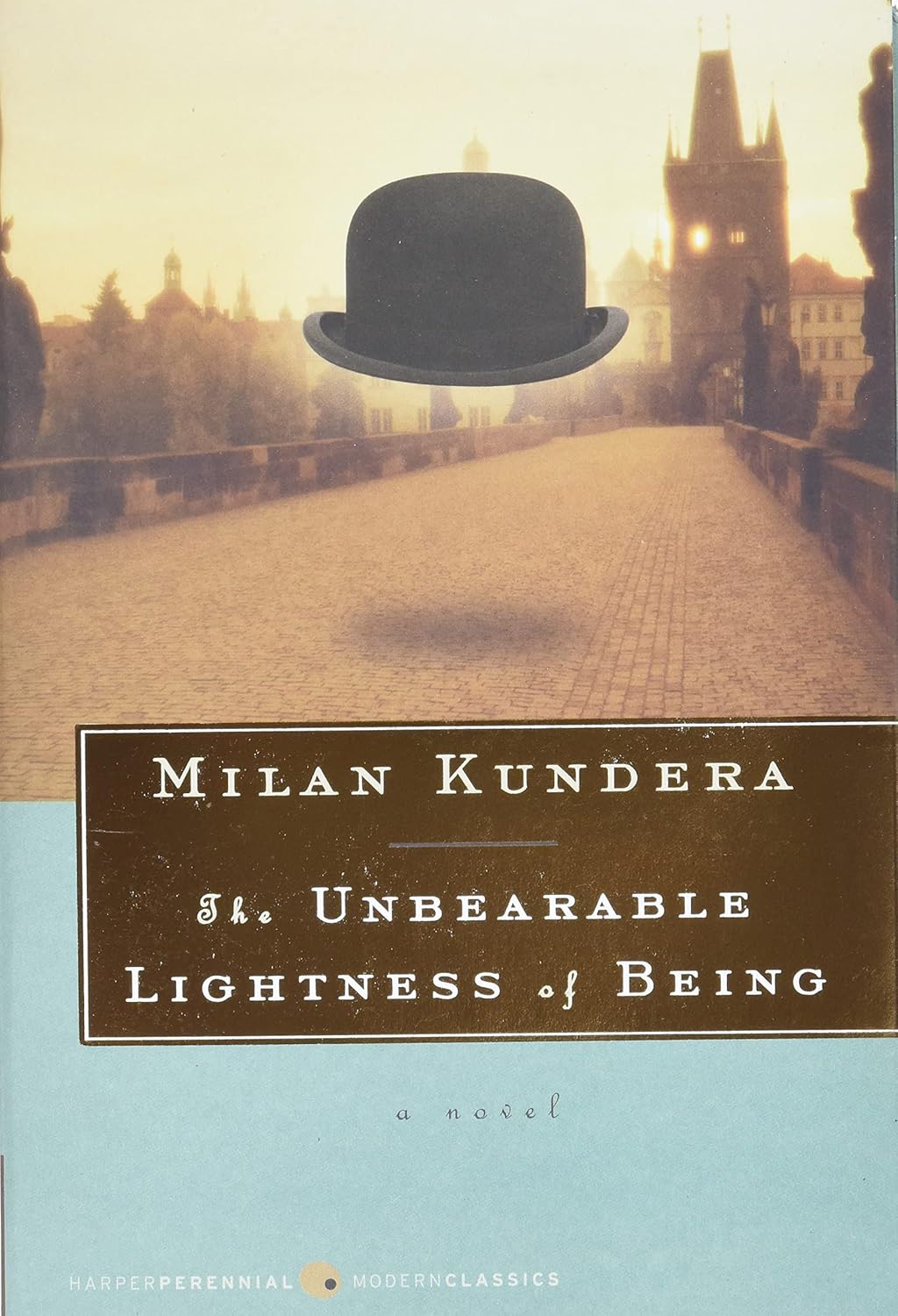
#1 — The Unbearable Lightness of Being — trans. Michael Henry Heim (1984)
- Readability: Clean, precise, and philosophically alert without flattening or over-dressing Kundera's direct prose.
- Accuracy: Highest possible; Kundera revised the text extensively and regarded it as a co-authored work.
- Tone: Dry wit, essay-like clarity, deliberate refusal of literary ornamentation.
- Accessibility: The standard edition encountered by most readers worldwide.
Which translation is right for you?
- Choose Heim if you want the definitive English text revised directly with Kundera and the version through which the novel reached its global audience.
About the Translator
Michael Henry Heim (1943–2012, 1984, Harper Perennial): Professor of Slavic Languages and Literatures at UCLA; one of the most important literary translators of the twentieth century, working from Czech, Slovak, Russian, German, Dutch, Croatian, and Hungarian. His other translations include Bohumil Hrabal's I Served the King of England, Anton Chekhov's letters, and Günter Grass's The Tin Drum. Kundera collaborated intensively with Heim on the English text, eventually coming to consider the translation a co-authored work; current Harper Perennial editions credit Kundera as sole author without a translator byline — an unusual situation reflecting both the closeness of the collaboration and Kundera's strongly held views about authorial primacy over translation.
Themes
Lightness and weight. The novel opens with a philosophical question drawn from Nietzsche's doctrine of eternal recurrence: if every moment returns infinitely, each choice carries infinite weight; if each moment occurs only once, nothing returns and therefore nothing truly matters. Kundera's four characters embody different positions on this spectrum. Tomáš is constitutionally light — uncommitted, unfaithful, free — and his love for Tereza is the weight that threatens his lightness. Tereza is heavy — burdened by her body, her jealousy, her dreams. Sabina cultivates lightness as a philosophical position. Franz confuses lightness with freedom and weight with meaning. The novel refuses to resolve which is better; both are, in the end, unbearable.
History and powerlessness. The Prague Spring of 1968 and its suppression by Soviet tanks in August of that year is the historical event around which the novel's private lives are organised. Kundera depicts his characters as profoundly unable to affect the historical forces that shape their lives: the invasion happens, people are photographed by the secret police and lose their jobs, emigration becomes necessary. The political is never absent, but it is also never sufficient — the novel insists that private life and its entanglements are where human beings most essentially live, regardless of the historical epoch crushing them.
The body, the soul, and the dream. Tereza is the novel's most fully realised study of the relationship between body and soul. She is unable to dissociate herself from her body in the way Tomáš dissociates himself from the bodies of his many lovers; she experiences his infidelities as violations of her own body even when her mind understands his reasons. Her recurring dreams — analysed by Kundera with the attention of a novelist who has also read Freud — are the most direct expression of what she cannot say or know while waking.
Key Characters
Tomáš — a surgeon and incorrigible womaniser who loves Tereza despite himself; his formula "love her but sleep with others" is the novel's central emotional paradox. His lightness is a philosophical position he cannot maintain once Tereza arrives; his inability to abandon her is the weight he cannot escape.
Tereza — a provincial waitress whose chance arrival in Tomáš's life via a novel and a coincidence he reads as destiny; the embodiment of weight, attachment, and the refusal of dissociation. Her jealousy is not a character flaw but a philosophical position: she insists that love and fidelity are inseparable, and the novel presents her position with full sympathy even as it presents Tomáš's with equal understanding.
Sabina — Tomáš's long-term mistress and a painter; the novel's most fully theorised embodiment of lightness and its pleasures. Her relationship with Franz, and her systematic betrayal of every commitment she makes — not from cruelty but from a principled refusal of kitsch and compulsion — constitute the novel's second major narrative strand.
Franz — a Swiss academic who falls profoundly in love with Sabina; his understanding of her is built entirely from misconceptions. He represents the European intellectual left's romanticism about Eastern European dissidence — he joins the March of Triumphal Return, a demonstration that takes protesters to the Cambodian border, and is killed there by a mugger, in an ending the novel handles with characteristic black comedy.
Karenin — Tereza and Tomáš's dog; named after Anna Karenina's husband. His illness and death in the novel's penultimate section constitute one of its most affecting passages, and Kundera uses Karenin to develop the novel's deepest meditation on unconditional love and what it means that human beings are capable of it with animals in a way they rarely are with each other.
Recommended Sources
For further academic reading on Kundera and The Unbearable Lightness of Being:
- Slavic Review (Cambridge University Press) — the leading journal for Slavic literature and culture; essential for Kundera in the context of Czech literary history and Central European dissident writing.
- The Journal of European Studies (SAGE) — key for Kundera's place in European intellectual culture and the reception of Central European literature in the West.
- Comparative Literature (Duke University Press) — the oldest American comparative literature journal; key venue for readings of Kundera in relation to the European novel tradition he explicitly engages.
There is only one English translation of The Unbearable Lightness of Being. Michael Henry Heim's text — revised extensively in collaboration with Kundera, who came to regard it as a co-authored work — is the translation through which the novel reached its global audience. Current Harper Perennial editions do not credit Heim by name, reflecting Kundera's own wishes about the primacy of the author over the translator. There is no alternative English version, and none is expected.
Frequently Asked Questions
What is The Unbearable Lightness of Being about?
The Unbearable Lightness of Being explores the philosophical concept of lightness versus weight through the lives of four characters in Soviet-occupied Prague. It delves into themes of love, fate, and the impact of political oppression on personal lives.
Is The Unbearable Lightness of Being hard to read?
The novel's philosophical themes can be challenging, but Heim's translation is praised for its clarity and precision, making it accessible to most readers.
Which The Unbearable Lightness of Being translation is best?
Michael Henry Heim's 1984 translation is the only English edition and the one through which the novel reached its global audience.
Heim vs any other translator — which should I choose?
There is no other English translation; Heim's version was revised extensively with Kundera and remains definitive.
Which translation is easiest to read?
Heim's translation is clean, precise, and philosophically alert, rendering Kundera's direct, essay-like prose without flattening or over-dressing it.
Which translation is most accurate?
Heim's translation is the most accurate because Kundera collaborated intensively on the text and came to consider the English version a co-authored work.
Why do current editions not credit Heim as translator?
Kundera's strongly held views about authorial primacy over translation led to editions that credit only the author, reflecting the closeness of their collaboration.
This guide is based on reading the translation and reviewing scholarly commentary. Last reviewed: June 2026.
As an Amazon Associate, I earn from qualifying purchases.
Looking for another classic? Browse all our translation guides →
Another Kundera novel translated by Heim? See our guide to the best The Joke translation.
For another Central European masterpiece, explore our Trial translation guide comparing Breon Mitchell and the Muirs.
Readers of Kundera often enjoy our Life and Fate translation guide on Robert Chandler's edition of Grossman's novel.
If you're interested in suppressed Eastern European fiction, our Doctor Zhivago translation guide compares Pevear & Volokhonsky against the classic version.