Don Quixote: What It's About & Best Translation
The translation you choose determines whether the novel is funny
As an Amazon Associate, we earn from qualifying purchases.
Don Quixote (1605/1615) follows Alonso Quijano, a middle-aged Spanish landowner who has read so many chivalric romances that he loses his grip on reality, renames himself Don Quixote de la Mancha, and sets out on horseback to become a knight errant — accompanied by his earthy, practical squire, Sancho Panza. What begins as parody becomes a meditation on idealism, friendship, and the gap between how we imagine the world and how it actually is. Below: which translation to read, plus a full breakdown of the novel's themes and characters.
Translation Comparison at a Glance
| Translation | Readability | Accuracy | Tone | Best For |
|---|---|---|---|---|
| Grossman (2003) | High | Very good | Warm, comic, clear | Most readers, pleasure reading |
| Rutherford (2003) | Moderate | Excellent | Scholarly, precise | Study, linguistic detail |
| Raffel (1996) | High | Good | Competent, academic | Students needing notes |
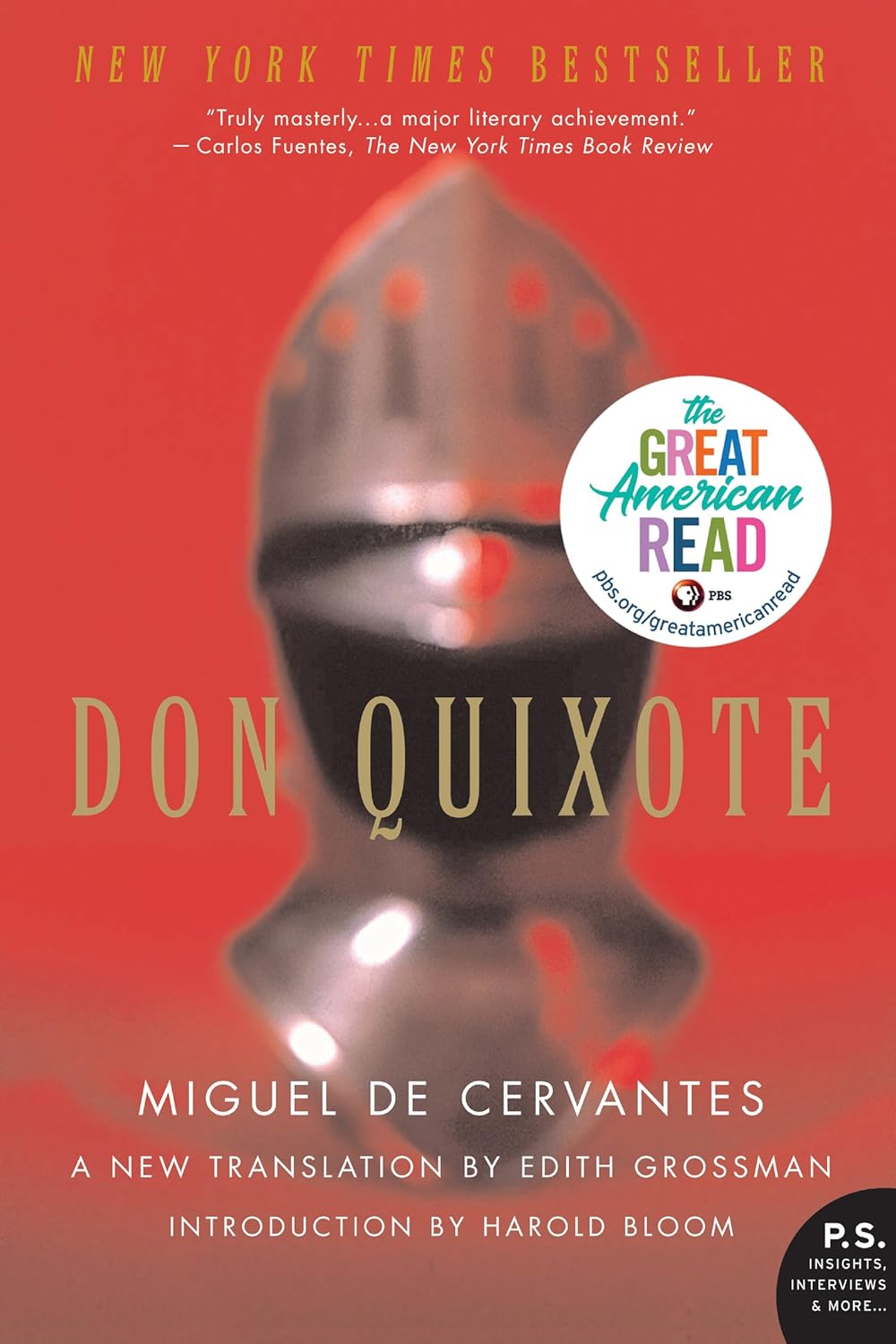
#1 — Don Quixote — trans. Edith Grossman (2003)
- Readability: Clear, flowing prose that lets the comedy shine without simplification.
- Accuracy: Highly faithful while prioritizing natural English rhythm and humor.
- Tone: Warm, witty, and emotionally nuanced between the two main characters.
- Accessibility: Excellent for first-time readers and general audiences.

George Guidall's masterful narration captures the humor and pathos of Don Quixote, while Edith Grossman's acclaimed translation preserves the richness and nuance of Cervantes' original text.
Listen on Audible →Which translation is right for you?
- Choose Grossman if you want the funniest, most readable version that still feels literary and captures the warmth between Don Quixote and Sancho Panza.
- Choose Rutherford if you want maximum fidelity to Cervantes's wordplay, puns, and linguistic jokes plus excellent scholarly notes.
- Choose Raffel if you are a student or want critical essays and contextual documents alongside the text.
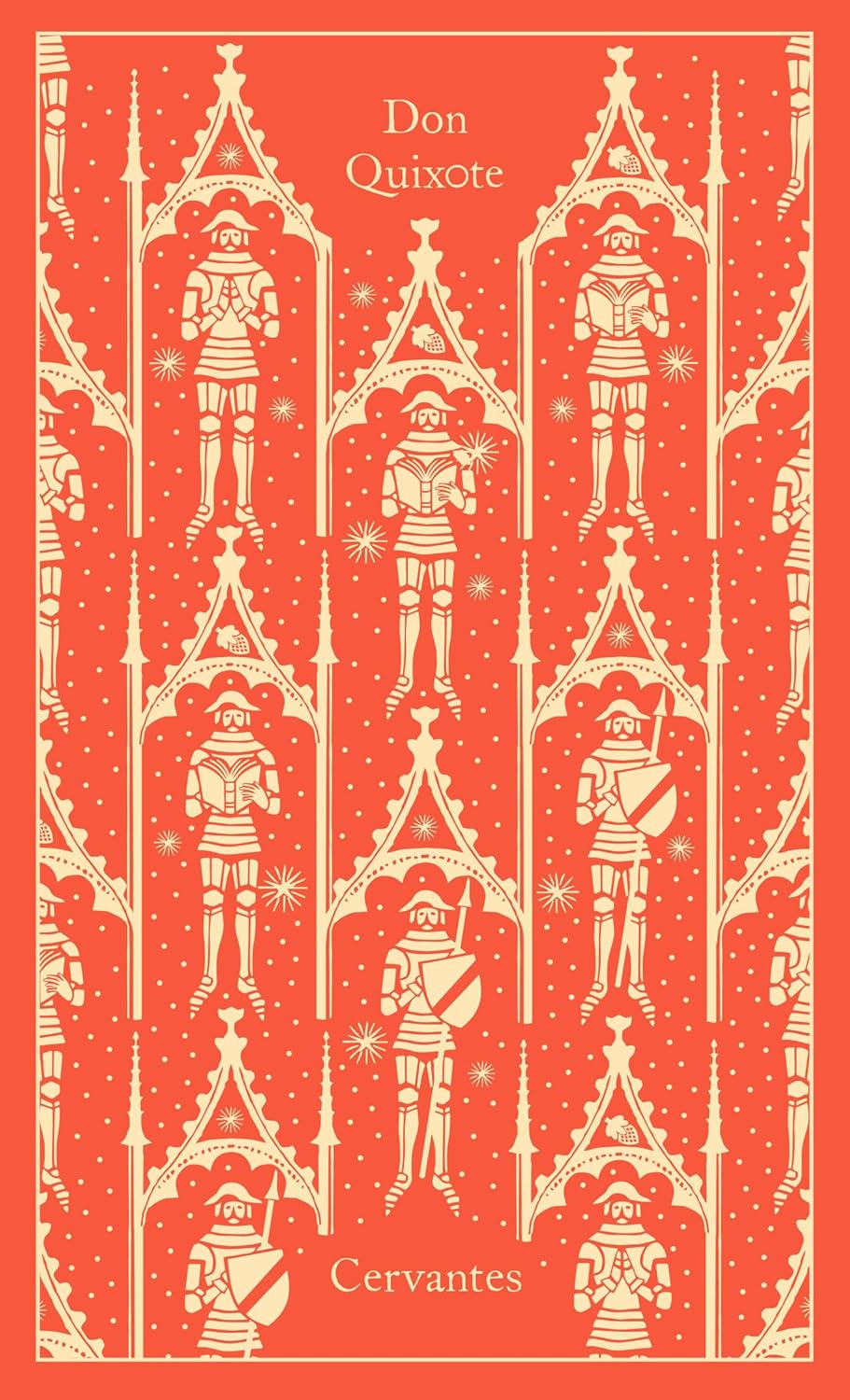
#2 — Don Quixote — trans. John Rutherford (2003)
- Readability: Slightly denser but still very accessible for serious readers.
- Accuracy: Exceptional fidelity to puns, wordplay, and linguistic jokes.
- Tone: Precise and scholarly with strong attention to Cervantes's registers.
- Accessibility: Best for those willing to engage with notes and context.
#3 — Don Quixote — trans. Burton Raffel (1996)
- Readability: Competent and straightforward for classroom use.
- Accuracy: Reliable and precise, though less celebrated for style.
- Tone: Scholarly and functional rather than stylistically distinctive.
- Accessibility: Highest when paired with the edition's critical apparatus.
About the Translators
Edith Grossman is an American literary translator who worked with virtually every major Latin American novelist of the twentieth century, including Gabriel García Márquez, Mario Vargas Llosa, and Carlos Fuentes. Her 2003 Don Quixote, published by Ecco/HarperCollins, arrived to near-universal critical acclaim and won the PEN/Ralph Manheim Medal for Translation in 2006. Grossman trained in Hispanic literature at Berkeley and NYU and brought to Cervantes both the precision of a scholar and the instincts of a working translator with a living relationship to contemporary Spanish prose.
John Rutherford is a British Hispanist and Emeritus Professor at Oxford who spent decades studying Cervantes and the picaresque tradition. His 2003 Penguin Classics translation distinguishes itself by its treatment of linguistic humor: Rutherford worked to find English equivalents for Cervantes's puns, malapropisms, and wordplay rather than sacrificing them for smoother prose. It is the choice for readers who want to understand what Cervantes was actually doing with the Spanish language, rather than simply reading the story.
Burton Raffel (1928–2015) was an American poet and prolific translator who worked across Old English, French, Spanish, and Indonesian literature. His 1996 Norton Critical Edition translation was designed for classroom use — accompanied by a substantial apparatus of scholarly essays, contextual documents, and critical perspectives assembled for a student audience. Raffel valued comprehensibility; his Don Quixote is a reliable scholarly instrument rather than a literary performance.
Themes
Don Quixote begins as a parody and becomes something else entirely. The premise — a middle-aged man has read so many chivalric romances that he has lost his grip on reality and sets out to become a knight errant — is comic, and the first part delivers sustained comedy. But Cervantes is not content with parody. By the time Don Quixote and Sancho Panza have been together long enough to need each other, the novel has become a meditation on what it means to believe in something the world insists is not real.
The relationship between the two main characters is the novel's real subject. Quixote is a man of vision with no practical capacity; Sancho is a man of earthly common sense who is secretly drawn to his master's impossible world. Over the course of the novel — especially in Part II (1615), which Cervantes wrote knowing Part I had been read and pirated — Sancho begins to believe and Quixote begins to doubt. That reversal is one of the great structural achievements in the history of fiction.
The moral status of Don Quixote is never settled. Cervantes does not tell us whether his hero is to be pitied, admired, or laughed at — and the novel is arranged so that all three responses are available simultaneously. Part I leans toward farce: Quixote is beaten, humiliated, and corrected repeatedly. Part II is harder to read that way; the dignity of Quixote's final disillusionment — when he renounces knight-errantry on his deathbed, recovers his sanity, and dies as Alonso Quijano — is not funny. Whether that trajectory constitutes a critique of idealism or a defense of it is a question the novel refuses to answer, which is one reason it has sustained four centuries of interpretation.
Key Characters
Don Quixote (Alonso Quijano) — A minor Castilian landowner, probably in his fifties, whose real name surfaces only at the novel's end. He has renamed himself Don Quixote de la Mancha, rechristened his horse Rocinante and his imaginary beloved Dulcinea del Toboso, and embarked on a career as a knight errant. His madness is selective: he is entirely lucid on most subjects, including at times the nature of his own project — a quality that complicates any simple reading of him as merely deluded.
Sancho Panza — Quixote's squire, a neighboring farmer persuaded to follow his master on the promise of an island to govern. Earthy, credulous, loyal, and fundamentally decent, Sancho functions as the novel's reality principle and, paradoxically, as its most susceptible character: it is Sancho who is most often tempted into believing in Quixote's world. His relationship with his master is the warmest and most carefully developed in early modern European fiction.
Dulcinea del Toboso — A woman who may not exist, or who exists only as Alonso Quijano's idealized memory of a farm girl he once saw. She never appears directly in the novel. As the object of Quixote's courtly devotion, she is the purest expression of the novel's central question: what is the relationship between idealization and reality, between love as it is felt and love as it actually is?
The Duke and Duchess (Part II) — Wealthy nobles who have read Part I and decide to entertain themselves by staging elaborate chivalric adventures for Quixote and Sancho. Their cruelty — and it is cruelty, however elegantly carried out — is one of Cervantes's clearest arguments about the relationship between power and illusion, and about how the world treats people who believe impossible things.
Recommended Sources
Cervantes: Bulletin of the Cervantes Society of America — The primary peer-reviewed journal for English-language Cervantes scholarship, published by the Cervantes Society of America. It covers all aspects of Cervantes's work, including close attention to translation questions and the novel's reception across literary traditions. Available through Project MUSE.
Hispanic Review — Published by the University of Pennsylvania Press and one of the oldest peer-reviewed journals in Hispanic literary studies, founded in 1933. It regularly publishes comparative work on Cervantes, translation theory, and the novel's influence on subsequent European and Latin American literature.
Bulletin of Spanish Studies — A peer-reviewed journal published by Taylor & Francis covering the literature, history, and culture of Spain and Latin America. The standard venue for detailed linguistic and stylistic analysis of Spanish literary texts, including ongoing scholarly engagement with Cervantes's language and its challenges for translators.
Frequently Asked Questions
What is Don Quixote about?
Don Quixote follows Alonso Quijano, a middle-aged Spanish landowner who reads so many chivalric romances that he loses his grip on reality, renames himself Don Quixote de la Mancha, and sets out on horseback to become a knight errant, accompanied by his practical squire Sancho Panza. What begins as parody becomes a meditation on idealism, friendship, and the gap between how we imagine the world and how it actually is.
Is Don Quixote hard to read?
Not in the Grossman translation — it's written in clear, flowing modern English that lets the comedy land naturally. The Rutherford and Raffel translations are slightly denser but still accessible. The novel is long, but no translation requires specialist background to follow.
Which Don Quixote translation is best?
The Edith Grossman translation is the primary recommendation. It recovers the novel's essential comedy and warmth better than any other modern English version.
Grossman vs Rutherford — which should I choose?
Choose Grossman for readability and comedy. Choose Rutherford if you want maximum fidelity to Cervantes's wordplay and linguistic jokes, plus scholarly notes.
Which translation is easiest to read?
Grossman's version is the easiest to read while remaining faithful. It is clear without simplification and lets the humor land naturally.
Which translation is most accurate?
Rutherford's translation is the most accurate to the original Spanish wordplay and linguistic detail, though Grossman is still highly faithful.
When should I choose the Norton Critical Edition of Don Quixote?
Choose Raffel's Norton Critical Edition when you need scholarly essays, contextual documents, and critical commentary alongside the text, such as for university study.
This guide is based on reading all 3 translations and reviewing scholarly commentary. Last reviewed: June 2026.
As an Amazon Associate, I earn from qualifying purchases.
Looking for another classic? Browse all our translation guides →
Spanish-language fiction continues with our guide to the best One Hundred Years of Solitude translation.
Another García Márquez novel? See our recommendations for the best Love in the Time of Cholera translation.
For more foundational European fiction, explore our Decameron translation guide.
Readers of Cervantes often enjoy our Pedro Páramo translation comparison.