Faust: What It's About & Best Translation
The tragedy that took Goethe sixty years to finish — and still feels unfinished
As an Amazon Associate, we earn from qualifying purchases.
Faust is a tragic play by Goethe that explores themes of ambition, desire, and redemption. It follows the scholar Faust, who makes a pact with the devil, Mephistopheles, in exchange for unlimited knowledge and worldly pleasures, leading to a journey of moral and existential exploration.
Translation Comparison at a Glance
| Translation | Readability | Accuracy | Tone | Best For |
|---|---|---|---|---|
| Greenberg (2014) | High | Very good | Tonally varied, poetic | Most readers, full work |
| Luke (Oxford) | High | Excellent | Elegant, scholarly | Academic study, Part Two |
| Arndt (Norton) | Moderate | Very good | Precise, metrical | Scholarly context, essays |

#1 — Faust: A Tragedy, Parts One and Two — trans. Martin Greenberg (2014, fully revised)
- Readability: Most tonally varied and poetically alive English Faust available.
- Accuracy: Carefully revised over decades with strong fidelity to verse forms.
- Tone: Preserves Goethe's rhymed couplets, blank verse, song, and ode.
- Accessibility: Excellent critical introduction; ideal first complete edition.
Which translation is right for you?
- Choose Greenberg if you want both parts in a single authoritative modern verse translation and the most tonally varied English Faust.
- Choose Luke if you are reading Part Two in an academic context and want the most carefully annotated scholarly edition.
- Choose Arndt if you are writing about Faust and need the critical apparatus, reception history, and scholarly context.
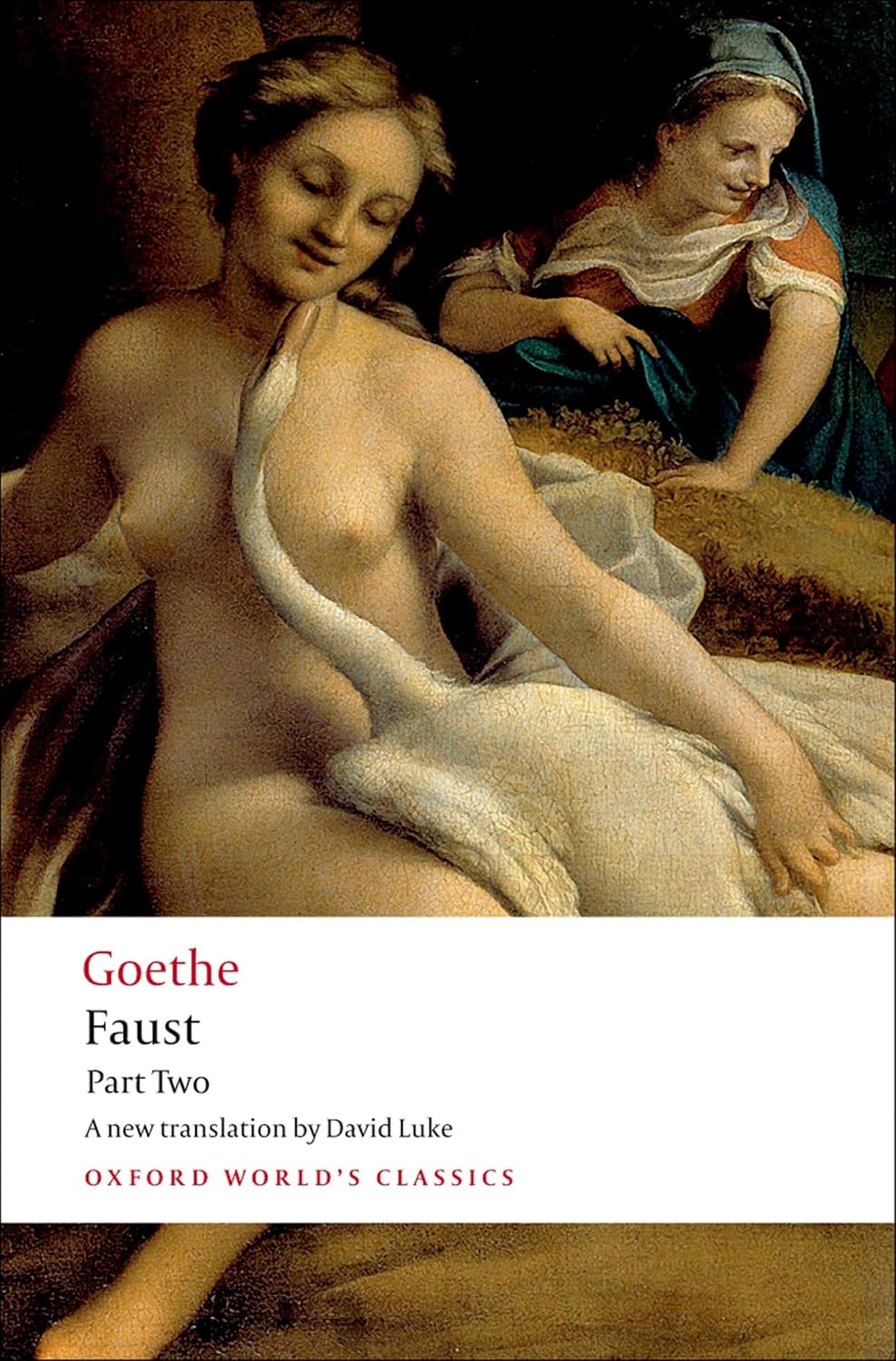
#2 — Faust: Part Two — trans. David Luke (Oxford World's Classics)
- Readability: Elegant handling of Goethe's verse forms.
- Accuracy: Exceptional philological care from an Oxford professor.
- Tone: Scholarly with detailed commentary.
- Accessibility: Best annotated edition for academic readers.
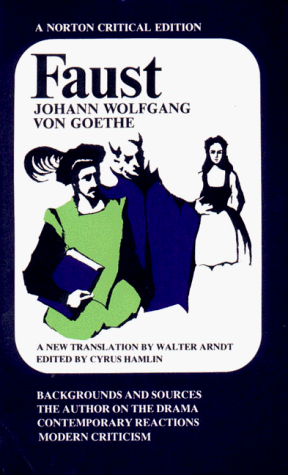
#3 — Faust: A Tragedy — trans. Walter Arndt, ed. Cyrus Hamlin (Norton Critical Editions)
- Readability: Precise and metrically disciplined.
- Accuracy: Strong fidelity from a Bollingen Prize winner.
- Tone: Academic with extensive apparatus.
- Accessibility: Indispensable for reception history and essays.
About the Translators
Martin Greenberg (1918–2012): American poet and translator; also translated Kleist's plays for Yale University Press. He spent several decades producing and revising his Faust — the first edition appeared in 1992 covering Part One; the fully revised edition of 2014 extends to both parts and represents a lifetime's engagement with the German.
David Luke (1921–2005): Emeritus professor of German at Christ Church, Oxford; also translated Thomas Mann (Death in Venice and other stories for Penguin) and German Romantic poetry. His Faust translations for Oxford World's Classics were the standard scholarly English edition for two decades.
Walter Arndt (1916–2011): Distinguished translator and Bollingen Prize winner; his other translations include Pushkin's Eugene Onegin and Rilke. The Cyrus Hamlin-edited Norton Critical Edition of his Faust is the most widely used academic text for English-language courses on the play.
Themes
The wager and the problem of striving. Mephistopheles bets God that he can corrupt Faust. But the bet's terms are peculiar: Faust will be damned only if he ever wishes a moment to last forever, only if he ever achieves complete satisfaction and stops striving. The implication is that the act of striving — of reaching, of desiring, of refusing to be satisfied — is itself sacred, whatever its object. Goethe's theology is not orthodox: it implies that the drive to know and experience is the divine element in human nature, and that a being who keeps reaching will ultimately be saved regardless of what destruction follows in his wake.
Gretchen and the cost of transcendence. The destruction of Gretchen — innocent girl, seduced by Faust, whose child she drowns and who goes mad and is condemned — is the dark underside of Faust's aspiration. His desire for experience and transcendence destroys everyone around him. Part One ends with Gretchen's death and Faust's horror. But Part Two moves on, and the question of what Faust's eventual redemption means in light of Gretchen's suffering is one the poem leaves unresolved.
Part Two's allegorical pageant. Part Two is a vast allegorical sequence that moves through the classical world (Helen of Troy; the Mothers; Homunculus), medieval empire (the court of the Holy Roman Emperor; paper money; the battle scene), and Faust's final project (reclaiming land from the sea; the murder of Philemon and Baucis). It is Goethe's summa — his attempt to put everything he thought about history, beauty, power, and redemption into a single work — and its difficulty is inseparable from its ambition.
Key Characters
Faust — the aging scholar who has mastered every discipline and found them empty; who makes a pact with Mephistopheles to experience everything life can offer; who destroys Gretchen, commands armies, builds empires, and dies at the moment of his greatest aspiration, still striving. The play's most famous puzzle is whether the terms of the pact have been met at the moment of his death.
Mephistopheles — the most enjoyable character in world drama. He is witty, cynical, self-aware, and genuinely charming; his nihilism is articulate and seductive. His function is to test Faust and to be the negative against which Faust's aspiration defines itself. He is also, in Goethe's theology, an instrument of divine providence — the spirit that denies, who ends up serving a purpose he cannot understand.
Gretchen (Margarete) — the young woman Faust seduces with Mephistopheles' assistance. She is not naive but innocent; she knows what she is doing and does it anyway, out of love for Faust. Her destruction — pregnancy, infanticide, imprisonment, madness, and her refusal to escape with Faust at the end of Part One — is the play's most morally serious event.
Wagner — Faust's assistant; the parody-scholar who succeeds at everything Faust despises. He creates Homunculus — a tiny artificial human in a glass bottle — in Part Two, which allows Goethe to develop his theme of artificial vs. natural creation. Wagner believes in scholarship; the play treats him with mild condescension.
Recommended Sources
For further academic reading on Goethe and Faust:
- Goethe Yearbook (North American Goethe Society) — the primary English-language journal for Goethe scholarship; central venue for Faust criticism across all periods of scholarship.
- German Life and Letters (Wiley-Blackwell) — the leading British journal for German literary studies; essential context for Faust in the Weimar Classical tradition.
- PMLA (Modern Language Association) — key venue for comparative readings of Faust in relation to European Romantic literature and world drama.
Which translation is right for you?
Choose Greenberg (Yale) for both parts in a single authoritative verse translation — it is the most complete English Faust currently available and the result of a lifetime's engagement with Goethe's German. Choose Luke (Oxford) if you are reading Part Two in an academic context — his is the most carefully annotated English version and the philological standard. Choose Arndt (Norton Critical) if you are writing about Faust — the critical apparatus, including Goethe's own commentary and the reception history, provides the most comprehensive scholarly context available in English.
Frequently Asked Questions
What is Faust about?
Faust is a tragic play by Goethe that explores themes of ambition, desire, and redemption. It follows the scholar Faust, who makes a pact with the devil, Mephistopheles, in exchange for unlimited knowledge and worldly pleasures, leading to a journey of moral and existential exploration.
Is Faust hard to read?
Faust can be challenging due to its complex themes and varied verse forms. The Greenberg translation is noted for its readability, while Luke's offers detailed annotations for academic readers.
Which Faust translation is best?
The Martin Greenberg translation is this guide's primary recommendation. It is the most complete, most carefully revised modern English verse translation and the natural first choice for a reader who wants the full work.
Greenberg vs Luke — which should I choose?
Choose Greenberg (Yale) for both parts in a single authoritative verse translation. Choose Luke (Oxford) if you are reading Part Two in an academic context — his is the most carefully annotated English version and the philological standard.
Which translation is easiest to read?
Greenberg's Yale translation is the most tonally varied and poetically alive English Faust available, rendering Goethe's varying verse forms into natural English equivalents.
Which translation is most accurate?
David Luke's Oxford World's Classics translations are the standard scholarly English edition, praised for accuracy and the elegance with which they handle Goethe's variety of verse forms.
Is Part Two of Faust worth reading?
Part Two rewards study but demands patience — it is less a continuous drama than a series of set pieces, masques, and philosophical allegories. Any edition that includes both parts is complete.
This guide is based on reading all 3 translations and reviewing scholarly commentary. Last reviewed: June 2026.
As an Amazon Associate, I earn from qualifying purchases.
Looking for another classic? Browse all our translation guides →
Thomas Mann's haunting novella is essential German literature — see our Death in Venice translation guide.
For more Mann, compare the leading versions in our Magic Mountain translation guide.
Hermann Hesse's psychological classic deserves close attention — read our Steppenwolf translation guide.
Nietzsche's philosophical masterpiece is another cornerstone of German thought; consult our Thus Spoke Zarathustra translation guide.