The Histories: What It's About & Best Translation
Herodotus's account of the Persian Wars — three translations for three kinds of readers
As an Amazon Associate, we earn from qualifying purchases.
The Histories by Herodotus is a detailed account of the Greco-Persian Wars, exploring the causes of the conflict, the diversity of human customs, and the interplay of fate and free will. It is considered the first work of history in Western literature.
Translation Comparison at a Glance
| Translation | Readability | Accuracy | Tone | Best For |
|---|---|---|---|---|
| de Sélincourt/Marincola (2003) | High | Very good | Clear, readable prose | First reading, general readers |
| Waterfield (2008) | Very high | Very good | Contemporary, light | Accessibility and speed |
| Purvis (Landmark, 2007) | High | Excellent | Precise, map-focused | Study with maps and notes |
#1 — The Histories — trans. Aubrey de Sélincourt, rev. John Marincola (1954, rev. 2003)
- Readability: Reads with the ease of good prose while remaining accurate.
- Accuracy: Revised to correct archaisms and update proper names.
- Tone: Clear and accessible for general readers.
- Accessibility: Most widely available edition with strong introduction.

David Timson's engaging narration captures the epic scope and lively storytelling of Herodotus, while the Rawlinson translation balances accessibility with scholarly rigor.
Listen on Audible →Which translation is right for you?
- Choose de Sélincourt/Marincola if you want the standard trade edition with the best short introduction and notes for a first reading.
- Choose Waterfield if you want the most contemporary, clean, and fast prose that makes digressions easy to follow.
- Choose Purvis (Landmark) if you want maps on every page and the most comprehensive scholarly apparatus for sustained study.
#2 — The Histories — trans. Robin Waterfield (2008)
- Readability: Clean, fast, and accessible with lightness.
- Accuracy: Contemporary rendering faithful to the Greek.
- Tone: Modern and easy to navigate.
- Accessibility: Ideal when ancient prose feels heavy.
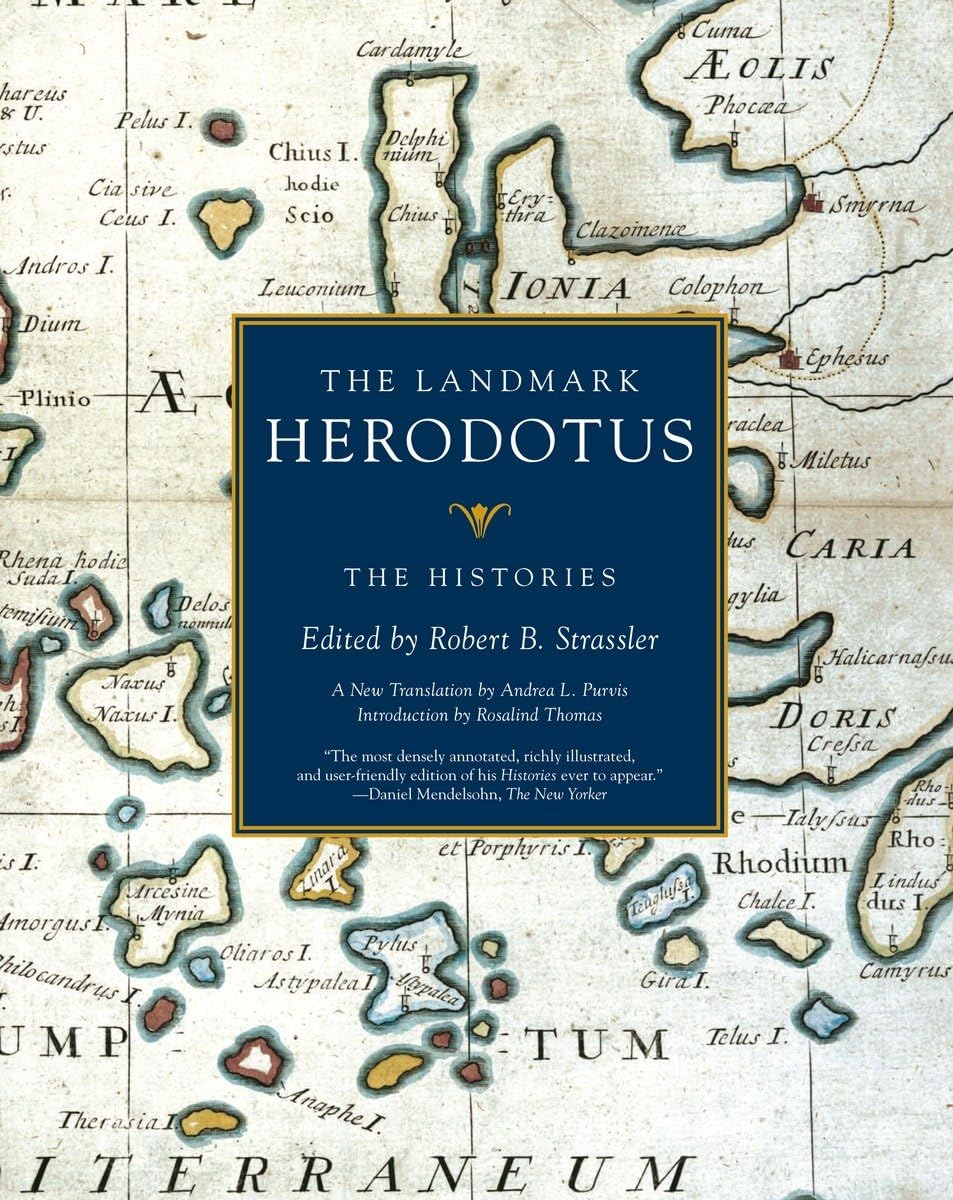
#3 — The Landmark Herodotus — trans. Andrea L. Purvis, ed. Robert B. Strassler (2007)
- Readability: Accurate and readable with geographical clarity.
- Accuracy: Commissioned for the Landmark series with scholarly precision.
- Tone: Precise and reference-oriented.
- Accessibility: Best with maps and appendices for study.
About the Translators
Aubrey de Sélincourt (1894–1962, 1954, Penguin Classics) revised by John Marincola (2003): de Sélincourt was a British classicist and school headmaster; his original translation established itself as the standard anglophone Herodotus for half a century. Marincola is Distinguished Research Scholar at Florida State University and the foremost English-language scholar of ancient historiography; his other work includes the Cambridge Companion to Greek and Roman Historiography and studies of Arrian and Livy. His 2003 revision corrected archaisms, updated proper name spellings, and added a substantial introduction and notes that bring the apparatus up to contemporary scholarly standards.
Robin Waterfield (2008, Oxford World's Classics): British classical scholar and prolific translator of ancient Greek; his other OWC translations include Plato's Republic, Thucydides, Xenophon's Anabasis, and Plutarch's Greek Lives. His Herodotus is the most contemporary-feeling of the three translations — clean, fast, and readable in a way that makes the digressions easy to navigate — with a substantial introduction by Carolyn Dewald (Bard College), the leading American scholar of Herodotus.
Andrea L. Purvis (2007, Landmark Herodotus, Pantheon / Anchor): American classicist; her translation was commissioned specifically for Robert B. Strassler's Landmark series — the same editor who produced the acclaimed Landmark Thucydides. The translation is accurate and readable, designed to work in conjunction with the apparatus rather than as a standalone literary text; its particular strength is in making the geographical passages intelligible to readers following the maps.
Themes
The causes of the Persian Wars and the limits of empire. Herodotus opens his Histories with a declaration of intent: to preserve the memory of great deeds and to investigate why the Greeks and the Persians went to war. His answer is not simple. The immediate cause is Greek intervention in Asia Minor; the deeper cause is a pattern of Persian expansion that Herodotus reads through the Greek concepts of hybris (excessive pride) and nemesis (divine retribution). Xerxes bridges the Hellespont and whips the sea when it destroys his first bridge; the sea wins. The logic of the text is that the greatest empire in the world was brought low because its ruler believed himself above ordinary constraints — human and divine.
The diversity of human customs and the principle of cultural relativism. Herodotus's Egyptian digression, his Scythian ethnography, and his accounts of Persian, Lydian, and Libyan customs are not distractions from the historical narrative; they are expressions of what may be his deepest conviction: that every people believes their customs to be the best, and that this belief is both natural and a source of dangerous misunderstanding. His story of Darius demonstrating to Greeks and Indians that each would find the other's funeral customs abhorrent is the text's most explicit statement of this principle. The Histories is the first systematic work of cultural anthropology in Western literature.
Oracle, prophecy, and the ambiguity of divine guidance. The Oracle at Delphi runs through the Histories as a structural principle: almost every major decision in the narrative is preceded by a consultation of Delphi, and almost every oracle proves — retrospectively — to have been accurate, though not in the way the questioner expected. Croesus is told that if he attacks Persia he will destroy a great empire; he does, and the empire is his own. This logic — that the gods are truthful but that mortals cannot interpret their truth correctly — is the Histories' most persistent moral framework.
Key Characters
Croesus — the fabulously wealthy king of Lydia whose hybris and fall occupy the first book; the text's first cautionary tale; the man who misread the Delphic Oracle and lost everything, and who ends the episode as Cyrus's philosophical advisor — the great reversal that structures everything that follows.
Xerxes — the Persian king who bridges the Hellespont, whips the sea, and invades Greece with the largest army ever assembled; Herodotus's primary exhibit of royal hybris; a figure of genuine complexity who is sometimes persuaded by good counsel and sometimes incapable of accepting it.
Themistocles — the Athenian general who persuaded Athens to build its fleet with the silver from the Laurium mines, who interpreted the "wooden walls" oracle correctly, and who orchestrated the Greek victory at Salamis; the text's greatest example of practical intelligence in the service of a correct assessment of reality.
Leonidas — the Spartan king who led the three hundred at Thermopylae; the most celebrated example in the text of the Spartan ideal — courage without hope — and the figure whose death Herodotus marks with an epitaph (the famous Simonides inscription) that is the text's most direct expression of what he thinks worthy of being remembered.
Recommended Sources
For further academic reading on Herodotus and the Histories:
- Classical Quarterly (Cambridge University Press) — the principal journal for Greek and Latin literary scholarship; essential for Herodotus's prose style, narrative technique, and relationship to the oral tradition.
- Histos (Durham University) — the specialist open-access journal for ancient historiography; the primary venue for Herodotus scholarship in the current generation.
- American Journal of Philology (Johns Hopkins) — key for Herodotus's relationship to the pre-Socratic philosophers, the sophists, and the wider intellectual culture of the fifth century BCE.
Which translation is right for you?
Choose de Sélincourt/Marincola (Penguin Classics) for a first reading — it is the most widely available edition, Marincola's introduction is the best short guide to Herodotus in print, and the translation reads with the ease that makes a first encounter with the Histories genuinely pleasurable. Choose Waterfield (Oxford World's Classics) if you want the most contemporary and immediately accessible version — his prose is the cleanest and fastest of the three, and Dewald's introduction provides the most scholarly apparatus alongside a narrative translation. Choose the Landmark (Pantheon) for sustained study — the maps on every page, the running summaries, and the appendices make it the essential reference edition for anyone who wants to follow the Persian Wars closely.
Frequently Asked Questions
What is The Histories about?
The Histories by Herodotus is a detailed account of the Greco-Persian Wars, exploring the causes of the conflict, the diversity of human customs, and the interplay of fate and free will. It is considered the first work of history in Western literature.
Is The Histories hard to read?
The Histories can be challenging due to its digressions and archaic language. However, translations like Waterfield's offer a more contemporary and accessible reading experience, while de Sélincourt/Marincola provides clarity and ease for first-time readers.
Which The Histories translation is best?
Start with de Sélincourt/Marincola (Penguin Classics) for a first reading — it is the most widely available edition, Marincola's introduction is the best short guide to Herodotus in print, and the translation reads with the ease that makes a first encounter with the Histories genuinely pleasurable.
de Sélincourt/Marincola vs Waterfield — which should I choose?
Choose de Sélincourt/Marincola for the standard trade edition with excellent notes. Choose Waterfield if you want the most contemporary and immediately accessible version — his prose is the cleanest and fastest of the three.
Which translation is easiest to read?
Waterfield (Oxford World's Classics) is the most contemporary-feeling of the three major translations: clean, fast, and accessible, rendering Herodotus's digressions with a lightness that makes them easy to follow.
Which translation is most accurate?
The Landmark Herodotus (Purvis/Strassler) is accurate and readable, with particular attention to making the geographical passages intelligible, supported by the most comprehensive scholarly apparatus.
When should I choose the Landmark edition over the others?
Choose the Landmark (Pantheon) for sustained study — the maps on every page, the running summaries, and the appendices make it the essential reference edition for anyone who wants to follow the Persian Wars closely.
This guide is based on reading all 3 translations and reviewing scholarly commentary. Last reviewed: June 2026.
As an Amazon Associate, I earn from qualifying purchases.
Looking for another classic? Browse all our translation guides →
Thucydides continues the story of ancient Greek warfare in our Peloponnesian War translation guide.
For the epic world that Herodotus describes, see our comparison of the best Iliad translations.
Readers of Greek tragedy will find our Oedipus Rex translation guide useful.
The full cycle of Sophocles is covered in our Theban Plays translation guide.
Plato's philosophical dialogues are compared in our Republic translation guide.