Symposium: What It's About & Best Translation
The dialogue on love — Waterfield's Oxford versus Nehamas and Woodruff's Hackett
As an Amazon Associate, we earn from qualifying purchases.
Symposium is a philosophical text by Plato that explores the nature of love through a series of speeches given by different characters at a banquet. The dialogue examines various perspectives on love, culminating in Socrates' recounting of Diotima's teachings on the ascent to the Beautiful itself.
Translation Comparison at a Glance
| Translation | Readability | Accuracy | Tone | Best For |
|---|---|---|---|---|
| Waterfield (2008) | High | Very good | Elegant and voiced | First reading, general readers |
| Nehamas & Woodruff (1989) | Moderate | Excellent | Precise and literal | Philosophy courses, close analysis |
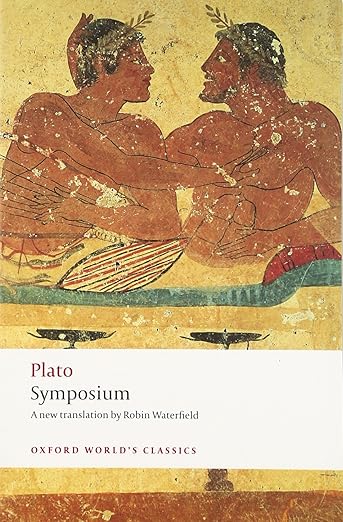
#1 — Symposium — trans. Robin Waterfield (Oxford World's Classics)
- Readability: Modern, fluent prose with distinct voices for each speaker.
- Accuracy: Strong philosophical sensitivity and contextual fidelity.
- Tone: Elegant yet natural, balancing literary and scholarly needs.
- Accessibility: Excellent for first-time readers and reading groups.

David Rintoul's clear and engaging narration brings Plato's philosophical dialogue to life, and Jowett's translation remains a classic choice for its accessibility and fidelity to the original text.
Listen on Audible →Which translation is right for you?
- Choose Waterfield if you want an elegant, readable first encounter with strong historical and literary context.
- Choose Nehamas and Woodruff if you are studying the dialogue as philosophy and need precise tracking of the arguments.
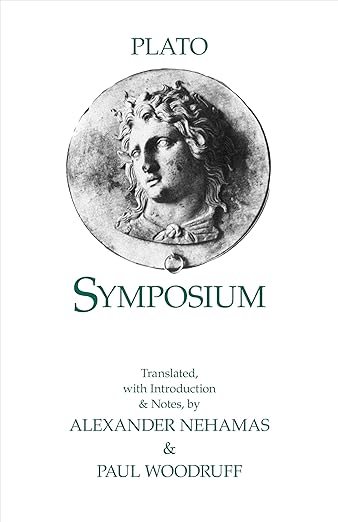
#2 — Symposium — trans. Alexander Nehamas and Paul Woodruff (Hackett Classics)
- Readability: Careful and precise, occasionally flattened for conceptual clarity.
- Accuracy: Excellent for tracking philosophical arguments and distinctions.
- Tone: Scholarly and literal where it serves understanding.
- Accessibility: Ideal for close academic study and philosophy courses.
About the Translators
Robin Waterfield (Oxford World's Classics): British classical scholar and prolific translator of ancient Greek for Oxford; his other translations for OWC include Plato's Republic, Aristotle's Physics, Herodotus's Histories, and Thucydides' History of the Peloponnesian War. His translations are consistently praised for their fluency and philosophical sensitivity; his Oxford Symposium comes with a scholarly introduction by Paul Cartledge (Cambridge) and is the edition most widely used by general readers seeking both readability and scholarly grounding.
Alexander Nehamas (b. 1946) and Paul Woodruff (b. 1943, Hackett Publishing): Nehamas is Edmund N. Carpenter II Class of 1943 Professor of Humanities at Princeton, author of The Art of Living: Socratic Reflections from Plato to Foucault; Woodruff is Professor in Ethics and American Society at the University of Texas at Austin and author of Reverence: Renewing a Forgotten Virtue. Both are distinguished Plato scholars with particular expertise in Plato's understanding of desire and beauty; their Hackett translation is the version most used in undergraduate philosophy courses in the United States, praised for its philosophical precision and detailed notes on each speech's argumentative content.
Themes
Diotima's ladder and the ascent toward the beautiful itself. The speech that Socrates reports from the priestess Diotima is the dialogue's philosophical centrepiece: a systematic account of how erotic love — the desire for beautiful bodies — is the beginning of a philosophical education that leads, if properly pursued, through beautiful souls, beautiful practices, beautiful knowledge, to the Beautiful itself: an eternal, unchanging, transcendent Form. Plato's theory of Forms is here presented not as abstract metaphysics but as a natural consequence of taking seriously what we feel when we are in love. The ascent is one of the most influential passages in the history of Western philosophy.
Aristophanes' myth of the spherical humans. The comic playwright's contribution — a mythological account of human beings as originally double creatures, spherical and self-sufficient, cut in half by Zeus as punishment for their arrogance, and now permanently seeking their other half — is simultaneously the most playful speech in the dialogue and philosophically the most interesting alternative to Diotima's account: where Diotima's eros ascends toward impersonal transcendence, Aristophanes' eros seeks a specific lost other half. The two accounts are left in productive tension.
Alcibiades and the failure of erotic philosophy. The final section — Alcibiades arriving drunk and gate-crashing the party — transforms the dialogue into something more complex. His speech in praise of Socrates is the most personal and most painful document in the dialogue: a man who tried to seduce his teacher and was rebuffed, and who has never recovered from the experience. His portrait of Socrates — strange, disturbing, irresistible, apparently immune to the erotic desire that motivates everyone around him — is the dialogue's most vivid characterisation.
Key Characters
Socrates — the dialogue's governing figure, who reports Diotima's account of eros and who, in Alcibiades' speech, is revealed as a figure of extraordinary and disturbing power: physically ugly, personally magnetic, philosophically irresistible, and apparently immune to the erotic desire that motivates everyone around him.
Alcibiades — the historical Athenian politician and general, brilliant and destructive, whose calamitous decisions would eventually contribute to Athens's defeat in the Peloponnesian War; his speech in praise of Socrates is the dialogue's most intimate document and a devastating portrait of what it is like to love someone who is beyond your reach.
Diotima of Mantinea — the priestess or wise woman from whom Socrates claims to have learned his understanding of eros; she is not present at the symposium but reported by Socrates; whether she was a historical person or Plato's fiction is uncertain. Her speech is the philosophical summit of the dialogue.
Aristophanes — the comic playwright whose mythological speech about spherical humans is the dialogue's most memorable set piece and its most philosophically interesting alternative to Socratic eros; his characterisation here — as irreverent, inventive, and unexpectedly moving — is consistent with what we know of him from his plays.
Recommended Sources
For further academic reading on Plato and the Symposium:
- Ancient Philosophy (Mathesis Publications) — the primary English-language journal for ancient Greek and Roman philosophy; essential for scholarship on Plato's theory of love and the Diotima speech's place in his larger metaphysics.
- Phronesis (Brill) — the leading international journal for ancient philosophy; key for comparative readings of the Symposium's speeches and their relationship to Plato's other dialogues.
- Classical Quarterly (Cambridge) — important for the Symposium's literary context: its genre (the symposium as literary form), its relationship to Xenophon's Symposium, and its portrait of Alcibiades as historical figure.
Which translation is right for you?
Choose Waterfield (Oxford World's Classics) for a first reading — his English is the most natural, Cartledge's introduction and notes provide historical and literary context, and the OWC paperback is the most accessible edition. Choose Nehamas and Woodruff (Hackett) for philosophy courses or close philosophical reading — their notes focus on the arguments of each speech with a precision the Waterfield complements but doesn't match, and their translation is the standard in American undergraduate philosophy education.
Frequently Asked Questions
What is Symposium about?
Symposium is a philosophical text by Plato that explores the nature of love through a series of speeches given by different characters at a banquet. The dialogue examines various perspectives on love, culminating in Socrates' recounting of Diotima's teachings on the ascent to the Beautiful itself.
Is Symposium hard to read?
Symposium can be challenging due to its philosophical content and historical context. Waterfield's translation is more accessible for general readers, while Nehamas and Woodruff provide a precise version for those studying the philosophical arguments.
Which Symposium translation is best?
Waterfield's Oxford World's Classics translation is the best choice for most readers, offering elegant modern English with strong scholarly support.
Waterfield vs Nehamas and Woodruff — which should I choose?
Choose Waterfield for a first reading or literary enjoyment; choose Nehamas and Woodruff for philosophy courses or close analysis of the arguments.
Which translation is easiest to read?
Robin Waterfield's translation is the most readable, with natural modern prose that preserves the distinct voices of each speaker.
Which translation is most accurate?
Nehamas and Woodruff's Hackett translation is the most accurate for philosophical purposes, with precise attention to conceptual nuance and argumentative structure.
Is the Symposium best read as philosophy or literature?
It is both: Waterfield highlights its literary and dramatic qualities while Nehamas and Woodruff emphasize its philosophical arguments.
This guide is based on reading both translations and reviewing scholarly commentary. Last reviewed: June 2026.
As an Amazon Associate, I earn from qualifying purchases.
Looking for another classic? Browse all our translation guides →
Plato's most famous work is covered in our guide to the best Republic translations.
For more Greek drama, see our comparison of the best Oedipus Rex translations.
Readers of ancient Greek literature will also want our Oresteia translation guide.
Another essential Sophocles collection is discussed in our Theban Plays translation guide.
Herodotus offers a different window on the Greek world in our Histories translation guide.